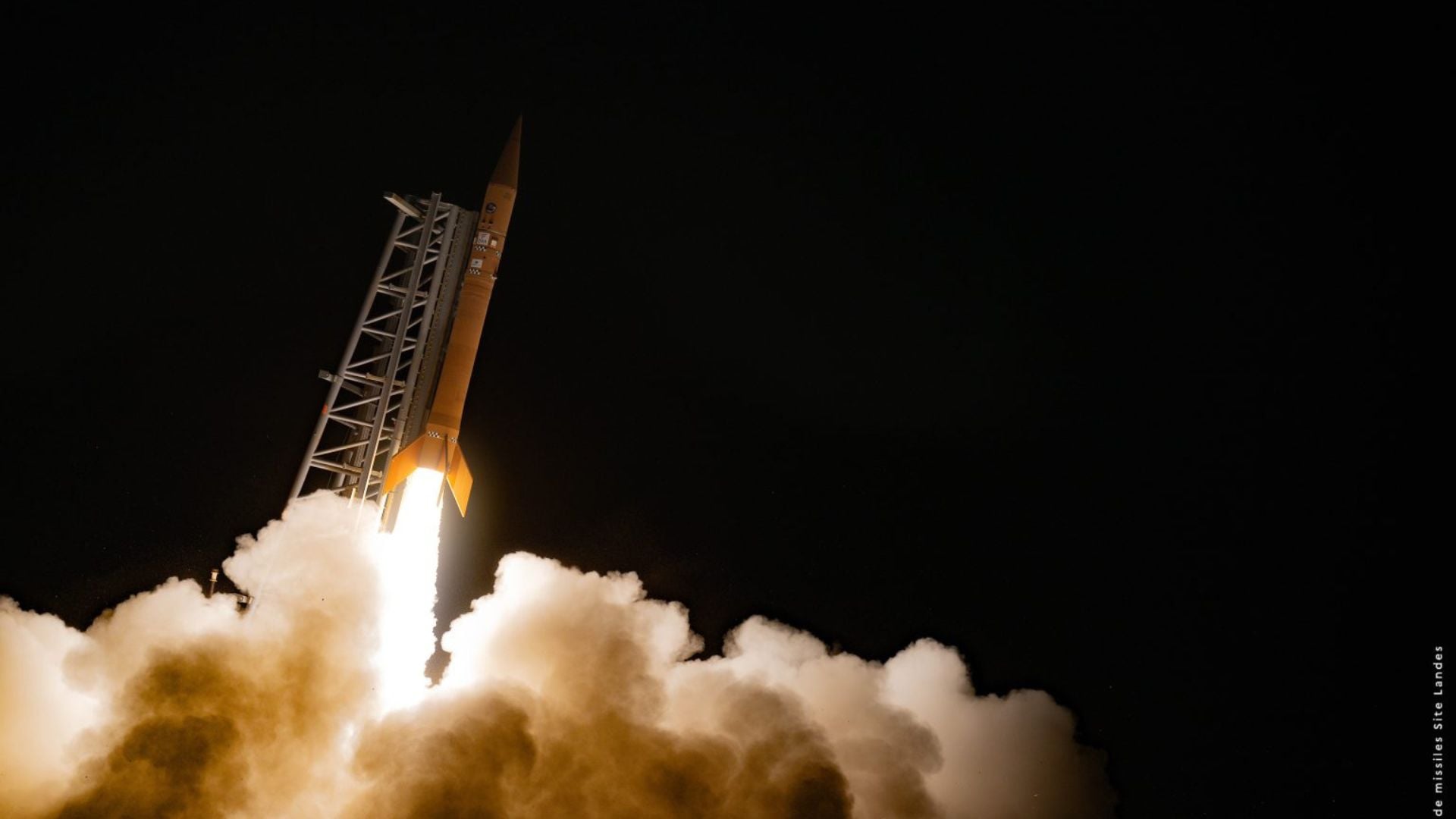
France’s Defence Procurement and Technology Agency (Direction générale de l’armement, DGA) launched the second SyLEx sounding rocket during the night of November 3 to 4, 2026, from the Landes site of its DGA Essais de missiles (DGA-EM) test center in Biscarrosse, carrying experiments for the payload of the future M51.4 submarine-launched ballistic missile (SLBM). Built by ArianeGroup, the single-stage rocket flew an exo-atmospheric trajectory on what the company describes as the system’s first operational flight, following a demonstration flight on November 28, 2025.
The launch came less than a month after the October 6, 2026, acceptance firing of an unarmed M51.3 from the ballistic missile submarine (SSBN) Le Vigilant. Minister of the Armed Forces and Veterans Catherine Vautrin said the SyLEx flight carried out new experiments essential to M51.4 development. It is also the first time SyLEx has carried a government payload: the 2025 flight lofted an ArianeGroup technology demonstration platform. Developed by ArianeGroup for the DGA since 2021, the system restores a national suborbital and high-atmosphere test capability that, according to the Ministry of the Armed Forces, France had lacked for several decades.
SyLEx Sounding Rocket Block 1 Specifications and Test Role
SyLEx, short for Système de Lancement d’Expériences (Experiment Launch System), is a solid-propellant sounding rocket family operated from a dedicated launch pad at Biscarrosse. The November 4 flight used the single-stage Block 1 configuration, which ArianeGroup lists at 10 meters in length and 0.7 meters in diameter, with a 300-kilogram payload capacity and 4 to 5 minutes of microgravity time. According to the ArianeGroup data sheet, Block 1 is powered by a single in-house SPARK solid rocket motor carrying 2 tonnes of propellant and producing up to 325 kilonewtons of thrust, for a total mass of 3.3 tonnes.
Official altitude figures vary. The November 4 company release gives an envelope of 200 to 400 kilometers for the system, while ArianeGroup’s product documentation cites 140 to 400 kilometers depending on configuration, with the upper bound belonging to the two-stage version. Neither the DGA nor ArianeGroup disclosed the apogee, trajectory, or impact zone of the latest flight.
The payload section combines a jettisonable fairing, onboard telemetry, a configurable volume, and controlled release conditions, allowing several experiments to share a single flight. That architecture supports atmospheric re-entry and microgravity experiments for military and civilian customers on the European market. For the November 4 flight, the DGA deployed radar, optical, and telemetry assets across its Biscarrosse and Hourtin sites and the missile range instrumentation ship Monge. SyLEx therefore flies within the same instrumented range used for M51 qualification firings, including the M51.3 qualification flight of November 18, 2023.
ArianeGroup built the system in under three years using test-and-learn methods. Vincent Pery, Director of Defence Programmes at ArianeGroup, said the second flight demonstrates the company’s ability to provide “a sovereign suborbital test platform that is essential to major development programmes.”
How SyLEx Supports M51.4 SLBM and V-MAX Hypersonic Testing
The DGA awarded ArianeGroup the M51.4 development and production contract on August 28, 2025. The fourth increment of the M51 is expected to enter service in the 2030s aboard the current Le Triomphant-class SSBNs and the third-generation SSBNs (SNLE 3G) that will replace them. According to the DGA, M51.4 will offer greater range, improved accuracy, and better penetration of adversary missile defenses. It succeeds the M51.3, which entered operational service in October 2025.
Beyond pointing to the missile’s payload, neither the DGA nor ArianeGroup has disclosed which M51.4 subsystems the SyLEx flight tested. Sounding rockets are typically used to expose components to vacuum, thermal loads, separation dynamics, and early re-entry conditions without the cost and range footprint of a full ballistic missile firing.
The hypervelocity track follows the same logic. The V-MAX (Véhicule Manœuvrant Expérimental) hypersonic glider demonstrator first flew from Biscarrosse on June 26, 2023, aboard a three-stage Terrier-Oriole-Oriole sounding rocket supplied and launched by the US Navy’s Naval Surface Warfare Center, Port Hueneme Division. ArianeGroup chief executive Martin Sion told the French Senate in February 2025 that future glider trials would use a French sounding rocket then in development.
Analysis: The strategic value of SyLEx lies less in its performance figures than in control of the test cycle. Flying deterrence-related experiments on a national launcher removes a foreign scheduling dependency and limits disclosure on the most sensitive program in the French inventory. Pairing SSBN acceptance firings with dedicated suborbital experiments also lets the DGA retire M51.4 technical risk incrementally rather than concentrating it in a few full-up missile tests. For a NATO nuclear power whose deterrent is built on strict national autonomy, that is a structural gain, and it positions ArianeGroup to offer European allies a sovereign suborbital service for military payloads.
The next milestone is the two-stage Block 2, 15 meters long, with a 600-kilogram payload and more than 6 minutes of microgravity, scheduled to fly by 2027. Open questions include the flight cadence the DGA intends to sustain, whether the follow-on V-MAX 2 glider demonstrator will fly on SyLEx, and whether ArianeGroup lands a first civilian or allied customer.