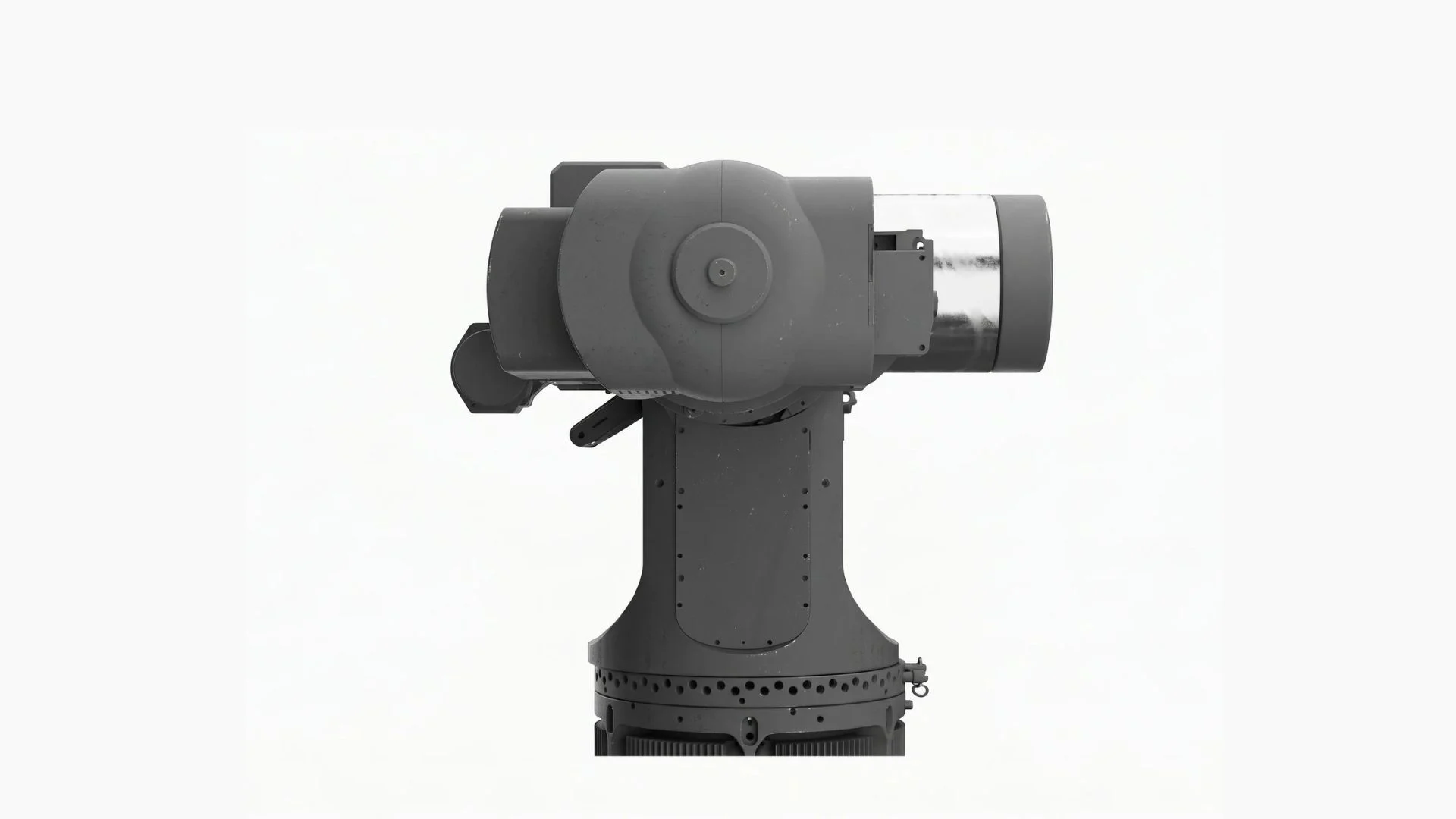
Allen Control Systems (ACS), the Austin, Texas-based maker of the Bullfrog autonomous counter-drone weapon station, announced on November 10, 2026, that it has established a Directed Energy division to develop high-energy laser capabilities for US and allied governments. The company named Amanda Clark as Vice President, Directed Energy, and John Mason as Program Director, High Energy Laser. Both join from the US Army Space and Missile Defense Command (SMDC).
The announcement lands as US laser weapons move from prototype to production. On September 2, 2026, the Army awarded AeroVironment a $464.8 million Other Transaction Agreement under the Enduring-High Energy Laser (E-HEL) program for dozens of 30-kilowatt LOCUST X3 systems, the service’s first production contract for a high-energy laser. ACS enters this market from the kinetic side: Bullfrog is deployed with US forces, the company holds contracts with the Army, Marine Corps, and US Special Operations Command (SOCOM), and the Marine Corps selected the system in July 2026 for its Light Marine Air Defense Integrated System (L-MADIS) through a prototype agreement worth roughly $6.2 million. Former Army Secretary Dan Driscoll told reporters earlier this year that the Pentagon had bought 12 Bullfrog systems for the war with Iran.
ACS Directed Energy Division Draws Its Leadership From Army SMDC
Clark arrives after 17 years of engineering and leadership work at SMDC in Huntsville, Alabama, most recently as Chief of the command’s Directed Energy Division. She previously served as Acting Director of the Joint Directed Energy Transition Office within the Office of the Under Secretary of War for Research and Engineering. She holds a Master of Engineering in Electrical Engineering with a focus on optics and photonics, and a Bachelor of Science in Computer Science, both from the University of Alabama in Huntsville.
Mason served as Directed Energy Technologies Branch Chief at SMDC, where he led technical development across the command’s directed energy portfolio. Before that, he held several technical leadership roles in industry developing high-energy laser weapons. He holds a PhD in Physics from Texas A&M University and a Bachelor of Science in Physics from Rensselaer Polytechnic Institute.
SMDC has long anchored the Army’s laser technology base, including oversight of the 100-kilowatt-class High Energy Laser Tactical Vehicle Demonstrator (HEL TVD) program. Clark and Mason bring direct knowledge of Army requirements, test standards, and the transition pathway that E-HEL has just validated, knowledge a new entrant needs to compete credibly for follow-on awards.
Bullfrog Fire Control as the Foundation for Laser Beam Control
ACS frames the division as an extension of Bullfrog’s core competency. “The defense industry has invested heavily in directed energy, but generating a powerful beam is only part of the challenge. You still have to find a fast-moving threat, stay on target, and engage it with precision,” said Joe Bingold, ACS President and CEO.
Bullfrog’s fire control architecture combines computer vision, autonomous tracking, and precision robotics to slew conventional weapons onto drones. The company offers four variants built around the 7.62mm M240, the 12.7mm M2, the 30mm M230 chain gun, and the M134 minigun. The M240 version weighs roughly 300 pounds and fires 850 rounds per minute, according to company figures. ACS says individual rounds can cost as little as $10.
The engineering overlap is real. A laser does not kill instantly; it must hold an aimpoint on a maneuvering target for several seconds to burn through structure or electronics, a problem governed by tracking stability, jitter, and beam director performance. A turret that holds precise pointing on a small, erratic drone solves part of that problem. It does not solve power generation, thermal management, or atmospheric beam propagation, the disciplines where SMDC experience becomes essential.
Undisclosed Power Class Leaves the ACS Laser Roadmap Open
ACS did not specify what laser technology the division will develop, what power class it will target, or which platforms it will integrate. Its website lists a dual-band laser dazzler and a Bullfrog 3kW Laser, a 3-kilowatt version of the weapon station, as capabilities under future development. A dazzler would target electro-optical sensors and camera-guided first-person-view drones rather than airframes, while a 3-kilowatt system sits an order of magnitude below the 30-kilowatt LOCUST X3, implying short engagement ranges against the smallest Group 1 threats. Neither has been confirmed as the division’s target configuration.
The industrial footprint already exists. ACS has announced a 191,000-square-foot manufacturing facility in Austin to scale Bullfrog production and an innovation lab in Huntsville, close to SMDC. The company has also signed Bullfrog contracts with the armed forces of South Korea and the United Arab Emirates, allied customers to whom a laser effector could later be offered.
Analysis: The ACS move signals that the counter-drone market is converging on mixed kinetic and directed energy effectors governed by common fire control. The Army’s own experience shows why beam control matters: the Stryker-based Directed Energy Maneuver-Short Range Air Defense prototypes drew reported criticism from soldiers after deployment to the Middle East, while the platform-agnostic, modular E-HEL design won the first production award. A company able to sell a single autonomous tracking and pointing layer that feeds guns today and lasers tomorrow would offer the services a lower cost per engagement across the drone threat spectrum. The risk is execution. ACS has proven itself with gun stations, not lasers, and building a fieldable high-energy laser is a power and thermal engineering problem that has slowed far larger contractors.
The next markers are disclosure of a target power class, a first demonstration, and any government funding vehicle, likely an Other Transaction Agreement. Watch whether the Army structures future E-HEL tranches or follow-on laser buys to admit new entrants, and whether the Marine Corps, already integrating Bullfrog on L-MADIS, signals interest in a laser effector for its expeditionary air defense units. Timelines, funding, and industrial partners for the division remain undisclosed.