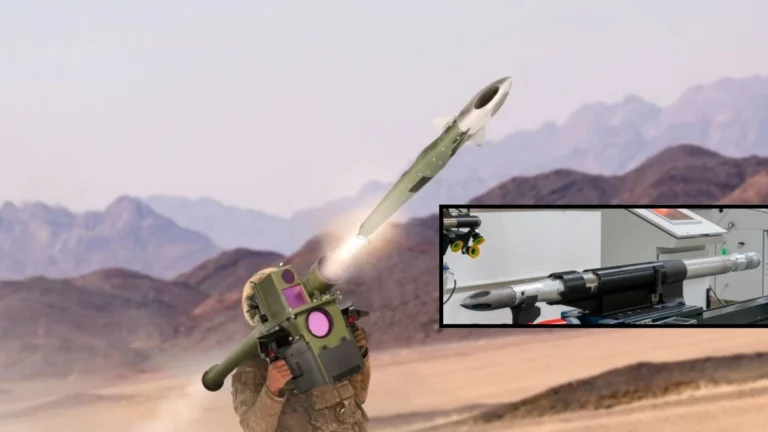
Lockheed Martin has delivered its 100,000th Guided Multiple Launch Rocket System (GMLRS) rocket and is now producing nearly 14,000 rounds per year, a rate the company said it reached ahead of schedule. The milestones were marked on November 10, 2026, at a ceremony at the company’s Camden, Arkansas, plant, alongside confirmation that General Dynamics Ordnance and Tactical Systems (GDOTS) has completed the first test of a new GMLRS solid rocket motor intended to become a third domestic source for the component.
The announcement comes as the U.S. Army shifts GMLRS from a wartime surge to a sustained high-volume requirement. Heavy expenditure in Ukraine since 2022 and the replenishment of U.S. and allied stockpiles have driven demand for the rocket. In June 2026, Lockheed Martin received a $3 billion fiscal year 2026 (FY2026) contract covering both standard-range and Extended-Range GMLRS (ER GMLRS) rounds. An Army market-research notice published on August 17, 2026, set out a maximum requirement of up to 133,014 rockets between FY2028 and FY2034, against a stated capacity ceiling of 19,002 rockets per year.
GMLRS Production Rate Reaches 14,000 Rockets Ahead of Schedule
At nearly 14,000 rounds annually, Camden now turns out the equivalent of roughly 2,330 six-round launch pod containers per year, or about 74% of the 19,002-rocket ceiling referenced in Army planning documents. Lockheed Martin did not disclose how the annual figure splits between standard rounds and ER GMLRS, nor what share is destined for foreign military sales customers.
Workforce expansion underpins the rate. More than 200 employees support GMLRS production in Camden, and the company said the site is hiring 50% more staff across several munitions lines, including the Patriot Advanced Capability-3 Missile Segment Enhancement (PAC-3 MSE) interceptor and the Precision Strike Missile (PrSM). Lockheed Martin is funding an Industrial Automation and Robotics Lab within the new Defense Manufacturing Center of Excellence at SAU Tech, and its high school hiring initiative, now in its fourth year, placed more than 40 graduates in full-time munitions roles this year.
The program draws on more than 200 suppliers in 35 states, more than 50 of them designated small businesses. That breadth spreads workload but also multiplies the number of sub-tier firms that must scale in step with final assembly. Gaylia Campbell, vice president and general manager of Lockheed Martin Tactical Missiles, said the company is “delivering with urgency, investing in our supply chain and ensuring American forces have what they need, before they need it.”
227 mm Rocket Family: Unitary, Alternative Warhead, and ER GMLRS
Publicly available specifications indicate the GMLRS is a 227 mm rocket roughly 3.94 meters long and weighing about 300 kilograms, guided by a GPS-aided inertial navigation system for all-weather precision strike from roughly 15 km to more than 70 km. The M31 series Unitary variant carries a 200-pound-class high-explosive warhead with a multimode fuze offering proximity, point-detonation, and delay settings, allowing crews to tailor effects from personnel in the open to hardened structures. The M30A1 and M30A2 Alternative Warhead variants replaced the cluster submunitions of the original M30 with a fragmentation payload of preformed tungsten fragments, delivering area effects without leaving unexploded submunitions on the battlefield.
Each rocket ships in a six-round pod. The M142 High Mobility Artillery Rocket System (HIMARS) carries one pod and the tracked M270A1 and M270A2 Multiple Launch Rocket System carries two. That shared logistics chain is central to the program’s value: Lockheed Martin describes GMLRS as a low-cost, low-risk round that limits collateral damage and deploys rapidly across both launcher fleets.
ER GMLRS extends reach to about 150 km from the same pods and launchers, roughly doubling the standard envelope. Lockheed Martin said on October 19, 2026, that the Unitary and Alternative Warhead ER variants completed Soldier-led operational testing at White Sands Missile Range, New Mexico, in September and October. The Army’s FY2027 budget keeps ER GMLRS Unitary as a production variant but shifts new procurement to the ER Alternative Warhead, whose initial production begins in FY2027.
How GDOTS Is Positioning to Become the Third GMLRS Motor Source
The new solid rocket motor stems from a strategic teaming agreement Lockheed Martin and General Dynamics announced in August 2024 to bring a third supplier into a U.S. market long dominated by L3Harris subsidiary Aerojet Rocketdyne and Northrop Grumman. GDOTS is completing a dedicated solid rocket motor production campus in Camden for the effort. Continued testing is planned, with motor qualification targeted for 2027.
GDOTS already supplies GMLRS warheads, rocket motor cases, and launch pod containers. Chris Haynes, senior vice president and general manager at GDOTS, called the test “an important milestone in our collaboration with Lockheed Martin to expand solid rocket motor production capacity.”
Key details remain undisclosed. Neither company released test performance data, a motor designation, planned annual output, or whether the new motor will power standard-range rounds, ER GMLRS, or both. The Army’s acceptance criteria for a new propulsion source have also not been made public.
Analysis: The 100,000th delivery is a cumulative marker; the more consequential figure is the gap between 14,000 rockets per year and the Army’s 19,002-round capacity ceiling. Closing that gap depends less on final assembly than on energetics and propulsion, the tier where tactical missile output has been most constrained since 2022. A qualified GDOTS motor would give the Army three domestic propulsion sources for its highest-volume precision munition and reduce exposure to any single supplier’s delivery problems. It does not resolve geographic concentration: Lockheed Martin’s final assembly, the GDOTS motor campus, and Aerojet Rocketdyne’s solid rocket motor operations all sit in Camden, tying a disproportionate share of U.S. rocket artillery output to one Arkansas town.
The next markers fall in 2027: GDOTS motor qualification, an expected full-rate production decision on ER GMLRS early in FY2027, and the start of ER Alternative Warhead production. The Army’s FY2028 to FY2034 procurement framework will then show whether funding follows the push toward 19,002 rockets per year. Allied production adds another variable, with Australia having fired its first domestically built GMLRS rockets in April 2026 and planning local solid rocket motor production by 2030.