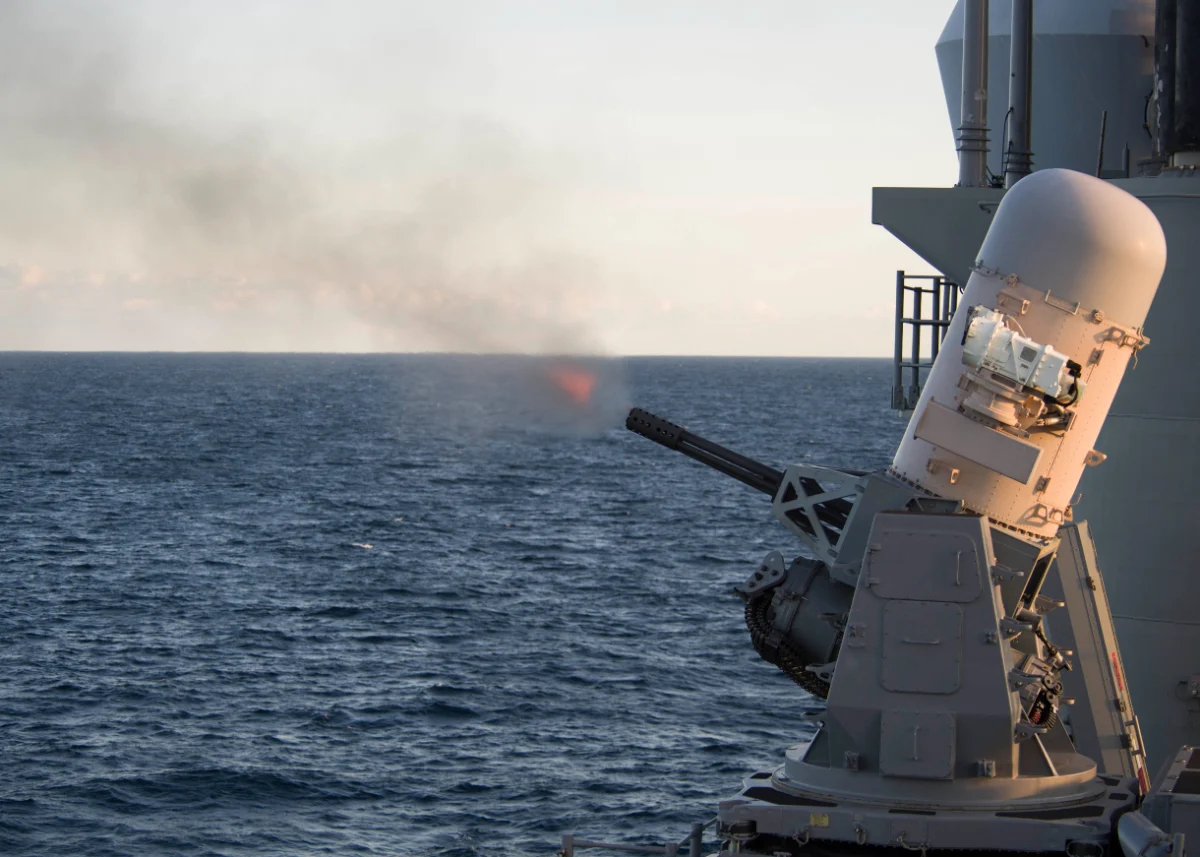
Raytheon has received a $247,089,895 firm-fixed-price contract to produce, upgrade, convert and overhaul MK 15 Close-In Weapon Systems for the U.S. Navy and U.S. Army, covering the shipboard Phalanx gun, the Land-based Phalanx Weapon System (LPWS) and the missile-armed SeaRAM, according to a Department of War contract announcement. Naval Air Systems Command (NAVAIR) at Patuxent River, Maryland, awarded the sole-source deal, which also funds associated hardware, equipment and spares and runs through September 2030.
The award closes fiscal 2026 and follows a $205 million Navy contract for Phalanx production, upgrades, conversions and overhauls that Raytheon announced on September 8, 2025, with work through 2029. Operational demand explains the tempo. On January 30, 2024, the destroyer USS Gravely (DDG 107) used its Phalanx to destroy a Houthi anti-ship cruise missile that had closed to about one mile, the first time a U.S. warship needed its last-ditch gun during the Red Sea campaign.
Inside the Phalanx CIWS Contract: Funding Split and Work Share
The Pentagon obligated $240,599,326 at award, all of it fiscal 2026 money, leaving roughly $6.5 million of the contract ceiling unfunded. Army accounts supply $104,169,293, or 43 percent: $83 million in other procurement and $21,169,293 in operations and maintenance. The Navy’s $136,430,033 comes from four appropriations: $51.4 million in other procurement, $50,240,130 in operations and maintenance, $27,363,903 in shipbuilding and conversion, and $7,426,000 in weapons procurement.
Two details in that mix stand out. First, $71.4 million, nearly 30 percent of the obligation, is one-year operations and maintenance money that cannot be newly obligated after September 30, which accounts for the year-end timing. Second, the shipbuilding and conversion line ties part of the order to hulls under construction or conversion, although the notice does not assign individual accounts to specific configurations. Nor does it state how many new systems Raytheon will build or how many fielded mounts it will upgrade, convert or overhaul.
Louisville, Kentucky, the primary Phalanx production and overhaul center, carries 33 percent of the work. Tucson, Arizona, takes 7 percent, followed by Mason, Ohio, at 5 percent and Colchester, Vermont; Melbourne, Florida; and Ottobrunn, Germany, at 4 percent each. Twelve additional U.S. sites hold between 1 and 3 percent, and unspecified continental U.S. locations account for 23 percent. The notice does not describe the German work, though Ottobrunn, near Munich, lies close to the German industrial partners of the RIM-116 Rolling Airframe Missile (RAM) program, suggesting SeaRAM-related content. The award sits alongside a separate $279.2 million cost-plus-fixed-fee Army contract, announced June 27, 2025, for LPWS functional management support through July 7, 2030.
Phalanx Block 1B, SeaRAM and LPWS: Three Configurations, One Sensor Core
Phalanx is an autonomous, radar-guided 20mm system built around the six-barrel M61A1 Gatling gun. According to Navy data, the Block 1B mount weighs 13,600 pounds (6,120 kilograms), carries 1,550 rounds of armor-piercing discarding sabot ammunition and fires 4,500 rounds per minute against anti-ship missiles and aircraft, or 3,000 rounds per minute against asymmetric threats. It performs its own search, detection, threat evaluation, tracking, engagement and kill assessment without cueing from the ship’s combat system.
Block 1B, first installed on USS Underwood (FFG 36) in 1999, added a forward-looking infrared sensor, optimized gun barrels and the Mk 244 Enhanced Lethality Cartridge with a heavier tungsten penetrator. The upgrade gave the gun a surface mode against fast attack craft, helicopters and unmanned aerial systems. Publicly available specifications put its maximum effective range at about 1,500 meters, leaving seconds to engage a sea-skimming missile that leaks through outer layers.
SeaRAM keeps the Phalanx Block 1B radar and electro-optical sensors but replaces the gun with an 11-cell launcher for RIM-116 missiles, extending the engagement envelope while fitting the Phalanx deck footprint. The Navy fields it as the MK 15 Mod 31 on Littoral Combat Ships and as the MK 15 Mod 33 on four Arleigh Burke-class destroyers. The LPWS, fielded since 2005, is the trailer-mounted fire unit of the Army’s Counter-Rocket, Artillery and Mortar (C-RAM) system, using the same gun and sensor architecture to destroy incoming rockets, artillery shells and mortar rounds over fixed sites. Publicly available data indicate it fires high-explosive incendiary tracer rounds that self-destruct to limit collateral damage.
Analysis: With 43 percent of the obligated money drawn from Army accounts, a Navy-managed contract now functions as a substantial land air defense buy, reflecting the Army’s reliance on LPWS as the kinetic backstop for base defense against rockets and mortars. Combined with the Navy’s Red Sea experience, the award shows the Pentagon treating a system in continuous production since 1978 as an enduring inner-layer capability rather than a legacy gun awaiting replacement by lasers or new interceptors. The sole-source structure also concentrates risk: depot work for both services centers on a single Louisville hub, so any throughput constraint there hits fleet and base defense readiness at once.
Open questions include how many LPWS units the award covers and whether the remaining $6.5 million will draw on fiscal 2027 accounts. SeaRAM conversion demand will also depend on the Navy’s plan, outlined in its fiscal 2025 budget request, to add RAM to more Arleigh Burke-class destroyers in place of existing Phalanx mounts. With this award running to September 2030 and the Army’s LPWS support contract expiring in July 2030, both services face their next Phalanx contracting cycle within the same window.