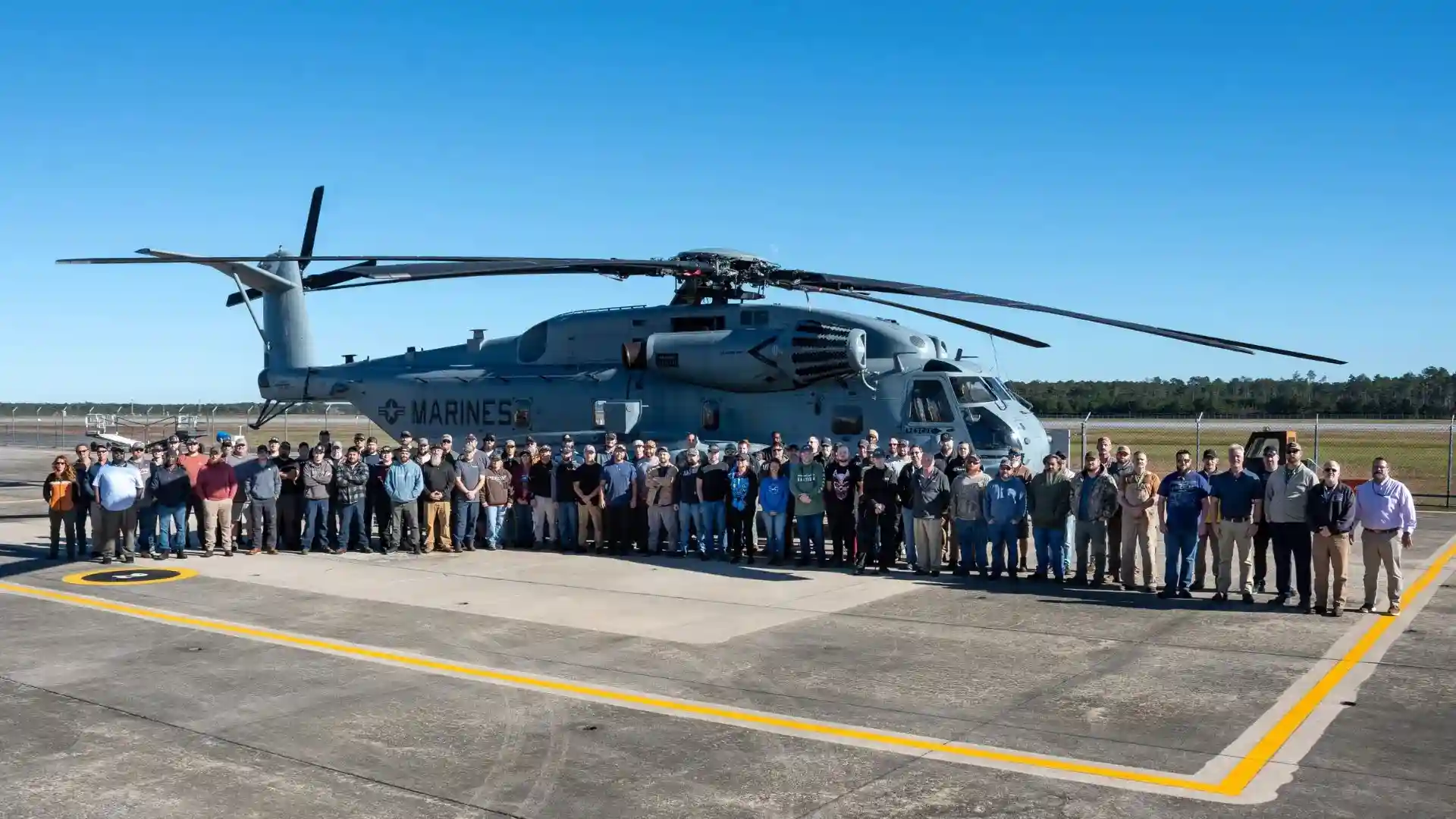
Fleet Readiness Center East (FRCE) returned a CH-53E Super Stallion heavy-lift helicopter to the fleet on November 16, 2026, 12 days ahead of its scheduled depot turnaround, the U.S. Navy announced on November 18. The depot, located at Marine Corps Air Station (MCAS) Cherry Point, North Carolina, credited the early delivery to front-loaded induction planning and process changes introduced under the Commander, Fleet Readiness Centers (COMFRC) Sprint Initiative, an enterprise-wide effort to expose workflow roadblocks early and eliminate H-53 production constraints.
The delivery comes as the Marine Corps runs a two-type heavy-lift fleet. The CH-53K King Stallion is replacing the Super Stallion under a 200-aircraft program of record, with the full changeover expected in fiscal year 2032. Until then, the CH-53E still makes up most of the Marine heavy-lift fleet for ship-to-shore movement, logistics, and sustainment, and every airframe held in depot maintenance is one fewer available to Marine heavy helicopter squadrons. FRCE has been working that problem for several years; in April 2026, the depot reported a 14% reduction in turnaround time on an earlier CH-53E induction.
How the Sprint Initiative Cut CH-53E Super Stallion Depot Time
According to H-53 Branch Head Michael Paul, the aircraft was part of the Sprint Initiative, which he said “focuses on removing barriers and obstacles and increasing production.” Paul described the early delivery as the result of changes the H-53 team has put in place over time. FRCE Commanding Officer Col. Christopher C. McDonald II said it represents “critical combat capability returned to our Marines sooner.”
Depot-level overhaul of the CH-53E is invasive work. H-53 Production Control Center Supervisor Mike Knapp said an induction can include complete airframe disassembly, structural repair, wiring-harness replacement, dynamic-component inspection, and functional test flights. Additional findings can arise during that process and shift turnaround timelines, which makes schedule variance a central management challenge on an airframe type that entered service in 1981.
Knapp said the team did not simply add manpower once the aircraft arrived. Before induction, planners reviewed the anticipated work, sequenced it by phase and location, coordinated supply, engineering, and manufacturing support in advance, and added personnel, strategically aligned with the aircraft’s condition and workload. The intent was to cut the time artisans spend waiting for decisions or parts. A phase-by-phase maintenance playbook divided the induction into subphases and defined what needed to be done and when, a tool Knapp said proved especially useful for junior work leaders.
The Navy has not disclosed the planned turnaround time for this induction or the number of days the aircraft spent at the depot. For reference, FRCE cited a negotiated CH-53 turnaround of 271 days in 2021, with a target of 250 days. A Government Accountability Office (GAO) review later reported that the 12 CH-53Es completed in fiscal year 2021 averaged 344 days against 271 planned, with excess corrosion cited as a key cause. It is unclear whether that baseline still applies.
Super Stallion Design, Lift Capacity, and Sustainment Demands
Until the CH-53K arrived, the CH-53E was the largest and heaviest helicopter in the U.S. military inventory. The Navy lists a length of 99 feet and a maximum gross weight of 69,750 pounds with an external load, and the seven-blade main rotor spans 79 feet. Power comes from three General Electric T64 turboshafts, rated at 4,380 shaft horsepower each in the T64-GE-416/416A configuration, with Naval Air Systems Command (NAVAIR) listing the T64-GE-419 at 4,750 shp. Open sources cite external hook loads of 32,000 to 36,000 pounds and seating for up to 55 troops, and the aircraft is fitted with an in-flight refueling probe.
Beyond the airframe, FRCE overhauls, assembles, and tests the T64 engines that power the Super Stallion, as well as the T408 engine that powers the CH-53K.
Its successor sets the comparison. The CH-53K carries 27,000 pounds over a 110-nautical-mile mission radius in standardized high and hot conditions, nearly three times what the CH-53E can deliver in the same environment. FRCE inducted its first CH-53K for depot maintenance in April 2025, meaning the same workforce now sustains both generations.
Analysis: A single aircraft delivered 12 days early is a modest data point, but the method behind it matters more than the margin. FRCE attacked schedule variance through pre-induction planning, phased work packages, and advance coordination of supply and engineering, rather than adding labor after the aircraft arrived. On aging airframes where hidden findings drive delays, reducing idle time between decisions is the most realistic lever available. With the CH-53E expected to remain in Marine service until the CH-53K changeover completes in fiscal year 2032, depot throughput on the legacy fleet is effectively the bridge for Marine heavy-lift capacity. The real test is repeatability: the Navy has not published current average CH-53E turnaround figures, so it remains unclear whether these gains are spreading across the line.
Paul said the H-53 team intends to build on the result during future overhauls as it works to reduce average turnaround time. Key unknowns include the baseline schedule for this induction, how many CH-53Es are currently in work at FRCE, and how quickly the Sprint Initiative’s practices transfer to other COMFRC sites. FRCE, North Carolina’s largest maintenance, repair, and overhaul provider, employs more than 3,800 civilian, military, and contract workers and reports annual revenue exceeding $868 million.