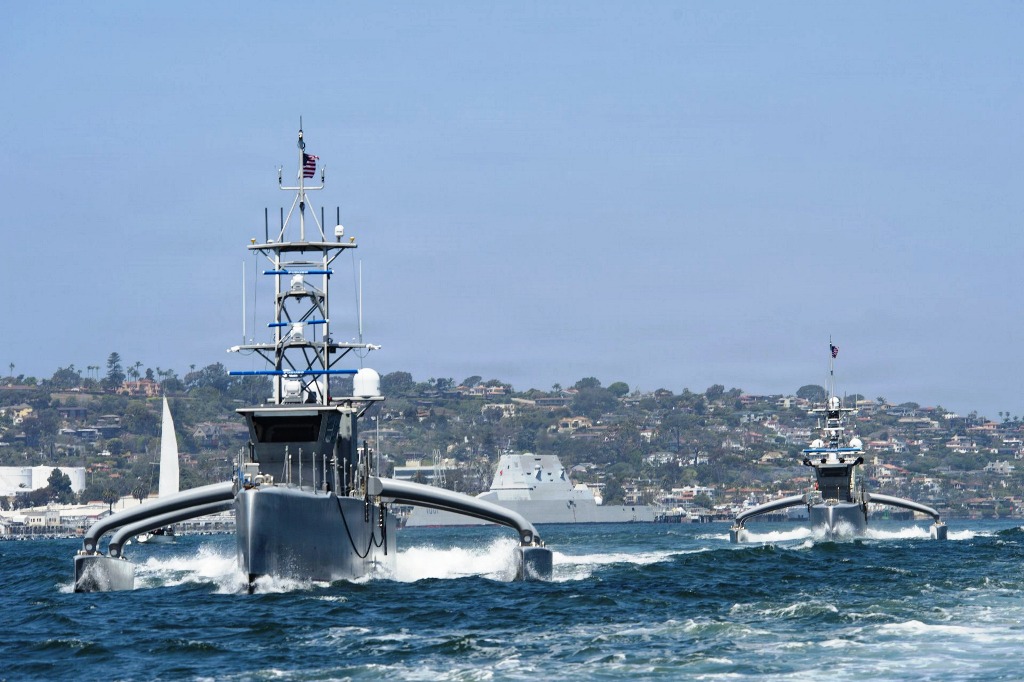
The U.S. Navy will buy 30 Medium Unmanned Surface Vessels (MUSVs) from Galliano Marine Services, HII and Saronic Technologies, the service announced on September 29, 2026, following completion of Phase I at-sea testing. Each company received a production Other Transaction Authority (OTA) agreement for 10 vessels at an average procurement cost of $40 million per hull, implying a combined value of roughly $1.2 billion. First deliveries are scheduled before the end of Fiscal Year (FY) 2027.
The order is the first production commitment under the MUSV Family of Systems effort, which the Navy stood up in March 2026 after cancelling the Modular Attack Surface Craft (MASC) program as too narrowly tailored. It follows years of restructured medium and large USV initiatives that left the fleet with a handful of experimental hulls. Officials aim to grow the medium USV inventory from four to 30 vessels by 2030, with the Indo-Pacific as the priority theater.
Phase I Testing: How Medium Unmanned Surface Vessels Earned Production Deals
Seven companies entered Phase I at-sea evaluations in June 2026 under prototype OTAs: Birdon, Galliano Marine Services, HII, Leidos, PacMar Technologies, Saronic Technologies and Sea Machines. According to the Navy, testing assessed each vessel’s ability to perceive its maritime surroundings, navigate autonomously in compliance with the International Regulations for Preventing Collisions at Sea (COLREGS), and sustain a long-duration mission.
Endurance served as the decisive filter. Candidates had to run roughly 26 hours across more than 360 nautical miles with a single input allowed from a command-and-control (C2) station, according to Chris Miller, the Navy’s Acting Direct Reporting Portfolio Manager for Robotic and Autonomous Systems (DRPM RAS). HII says its vessel logged 420 nautical miles over 28 hours during Navy-monitored trials. Saronic says Marauder ran continuously through an eight-day evaluation spanning more than 140 scenarios, including passive-perception runs in which it detected, tracked and followed other vessels using onboard passive sensors without active radar.
That last capability carries operational weight. A USV that builds a surface picture without emitting gives adversary electronic support measures no easy cue, a practical prerequisite for hulls operating forward in a contested Western Pacific.
Miller said the awards reflected the optimal mix of autonomy, performance, design, production schedule and cost. Leidos, PacMar and Sea Machines completed their prototype agreements without winning production work; each receives a $15 million award under the prototype OT terms and joins the Drones.mil Maritime Marketplace, where they remain eligible for follow-on production agreements. The three winners receive the same award and marketplace access. Birdon did not complete the required testing.
“Our message to the defense industrial base is simple: build fast, deliver on time, and match the urgency of the threat,” said Acting Secretary of the Navy Hung Cao.
Romulus 190, Marauder and the Shifting MUSV Requirements Baseline
HII’s entry is Romulus 190, flagship of an autonomous vessel family unveiled in September 2025. Publicly available specifications indicate a 190-foot (58-meter) hull adapted from a commercial offshore crew-support design, a top speed above 25 knots and a minimum range of 2,500 nautical miles carrying four 40-foot ISO containers, all managed by HII’s open-architecture Odyssey autonomy suite. Saronic’s Marauder measures 54.9 meters (180 feet); the company says it moved from initial design to the water in under a year and has flipped its third hull. Galliano Marine Services, an Edison Chouest Offshore affiliate, has not publicly identified its design. Production begins immediately at shipyards in Loreauville, Houma and Franklin, Louisiana, with deliveries as early as the fourth quarter of FY2027, per the Navy.
Phase I thresholds, published in March 2026, demanded at least 2,500 nautical miles at 25 knots with a 25-metric-ton deck load in Sea State 4, 40-foot container capacity and underway refueling at 2,000 gallons per minute. The Navy has not disclosed the mission set beyond that containerized focus; program officials have cited sensors and ship repair equipment as candidate payloads.
The Phase II Integration and Testing Call for Solutions, issued September 23, 2026, loosens that baseline. It drops the speed and refueling targets, caps hulls at 295 feet (90 meters) and 5,000 metric tons, and requires two 20-foot containers of 24,000 kilograms each drawing 25 kilowatts apiece, plus 10 days of unmanned endurance. Vessels must be operable in Sea State 4, survivable in Sea State 6 and demonstration-ready at submission.
Analysis: The Phase II rewrite may prove more consequential than the 30-hull order. By dropping the speed and refueling thresholds, the Navy is trading sprint performance for a broader, partly dual-use supplier base and a recurring buy cycle. That fits the Tailored Offset logic of the Fighting Instructions, which Chief of Naval Operations Adm. Daryl Caudle frames as capacity “placed at risk without placing Sailors at unnecessary risk.” Attritable mass depends on replacement hulls from multiple yards, and three builders plus a marketplace bench provide that. Whether $40 million per hull stays attritable once mission containers are priced in remains unanswered.
Phase II testing can begin as early as November 16, with proposals assessed on a rolling basis over five years. Risks persist: a July lawsuit by Blue Water Autonomy and Saildrone contesting their exclusion from Phase I remains pending, and Miller acknowledged budget limits could shape demand. The Navy has not said where the 30 vessels will be homeported or which fleet will operate them.