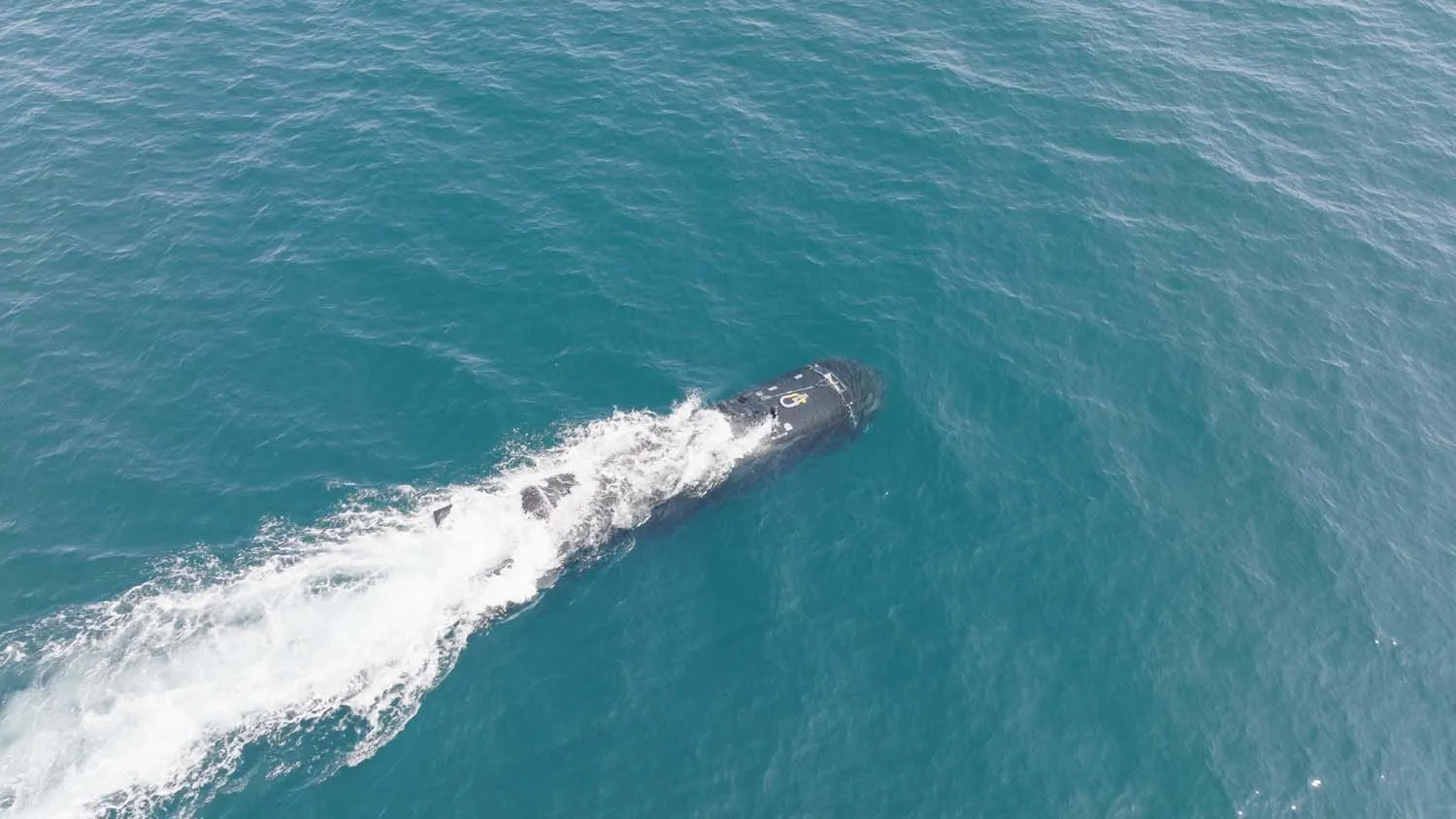
The Royal Navy’s XV Excalibur, an Extra-Large Uncrewed Underwater Vehicle (XLUUV), launched a US Navy Mk 48 Mod 4 heavyweight torpedo on September 13, 2026, at the British Underwater Test and Evaluation Centre (BUTEC) near the Kyle of Lochalsh in Scotland. London and Washington describe the event as the first time either nation has fired a heavyweight torpedo from an uncrewed underwater vessel rather than a crewed submarine. The trial used an inert, recoverable exercise round.
The firing was the centerpiece of Project Broadsword, also designated Trial Iron, which the Royal Navy calls the leading operational milestone of AUKUS Pillar 2, the Australia-United Kingdom-United States partnership’s rapid capability development track. The effort moved from approval in February 2026 to a live launch in roughly six months. The three-week experiment involved the Royal Navy, the US Navy, the UK Submarine Delivery Group Autonomy Unit, the Defense Innovation Unit (DIU), Naval Undersea Warfare Center (NUWC) Keyport, builder MSubs, and range operator QinetiQ. The Royal Navy says it opens a US-initiated series of increasingly complex trials aimed at operational deployment of torpedo-armed uncrewed vessels.
How the Royal Navy XLUUV Was Adapted to Launch a Mk 48
Built by MSubs in Plymouth under Project CETUS for an estimated £15.4 million, the vehicle measures 12 meters in length and 2.2 meters in diameter and displaces approximately 19 tonnes, according to publicly released program figures. Its main payload bay is a 2-meter cube, and the vessel has a reported endurance of up to 1,000 miles per mission and can dive deeper than the Royal Navy’s crewed submarines. It was named at HM Naval Base Devonport in May 2025 and passed into Royal Navy ownership in December 2025, with MSubs operating it on the service’s behalf within the Fleet Experimentation Squadron.
For Trial Iron, engineers fitted a specialist management system allowing the XLUUV to fire and control the torpedo. The Mk 48 does not fit inside the payload bay; US Navy imagery shows the weapon carried externally beneath the hull. The US Navy says the trial validated the mechanical, electrical, and software integration between weapon and vehicle.
That configuration explains the speed of the effort. Rather than designing a bespoke launch tube, the partners mated an existing weapon to an existing hull. The trade-off is operational: external carriage is likely to impose drag and flow-noise penalties, and a single slung round offers no reload. Neither navy has disclosed how Excalibur was commanded during the launch, whether the torpedo ran against a target, or whether its guidance wire was used. First Sea Lord General Sir Gwyn Jenkins said British and American teams had “delivered a credible fighting capability” in six months.
Mk 48 Mod 4 Specifications and the Case for Weapon Interchangeability
The Mk 48 has been the US Navy’s standard submarine-launched heavyweight torpedo since 1972 and is employed against both submarines and surface ships. NUWC data list the Mod 4 at 5.86 meters in length and 53.2 centimeters in diameter, with a warshot weight of 1,553 kilograms; the exercise configuration, which replaces the warhead with an exercise section, weighs 1,119 kilograms. The weapon runs on liquid Otto fuel driving a swashplate engine and pump-jet propulsor, combines wire guidance with active and passive acoustic homing, and can execute multiple re-attacks. Legacy US Navy fact sheets give speed as greater than 28 knots and range as greater than 8 kilometers; open-source estimates place top speed near 55 knots. The warshot carries a 650-pound (292-kilogram) high-explosive warhead.
The Mod 4 predates the Advanced Capability (ADCAP) Mod 5 introduced in 1988. The current production standard, the Mod 7, was co-developed with the Royal Australian Navy and reached initial operational capability in 2006. Using an older exercise variant fits a proof of concept whose objective was the interface, not the weapon’s performance.
The weapon choice carries its own signal. The Royal Navy’s own heavyweight torpedo is the BAE Systems Spearfish, not the Mk 48. Firing a US weapon from a British vehicle, within a program that also includes Mk 48 operator Australia, points toward a common AUKUS payload standard. Per the Royal Navy, the Mk 48 is in service with half a dozen navies. US Chief of Naval Operations Admiral Daryl Caudle framed the result as validation of allied weapon interchangeability.
Analysis: The trial matters less for what Excalibur fired than for how quickly an allied weapon was made to work on a hull never designed for it. If the AUKUS partners standardize weapon interfaces across XLUUVs such as Excalibur, Australia’s Ghost Shark, and the Dive-XL, a torpedo in one navy’s magazine becomes a usable payload for another’s drone fleet. For the Royal Navy, an armed XLUUV would add an attack option to Atlantic Bastion, the hybrid anti-submarine network it is building to counter Russian submarine activity in the North Atlantic. The harder problems remain open: undersea command and control over minimal bandwidth, human authorization for weapon release, and launch and recovery at scale.
The next phase shifts to the US-led Project CUTLASS, which will use Anduril’s Dive-XL to work through advanced payload integration, command-and-control architectures, and tactical employment scenarios. Excalibur continues trials under an MSubs support contract, with the six-year CETUS program due to conclude in 2028. No timeline or funding line has been announced for an operational torpedo-armed XLUUV, and neither navy has said whether a warshot firing will follow.