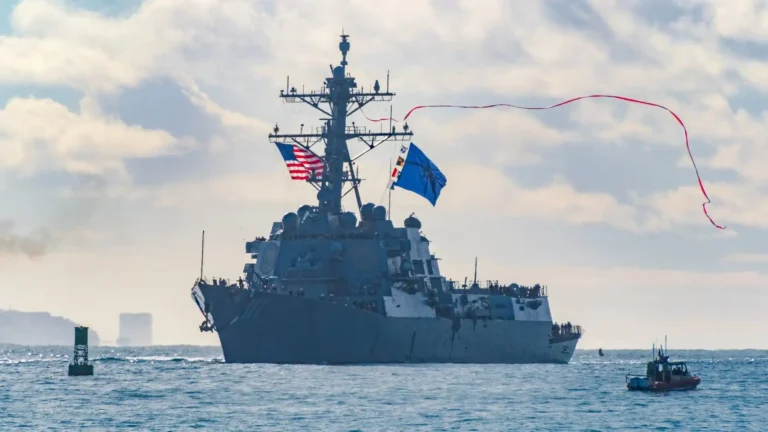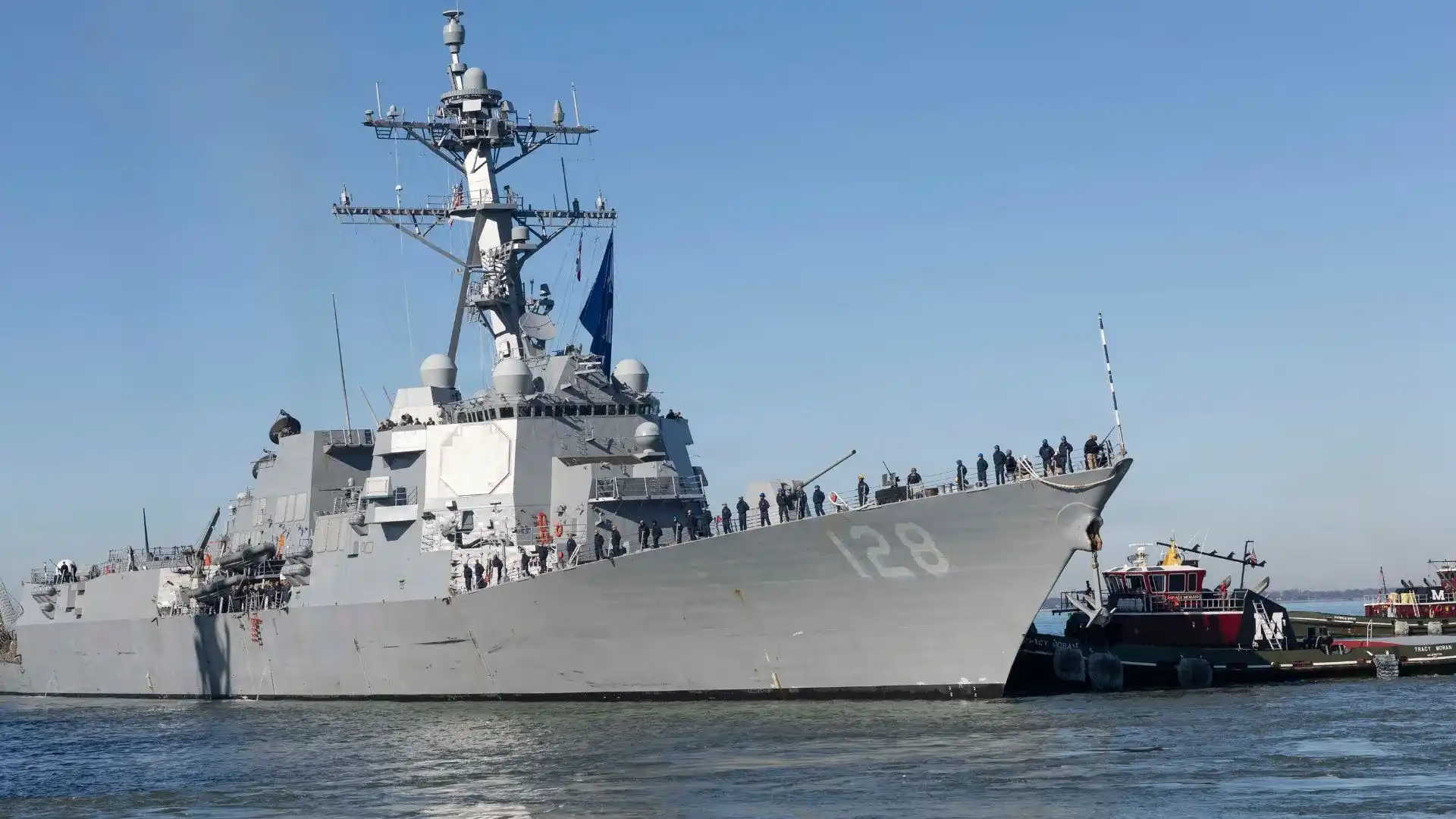
USS Ted Stevens (DDG 128), the U.S. Navy’s newest Flight III Arleigh Burke-class guided-missile destroyer, arrived at its homeport of Naval Station Norfolk, Virginia, on November 18, 2026. The arrival, which coincides with the birthday of the ship’s namesake, marks its return to the East Coast as a commissioned warship following its October 3 commissioning in Whittier, Alaska. According to the U.S. Navy, the milestone moves DDG 128 from post-delivery testing toward full operational integration with Naval Surface Force Atlantic (SURFLANT).
Ted Stevens is the second Flight III destroyer delivered by Huntington Ingalls Industries’ (HII) Ingalls Shipbuilding division in Pascagoula, Mississippi, after USS Jack H. Lucas (DDG 125). Each Flight III hull carries more weight than its predecessors in fleet planning: the configuration is built around the AN/SPY-6(V)1 Air and Missile Defense Radar (AMDR) and the Aegis Baseline 10 combat system, and it arrives as the Navy retires its Ticonderoga-class cruisers and shifts a growing share of fleet air and missile defense onto destroyers. The ship now joins a SURFLANT force of 66 ships and 31 shore commands.
USS Ted Stevens Completes Shock Trials and Alaska Commissioning Voyage
The destroyer first reached Norfolk as a pre-commissioning unit on May 15, 2026, after sailing from Pascagoula. In July, it completed full-ship shock trials off the coast of Florida. These trials subject a warship to nearby underwater detonations to validate the hull, combat system and machinery under combat-representative stress, a test of particular relevance for a configuration that adds heavier radar arrays and new power and cooling equipment to the DDG 51 design.
Ted Stevens then transited to the Pacific. On September 17, it sailed alongside USS Daniel Inouye (DDG 118) off San Diego to honor the lifelong bond between the two ships’ namesakes, both World War II veterans who served together in the U.S. Senate. The October 3 ceremony in Whittier, attended by Navy leadership and ship sponsors Catherine Ann Stevens, Susan Stevens Covich and Lily Stevens Becker, was the first Navy commissioning held in Alaska since USS Anchorage (LPD 23) in May 2013.
After a port visit to Juneau from October 7 to 11, the ship called at San Diego, crossed the Panama Canal and made logistics stops at Naval Station Mayport and Tampa, Florida. From November 6 to 13, Ted Stevens escorted the decommissioned aircraft carrier ex-Enterprise (CVN 65), the world’s first nuclear-powered carrier, as the hulk was towed to Mobile, Alabama, for dismantling.
“We are proud to return to our homeport of Norfolk as a commissioned warship,” said Capt. Mary Katey Hays, the ship’s commanding officer. “From Full Ship Shock Trials to our commissioning in Whittier, AK, from our port visit in Juneau and back through the Panama Canal, the crew has embodied our motto, ‘Lead with Courage.’ We are ready to join the Fleet!”
SPY-6 and Aegis Baseline 10 Define Flight III Air Defense
The core of the Flight III upgrade is the Raytheon AN/SPY-6(V)1, an active electronically scanned array radar with four fixed faces, each built from 37 Radar Modular Assemblies (RMAs). Each RMA is a self-contained radar unit roughly 2 feet on a side, an architecture that allows the same building blocks to scale across the SPY-6 family fitted to carriers, amphibious ships and backfitted Flight IIA destroyers. The manufacturer states that SPY-6(V)1 is more than 30 times more sensitive than the AN/SPY-1D(V) it replaces, allowing it to detect targets half the size at twice the distance.
Aegis Baseline 10 integrates the new radar and is designed to let the ship conduct air defense and ballistic missile defense simultaneously, rather than trading one mission against the other. According to the Navy, the combination is paired with upgraded electrical power and cooling capacity designed to detect, track and counter advanced ballistic, cruise and hypersonic missile threats. The Navy says Flight III ships also receive updated gas turbine generator sets producing 4 megawatts each to feed the radar’s heavier load.
The Navy lists a length of 509.5 feet (155.3 meters) and a modified steel hull displacing more than 9,500 tons, compared with about 9,300 tons for a Flight IIA destroyer. Armament centers on the 96-cell Mk 41 Vertical Launching System, capable of hosting Standard Missile variants, Evolved Sea Sparrow Missiles and Tomahawk land-attack missiles.
Analysis: A Norfolk-based Flight III destroyer gives SURFLANT a sensor and engagement capacity that its Flight IIA hulls cannot match until SPY-6(V)4 backfits arrive. That matters as Flight III destroyers take over the air and missile defense commander role once held by the retiring Ticonderoga-class cruisers. The broader constraint is pace. Two Ingalls-built Flight III ships in service several years after the first delivery underline that the integrated air and missile defense fleet will grow incrementally.
The Navy has not announced dates for Ted Stevens’ post-shakedown availability, combat system certification or first deployment, nor its assignment to a carrier strike group. Those milestones, along with the delivery cadence of follow-on Flight III ships from Ingalls and Bath Iron Works, will determine how quickly the configuration becomes a routine presence in the Atlantic fleet.