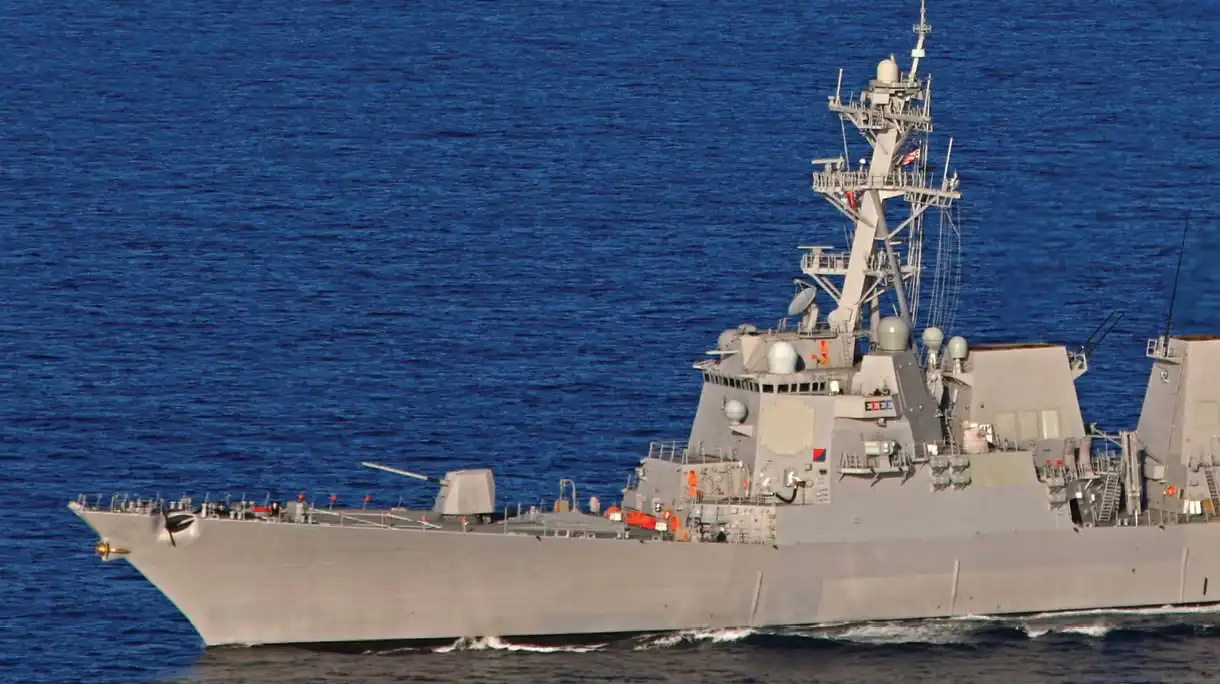
L3Harris Technologies has completed U.S. Navy operational testing of its FleetLink communications system aboard an Arleigh Burke-class guided-missile destroyer, the company announced on November 12, 2026. L3Harris did not name the ship, the test location, or the period during which the evaluation took place, and the Navy has not released results.
FleetLink is the system L3Harris developed in 2023 under the Navy’s Scalable, Modular, Radio Cluster (SMRC) contract, an effort to replace legacy shipboard communication equipment with a modular architecture built around current radios and waveforms. Completing operational testing on a DDG-51 hull, the Navy’s most numerous surface combatant class, moves the program beyond development and toward a production and fielding decision the service has yet to announce. The value of the SMRC contract has not been disclosed.
L3Harris FleetLink Architecture and Its Three Radio Configurations
According to L3Harris, FleetLink is a high-speed, modular communications solution that brings together the company’s radios and waveforms and integrates data rapidly from multiple sources. The SMRC designation describes the design intent: a radio cluster that scales and reconfigures by module to fit the host platform, rather than a collection of single-purpose radio sets installed one at a time. Consolidation matters on a destroyer, where radio room space, power, cooling and the number of separate cryptographic devices all limit how many circuits a ship can sustain.
The system comes in three configurations:
- A four-channel high-frequency (HF) variant
- A four-channel multi-band variant
- A submarine multi-band variant
The four-channel layout points to a single installation supporting several concurrent circuits, a practical requirement for destroyers that must keep command, tactical and coordination nets running at the same time. L3Harris has not published the frequency coverage of the multi-band variants, channel bandwidths, the data rates behind the “high-speed” label, or the specific radio hardware inside each cluster. Those figures will determine how FleetLink performs against the shipboard suites it is meant to replace.
The submarine configuration extends the program’s scope beyond surface combatants. It points to a common radio cluster family spanning surface and undersea platforms, although no submarine test has been announced. Submarines face tighter volume and mast antenna constraints than surface ships, which makes a modular cluster particularly relevant for undersea installations.
HF Resilience and NSA-Certified Cryptography for Contested Seas
HF communications have regained priority across the U.S. military because they provide beyond-line-of-sight connectivity without satellites. Military HF systems typically operate between 2 and 30 MHz and reach over the horizon by refracting signals off the ionosphere, giving a ship a fallback path when satellite links are jammed, degraded or denied. For a destroyer operating inside an adversary’s electronic warfare and counterspace envelope, that redundancy is a core requirement rather than a secondary option.
The Navy’s wider investment in HF is visible beyond FleetLink. In late 2025, Naval Information Warfare Center Pacific placed a $30.3 million order with L3Harris for HF network equipment supporting the Battle Force Tactical Network Resilient Command, Control, and Communication System Enhancement (BFTN RC3), a separate program that provides networked HF and ultra-high frequency (UHF) communications to ships, submarines, aircraft and shore sites. L3Harris has not stated whether FleetLink interfaces with BFTN RC3.
Security is the second pillar. FleetLink integrates what L3Harris describes as its latest National Security Agency (NSA)-certified cryptographic capability, which the company says enhances secure information exchange and supports the Navy’s goal of resilient, reliable communication across platforms. The company did not specify the certification type or how encryption is distributed across channels.
“Interoperability is a foundational requirement for the Navy’s increasingly complex operations,” said Faisal Munir, president of Mission Critical Communications in the L3Harris Communications & Spectrum Dominance segment. “FleetLink demonstrates exactly how the equipment will perform under real-world conditions to ensure combat readiness and provide commanders with seamless surface and undersea communications.”
Analysis: FleetLink’s importance lies less in any performance figure, none of which has been released, than in the procurement model it represents. A common, modular radio cluster spanning destroyers and submarines would give the Navy a single hardware and cryptographic baseline for HF and multi-band links across surface and undersea platforms, which would simplify interoperability, training and sustainment. It also deepens the L3Harris footprint in Navy HF communications, already visible in BFTN RC3. For now, the test remains a company-reported milestone; independent validation will come only when the Navy publishes results or commits production funding.
The next decision points are a Navy production commitment, the identification of the first ships to receive FleetLink, and a test schedule for the submarine multi-band variant. Key unknowns include the SMRC contract value, the installation timeline across the DDG-51 fleet, and whether L3Harris will offer FleetLink to allied navies that operate on shared U.S. HF networks.