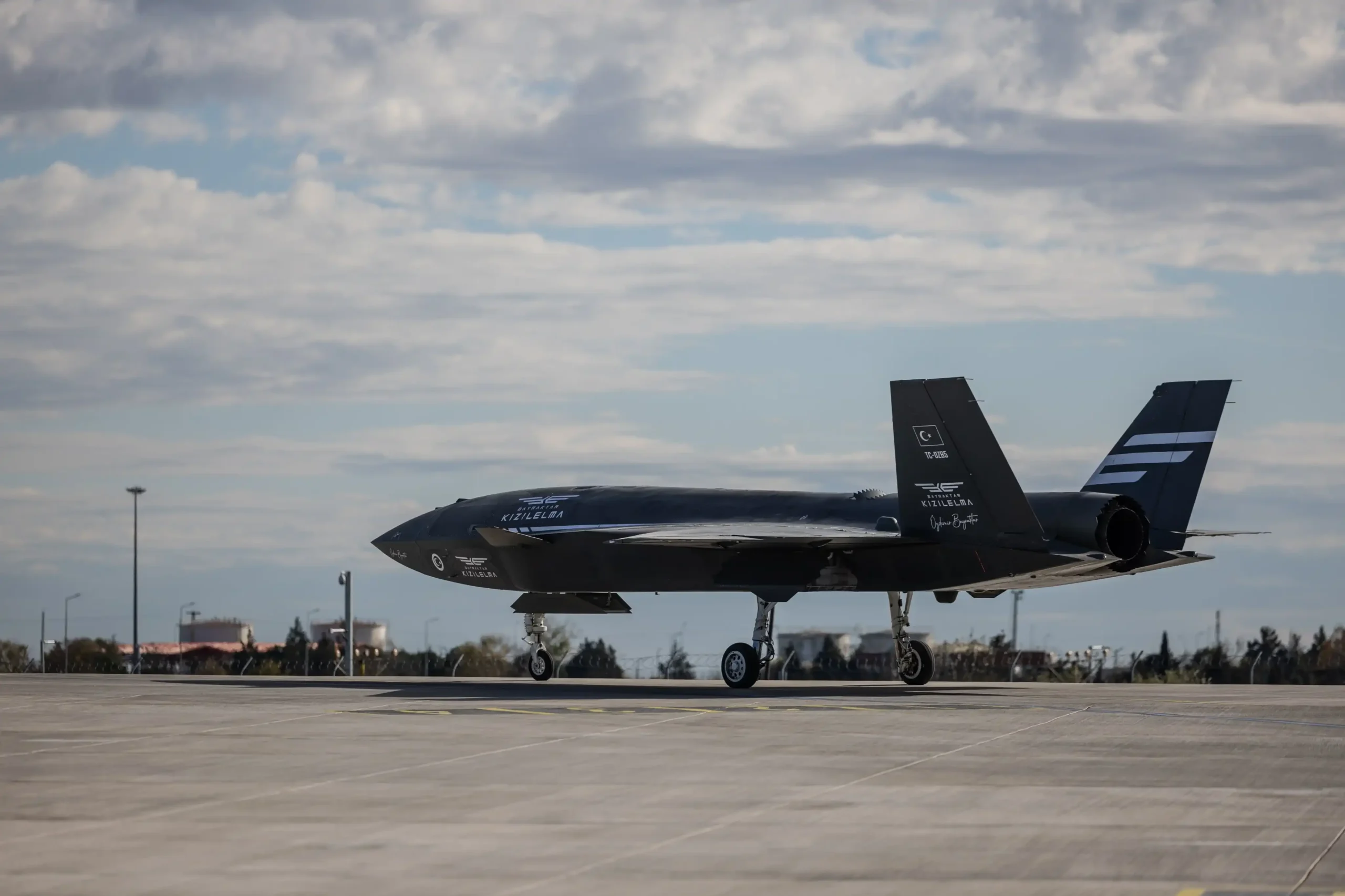
Türkiye’s security forces took delivery of the first three Baykar KIZILELMA unmanned fighter jets on November 19, 2026, after the aircraft completed acceptance testing, the company announced. Baykar says the handover makes Türkiye the first country to induct an unmanned fighter jet into its operational inventory. Test and training activity under the program has reached 600 sorties to date.
The delivery closes a five-year development cycle that Baykar financed entirely from its own resources. Conceptual renderings were unveiled on July 20, 2021, the first airframe entered the production line on March 12, 2022, and the maiden flight followed on December 14, 2022. Induction comes later than first announced: in January 2026, Baykar said two serial-production aircraft would reach the Turkish Armed Forces in the first quarter of the year. Neither Baykar nor Ankara has yet identified which service received the three aircraft, which configuration was delivered, or the value of the contract behind them.
KIZILELMA Unmanned Fighter Test Campaign From Formation Flight to BVR Kill
The flight test campaign moved from airframe validation to weapons employment in under three years. On April 24, 2023, KIZILELMA flew in close formation with the AKINCI unmanned combat aerial vehicle (UCAV), which Baykar describes as the first close formation flight between two unmanned aircraft. Live munitions followed on October 8, 2025, with the first releases of TOLUN and TEBER-82 precision-guided weapons. The ASELSAN TOYGUN electro-optical targeting system was integrated on November 17, 2025.
The decisive air-to-air milestone came on November 29, 2025, off the Black Sea coast near Sinop. Cued by ASELSAN’s MURAD active electronically scanned array (AESA) radar, KIZILELMA fired a GÖKDOĞAN beyond-visual-range air-to-air missile (BVRAAM), developed by TÜBİTAK SAGE, and scored a direct hit on a jet-powered target aircraft. Baykar presents this as the first such kill by an unmanned fighter. The shot validated an all-domestic kill chain, from sensor to missile, on an uncrewed airframe.
Autonomy work ran in parallel. On December 27, 2025, two KIZILELMA aircraft flew in close formation under Baykar’s smart fleet autonomy, a building block for collaborative swarm tactics. On May 20, 2026, the aircraft flew an autonomous formation alongside Italian M-346 jets, a step toward manned-unmanned teaming. On July 13, 2026, KIZILELMA hit its target with the JET-230 supersonic missile, and later that month it released TEBER-82 and TOLUN munitions from its internal weapons bay for the first time, a prerequisite for low-observable operations.
Airframe, Payload, and Propulsion: What Baykar Has Disclosed
Baykar’s published specifications describe a single-engine, low radar cross-section (RCS) airframe 14.5 m long, with a 10 m wingspan and a height of 3.5 m. Maximum takeoff weight is listed at 8,500 kg, with 1,500 kg of payload split between internal and external stations. The company quotes a cruise speed of Mach 0.6, a maximum speed of Mach 0.9, an operational altitude of 25,000 ft, and endurance above three hours. Line-of-sight (LOS) and beyond-line-of-sight (BLOS) datalinks support control, while taxi, takeoff, landing, and cruise are fully autonomous. Baykar has not released RCS values or independently verified signature data.
Propulsion remains the program’s main external dependency. Publicly available specifications indicate current high-performance configurations use the Ukrainian Ivchenko-Progress AI-322F afterburning turbofan, rated at roughly 24 to 25 kN dry and above 40 kN with reheat, while TUSAŞ Engine Industries (TEI) develops the TF6000 as the intended domestic replacement. Baykar lists five variants, KIZILELMA-A, -B, -CA, -CB, and -D, differentiated largely by engine fit and performance. The variant delivered on November 19 has not been disclosed.
Analysis: The world-first claim depends on how an unmanned fighter and an operational inventory are defined, but the timing is real. The US Air Force moved its FQ-42A and FQ-44A Collaborative Combat Aircraft into Increment 1 production only in June 2026. Ankara now fields, at least in token numbers, a jet-powered unmanned airframe that pairs an indigenous AESA radar, BVR missile, and autonomy stack inside NATO. Three aircraft do not make an operational capability, and reliance on a foreign engine supplier is a supply-chain risk. For Baykar, which posted $2.2 billion in exports in 2025 and has signed export contracts with 40 countries, 37 for the Bayraktar TB2 and 16 for the AKINCI, a domestic induction provides the reference customer that fighter-class export campaigns require.
Key unknowns remain the receiving service, basing, the delivered configuration, and the size of the firm order behind this first batch. The next indicators to watch are follow-on deliveries, TF6000 integration, operational evaluation results from the receiving unit, and whether manned-unmanned teaming with Turkish crewed fighters moves from demonstration to doctrine. Baykar has already signed its first KIZILELMA export agreement: CEO Haluk Bayraktar said at SAHA 2026 in May that it covers 12 aircraft, with first deliveries targeted for 2028, in a deal reported as being with Indonesia. Follow-on export orders would show whether Baykar can repeat its TB2 and AKINCI trajectory in the fighter segment.