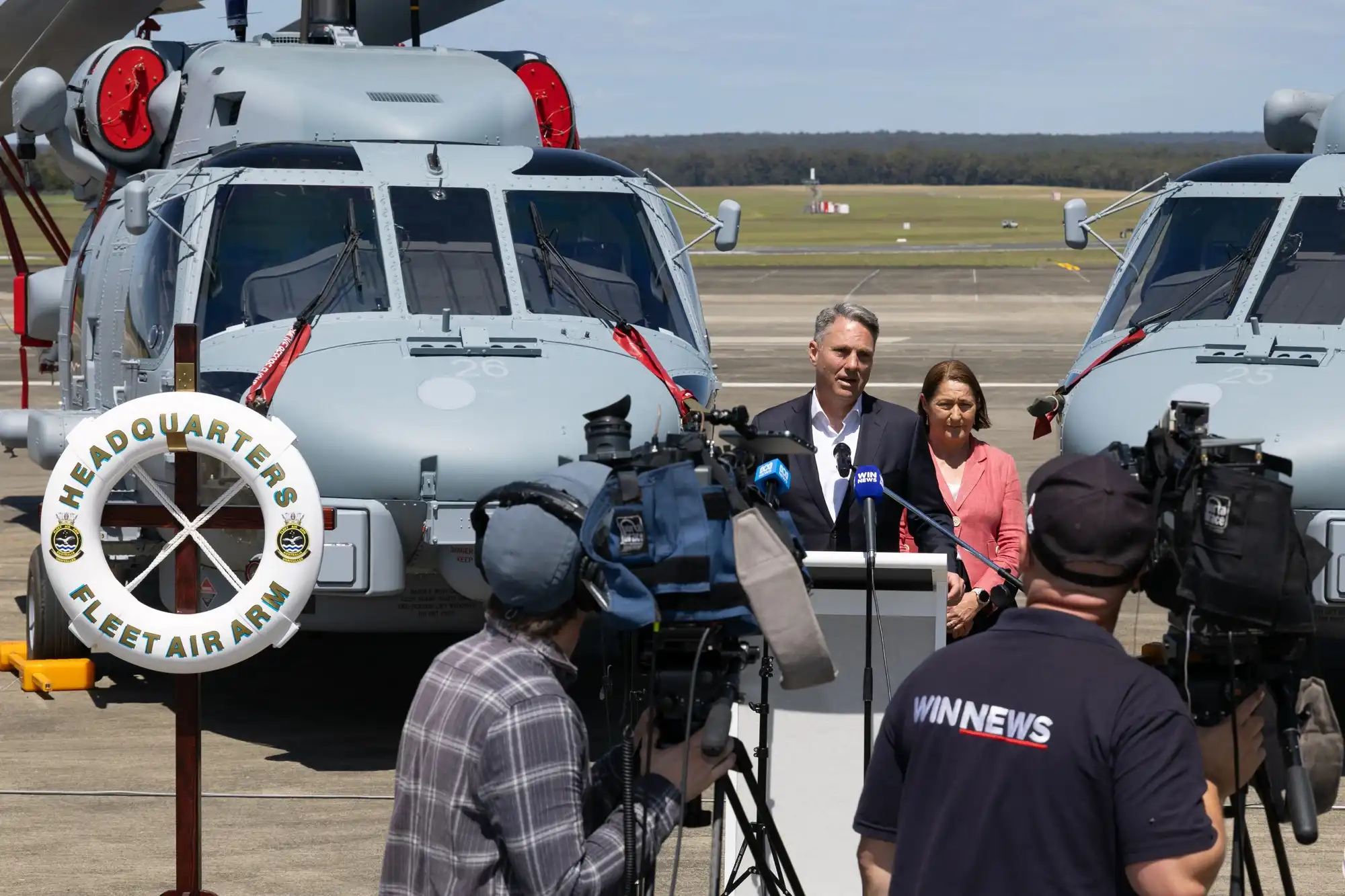
Australia has taken delivery of two additional MH-60R Seahawk maritime helicopters at HMAS Albatross in Nowra, New South Wales, the first tranche of 13 extra aircraft that will grow the Royal Australian Navy (RAN) fleet to 36 airframes. Deputy Prime Minister and Minister for Defence Richard Marles and Minister for Defence Industry Pat Conroy announced the arrival on November 19, 2026, citing 75 new high-skilled jobs in the Shoalhaven region.
The deliveries close a gap the Navy has carried since its six MRH-90 Taipan utility helicopters ceased operations in May 2022. Canberra opted for a common Romeo fleet after the US State Department approved a US$985 million Foreign Military Sale (FMS) of 12 MH-60Rs on October 8, 2021, and the US Navy contracted Lockheed Martin in September 2022 under Project SEA 9100 Phase 1, the Improved Embarked Logistics Support Helicopter program. A 13th aircraft replaces an MH-60R lost on operations in October 2021, which had left the in-service fleet at 23. The government places the buy within an A$2.5 billion investment in the Seahawk fleet over the decade.
From 23 to 36: How SEA 9100 Expands the MH-60R Seahawk Fleet
The new aircraft are intended for the amphibious and afloat support fleet, where the MRH-90 previously flew vertical replenishment, search and rescue and personnel transfer. The 12 SEA 9100 helicopters will form the Fleet Air Arm’s third MH-60R squadron, alongside 725 and 816 squadrons, which already operate the type at Nowra. Standardizing on one type, which Defence describes as rationalising the Navy’s support and logistics helicopter fleet, removes a separate training, spares and maintenance chain for a six-aircraft fleet.
According to the ministers, the larger fleet expands capacity for anti-submarine and anti-surface warfare, intelligence, surveillance and reconnaissance (ISR), maritime strike, search and rescue, logistics support and personnel transfer. That breadth is the point: every Romeo assigned to a landing helicopter dock or replenishment ship arrives with full combat mission systems, giving those hulls an organic undersea and surface search capability rather than a pure utility lift asset.
RAN officials told Naval News in April 2025 that the MH-60R is due to reach final operating capability in 2032, defined as 14 deployable flights with aircraft, crews and logistics support, each able to sustain sea deployments of up to 90 days. Lockheed Martin planned in 2022 to deliver all 12 SEA 9100 helicopters between mid-2025 and mid-2026, and the government stated in February 2025 that the 13 additional aircraft would be delivered by the end of 2026. The November announcement gives no updated schedule for the remaining 11.
Romeo Mission Systems and the Nowra Sustainment Hub
The 2021 FMS notification covered 30 T700-GE-401C turboshaft engines (24 installed, six spares), 12 AN/APS-153(V) multi-mode radars and 12 AN/AAS-44C(V) Multi-Spectral Targeting Systems, plus weapons launchers but not the weapons themselves. Publicly available specifications indicate each T700-GE-401C delivers about 1,890 shp, for a maximum gross weight of 23,500 lb (10,660 kg). The RAN lists a top speed of 180 kt and a range of 470 nm for its Romeos.
The APS-153 provides surface search with inverse synthetic aperture radar imaging and automatic periscope detection, while the Airborne Low Frequency Sonar (ALFS) dipping sonar and sonobuoys build the undersea picture, with electronic support measures (ESM) adding passive emitter detection. Open-source figures put mission endurance at about 2.7 hours in the anti-submarine role and 3.3 hours for surface warfare, which drives how often a single embarked flight must cycle aircraft to hold a search. The RAN lists the Mk 54 lightweight torpedo and AGM-114 Hellfire missile among the type’s weapons. Commonality with the US Navy fleet keeps Australia on the same sensor and software upgrade path.
Sustainment stays at Nowra through Lockheed Martin Australia and Sikorsky Australia. In February 2025, Sikorsky Australia was awarded an A$313.5 million, three-year sustainment contract that the government said would create 75 jobs and support another 200 at its Nowra maintenance and logistics facility. Conroy tied the expansion to the Integrated Investment Program’s emphasis on “strengthening sovereign sustainment capability.”
Analysis: The value of SEA 9100 lies less in airframe numbers than in fleet rationalization. Replacing a small, hard-to-support utility type with combat-capable Romeos turns amphibious and support ships into additional anti-submarine and ISR nodes while the surface combatant force is in transition, with Anzac-class frigates retiring ahead of new construction. The constraint is decks, not helicopters, a risk Naval News already raised in 2025: 36 aircraft only translate into presence if enough air-capable hulls are available to embark them, and that depends on shipbuilding timelines outside this program’s control.
The next milestones are delivery of the remaining 11 aircraft, the stand-up of a third MH-60R squadron and the 2032 final operating capability target. Key unknowns remain the updated delivery schedule, the split of flights between combatants and support ships, and how the A$2.5 billion figure divides between acquisition and sustainment.