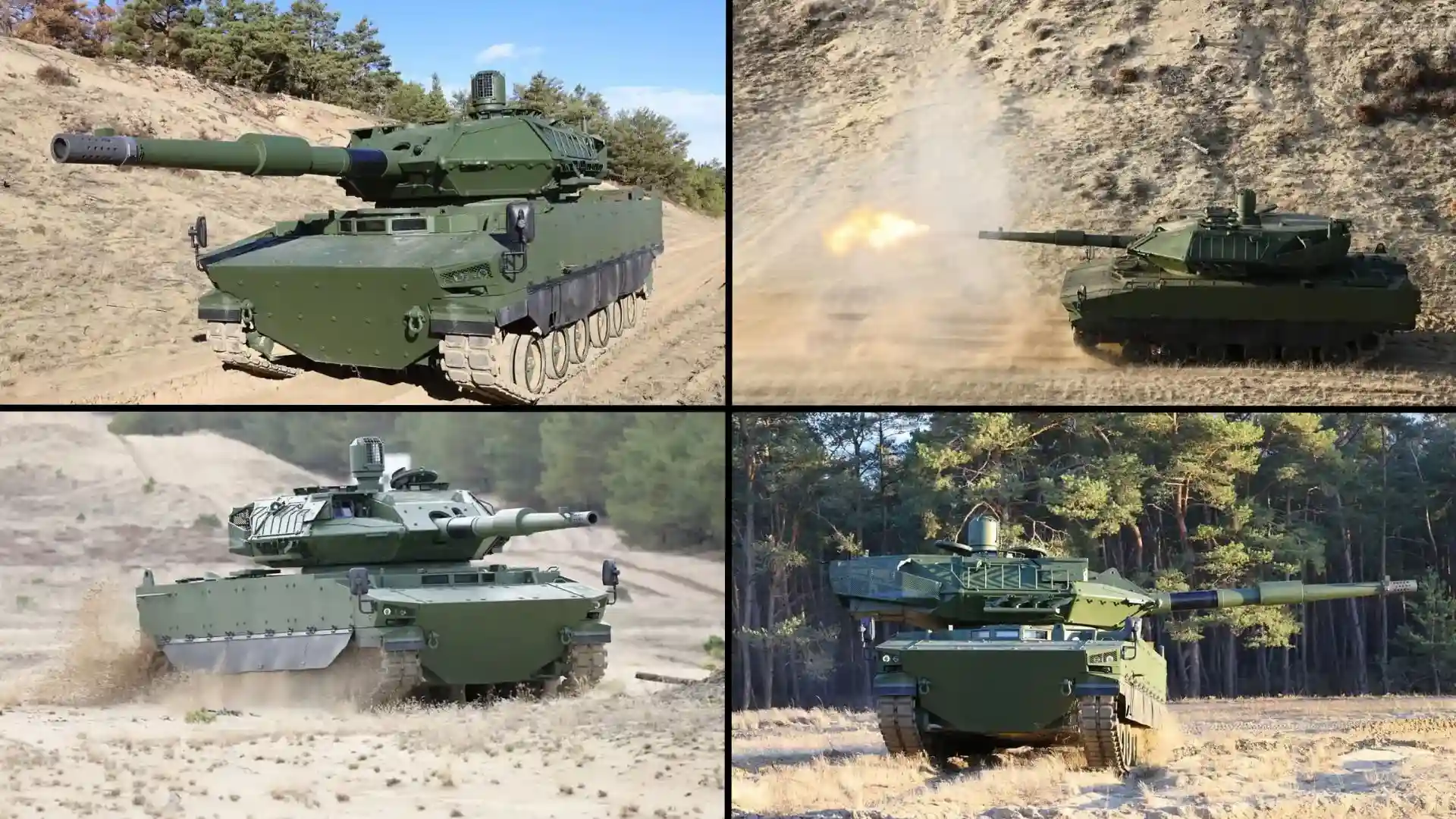
FNSS and the Czechoslovak Group (CSG) have completed the first dynamic live-fire demonstration of their CFL-120 KARPAT medium tank at Slovakia’s Záhorie Military Testing Area, FNSS announced on November 20, 2026. The 34-tonne tank, flagship of their Slovak joint venture Danube Defence Systems, drove off-road and engaged targets in front of potential users, whom the company did not name. It mounts a 120 mm gun, and FNSS says first deliveries could follow within 19 to 20 months.
The event is the first time the KARPAT has been shown moving and firing since its static world premiere at the IDEB 2026 exhibition in Bratislava on May 12, 2026. CSG Defence and FNSS signed a framework agreement at Eurosatory in June 2026 to establish Danube Defence Systems, headquartered in Trenčín, with CSG Defence expected to hold 51% and FNSS 49% once the transaction closes. The demonstration comes as Bratislava weighs lighter alternatives to full-weight main battle tanks (MBTs).
KARPAT Medium Tank Design: KAPLAN Hull Meets HITFACT MkII Turret
The CFL-120 KARPAT pairs the FNSS KAPLAN tracked platform with Leonardo’s HITFACT MkII turret and its 120 mm gun, two subsystems already in service with other armies. The hull descends from the KAPLAN MT, co-developed with Indonesia’s PT Pindad and fielded by the Indonesian Army as the Harimau, with the first ten tanks handed over in early 2024. Publicly available specifications for that baseline list a 711 hp Caterpillar C13 diesel, an Allison/Caterpillar X300 fully automatic transmission, torsion bar suspension and a power-to-weight ratio of 22.2 hp per tonne. FNSS has not confirmed whether the KARPAT retains that exact power pack.
Figures released at the IDEB unveiling give the KARPAT a combat weight of up to 34 tonnes, a maximum speed of 70 km/h and a range of approximately 450 km. FNSS claims the lowest silhouette and highest power-to-weight ratio in its class. The power pack is combined with electronically controlled systems, an auxiliary power unit (APU) and a heavy-duty suspension, which the company says ensure continuous power during expeditionary manoeuvres, day and night.
The layout follows the conventional tank concept, with the power pack at the rear. FNSS argues this improves acceleration on soft ground, lets the driver keep full situational awareness without opening the hatch, and supports ballistic and mine protection that front-engine designs derived from armored personnel carriers cannot match. The HITFACT MkII, NATO qualified and in production, accepts a 120/45 mm low-recoil smoothbore or a 105/52 mm rifled gun, has a fully digital architecture with panoramic sights for the commander and gunner, and can be configured for two crew with an autoloader or three crew. It already arms the Italian Army’s Centauro II 8×8. Neither company has specified the crew configuration of the KARPAT demonstrator.
Trenčín Production Plan and Slovakia’s Medium Tank Competition
Production is planned at MSM Land Systems, the CSG subsidiary in Trenčín, with Slovak suppliers invited into the supply chain. FNSS states the KARPAT is ready for serial production, with first standard-configuration deliveries possible within 19 to 20 months and initial operational capability (IOC) within 26 months. The company did not specify the reference point for those timelines. For FNSS, Trenčín provides an EU-based production footprint. Danube Defence Systems also plans armored personnel carrier and infantry fighting vehicle (IFV) variants within the KARPAT family, other FNSS wheeled and tracked vehicles built in Europe, and the full FNSS weapon system portfolio.
Slovakia is the immediate target market. The Slovak Army operates 15 Leopard 2A4 tanks received from Germany and roughly 30 legacy T-72M1s. The Ministry of Defence has dropped the Leopard 2A8 and K2PL on cost grounds and is evaluating lighter options, with the BAE Systems Hägglunds CV90120 a leading contender. That vehicle shares its chassis with the 152 CV90 IFVs Slovakia is already acquiring, a logistics argument the KARPAT must counter with local production and a dedicated tank layout. Otokar’s Tulpar, shortlisted alongside the CV90120 in September 2025, completed static and dynamic live firing with the same HITFACT MkII 120 mm turret in September 2026. Defence Minister Robert Kaliňák has described a unit cost of roughly €25 million per Leopard 2A8 as prohibitive, and Slovakia’s CV90 programme carries a mandated minimum of 40% direct Slovak industrial content, a localization benchmark any KARPAT offer will be measured against.
Analysis: With the HITFACT MkII now offered on at least two Turkish tracked hulls, firepower no longer separates the leading medium tank bids for Slovakia; hull architecture, delivery schedule and workshare do. A rear-engine layout and a stated 26-month path to IOC give Danube Defence Systems a credible pitch, but fleet commonality between the CV90120 and Slovakia’s incoming CV90 IFVs remains the hardest argument to beat for a small army trying to contain training and spares overhead. The outcome will also test whether medium tanks can substitute for, rather than supplement, heavy MBTs in NATO’s smaller armies.
Key unknowns remain the KARPAT’s final power pack, certified protection levels and unit price, none of which FNSS disclosed. The next milestone is a Slovak decision on its tank requirement. Completion of the Danube Defence Systems transaction, still subject to contractual and regulatory conditions, will determine when Trenčín can begin series work.