Argentina signed a Letter of Intent (LoI) with Italy in Rome on November 18, 2026, setting out its intent to acquire up to three Fincantieri FCX20 corvettes in full configuration. The package includes Integrated Logistic Support (ILS), and the document was signed by Argentine Defense Minister Carlos Presti and Italian Defense Minister Guido Crosetto. Fincantieri disclosed the Argentine Navy’s interest on November 19. The FCX20 is a 95-meter corvette of about 2,300 tonnes, built on the same platform as the Italian Navy’s Ugolino Vivaldi-class patrol vessels. The LoI also allows for the transfer of ships currently in service, which the Argentine Ministry of Defense says include four Italian Navy Comandanti-class patrol vessels.
The initiative targets a surface fleet built around aging German designs. The Argentine Navy’s principal combatants remain the four MEKO 360 Almirante Brown-class destroyers commissioned in 1983 and 1984 and the six MEKO 140 Espora-class corvettes, while its only recent new-build warships are four Gowind-class offshore patrol vessels (OPVs) delivered by France’s Naval Group from 2019. The last Espora-class corvette, ARA Gómez Roca, entered service in May 2004, two decades after it was laid down in 1983. Since 2025, Buenos Aires has also explored second-hand options, including retired Italian Maestrale-class frigates and Danish Iver Huitfeldt-class frigates, without concluding a deal.
FCX20 Corvette Design: Dimensions, Propulsion, and Combat Fit
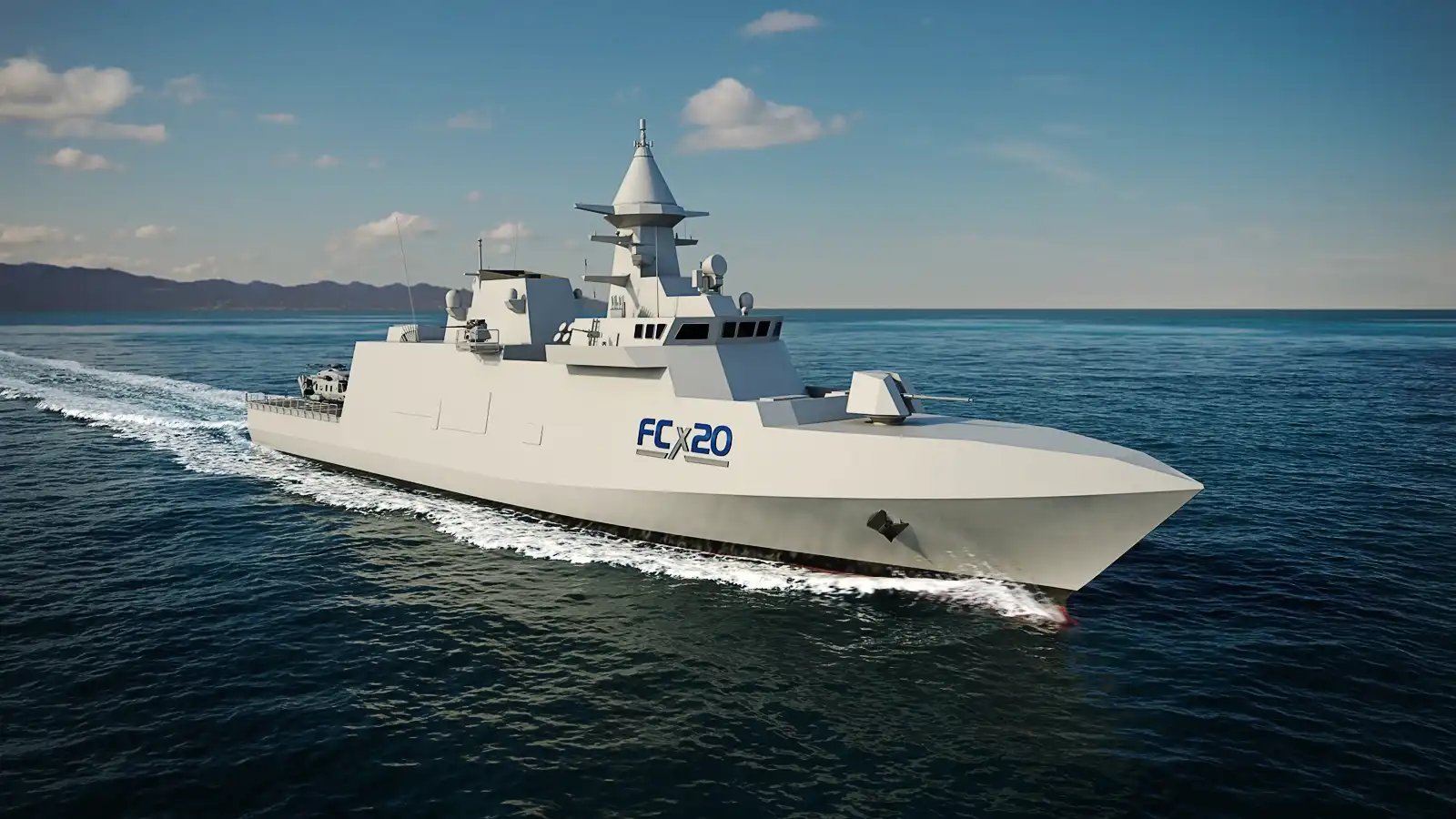
The FCX20 is the 95-meter member of Fincantieri’s scalable FCX family, positioned below the 107-meter, 3,200-tonne FCx30. Fincantieri’s published baseline gives a moulded breadth of 14.2 meters, a depth of 8.4 meters, and a displacement of approximately 2,300 tonnes. Propulsion is a combined diesel-electric and diesel (CODLAD) arrangement with two propulsion diesel engines, two electric propulsion motors, two reduction gears, and two controllable-pitch propellers, supplied by four diesel generator sets. Manufacturer data cite a maximum speed of 25 knots, a range of 3,500 nautical miles at 14 knots, 20 days of endurance, and a crew of 93.
The electric drive suits an Argentine mission set dominated by long, low-speed patrols of the South Atlantic exclusive economic zone (EEZ), where fuel economy and acoustic discretion at loiter speed matter more than sprint performance. The 3,500 nm range is, however, modest against the distances of that EEZ and the Antarctic support missions the Navy also conducts.
The brochure combat fit centers on a Leonardo Kronos-family multifunction radar, infrared search and track (IRST), radar and electro-optical fire control, RESM/CESM electronic support, and Link 11, Link 16, and JREAP data links, with Link 22 fitted for but not with (FFBNW). Armament in that configuration comprises MBDA VL-MICA vertical-launch surface-to-air missiles, Exocet anti-ship missiles, a 76 mm main gun, two secondary guns in the 25 to 30 mm class, two torpedo launchers, and decoy launchers. Whether Argentina’s “full configuration” mirrors this baseline has not been disclosed; neither the LoI nor Fincantieri’s statement specifies sensors, weapons, or a combat management system. The hull is not a paper design: the Italian Navy’s PPX OPVs of the Ugolino Vivaldi class, contracted in 2023, use an evolved FCX20 hull displacing about 2,400 tonnes.
Comandanti Patrol Ships and San Giorgio-Class Amphibious Transfers
The LoI reaches beyond new construction. According to the Argentine Ministry of Defense, it covers the possible transfer of four Comandanti-class patrol vessels now serving with the Italian Navy, and Italy has offered to add sensors, combat systems, and armament to bring them to corvette standard. The class, led by Comandante Cigala Fulgosi, displaces about 1,520 tonnes at full load on an 88.4-meter hull. A first unit could reach Argentina in 2027, although no transfer date has been confirmed.
Buenos Aires is also studying San Giorgio-class amphibious transport docks, referred to in the Argentine announcement as the Santi class, with San Giorgio and San Giusto named. Their flight deck, floodable well deck, and medical facilities would give Argentina a command platform and an amphibious and disaster relief capability. The number of ships under consideration has not been stated.
Fincantieri, represented at the signing by CEO Pierroberto Folgiero and Naval Vessels Division General Manager Eugenio Santagata, said it would support the program “throughout its different phases.” Folgiero said the agreement “confirms the strategic value of Italian shipbuilding as a driver of international cooperation.” The wider LoI also covers training, logistic support to Antarctic operations, cyber defense, and research. The ministry says the next step is identifying financing alternatives, with a possible government-to-government arrangement. No cost, delivery schedule, or construction site has been released.
Analysis: The package reads as a two-speed fleet recovery: second-hand Italian hulls to restore numbers quickly, and FCX20 new builds to anchor a longer-term shift from analog to digital combat systems. It also follows Fincantieri’s export pattern, in which transfers and ILS build a sustainment relationship ahead of new-build contracts. The binding constraint is financial. An LoI carries no funding commitment, and several announced Argentine naval programs have stalled at this stage. Component sourcing will matter too, given British export restrictions that have complicated past Argentine procurements.
The next milestones are a financing framework, a defined FCX20 combat configuration, and a decision on the Comandanti transfer, which is likely to come first. Neither government has said where the corvettes would be built or whether Argentine shipyards would take part. Funding lines in Argentina’s 2027 defense budget will be the first concrete test of the program.