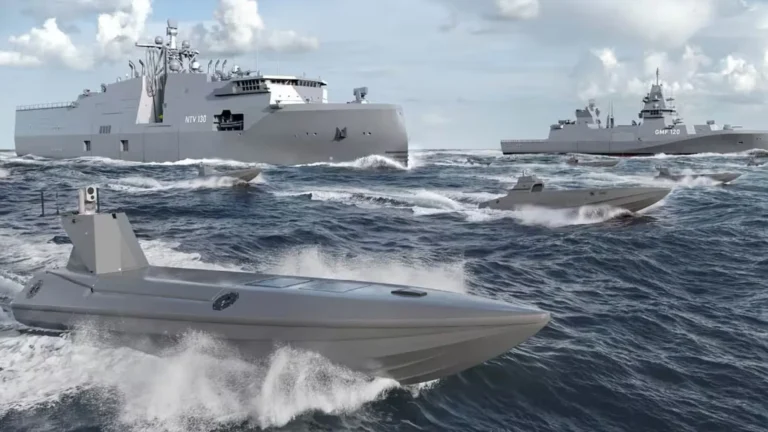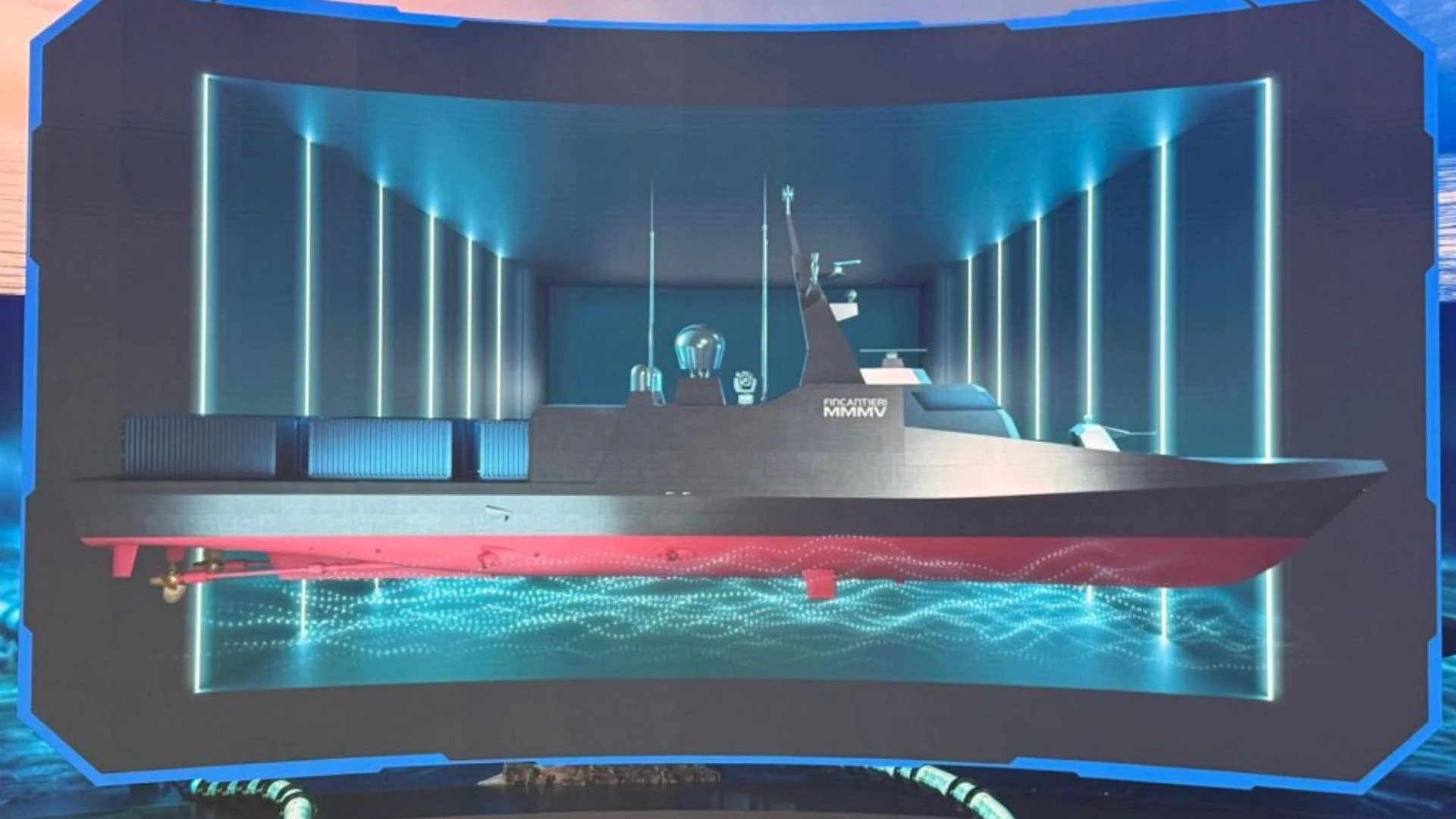
Fincantieri unveiled its Multi-Mission Modular Vessel (MMMV) at the Euronaval 2026 exhibition in Paris on November 5, 2026, presenting a 50-meter, 500-ton low-signature patrol ship that runs on a core crew of six and switches between six mission sets by swapping containerized payloads on a covered stern deck. The Italian shipbuilder describes the design as optionally remotely controlled, swarm-capable and prepared for future uncrewed operation.
The launch comes as European navies try to cover growing constabulary and seabed-security demands with fleets built around small numbers of expensive frigates. A string of Baltic Sea cable and pipeline incidents since the September 2022 Nord Stream sabotage led NATO to launch its Baltic Sentry activity in January 2025, while combat in the Black Sea has shown how cheap uncrewed systems can hold larger warships at risk. Eugenio Santagata, General Manager of Fincantieri’s Naval Vessels Division, said the “MMMV does not revolve around a mission. It is a ship that receives a mission.”
Fincantieri MMMV Design: Hull, Propulsion and Containerized Mission Deck
The MMMV measures 50 meters overall with an 8.8-meter beam, according to figures Fincantieri presented at the show. The low radar cross section (RCS) hull carries limited superstructure, and the company calls the ship software-designed, with an open architecture meant to absorb new mission systems across its service life.
Propulsion relies on an electric arrangement driving two shafts, two propellers and twin rudders, with stabilizing fins amidships. Fincantieri quotes a maximum speed of 23 knots, a range of 2,500 nautical miles at 14 knots and an endurance of seven to 10 days. Installed power and prime movers have not been disclosed. Those figures make the MMMV a regional asset for Exclusive Economic Zone (EEZ) and littoral patrol, not a blue-water escort.
Roughly half the ship’s length is a flat working deck that accepts up to six 20-foot ISO containers in three rows of two; the bays also take 10-foot modules. A retractable hangar with lateral openings closes over all six slots, reducing the ship’s radar signature and sheltering crews and equipment working on deck.
Forward, a light gun station mounts a Leonardo Lionfish 30 remote turret. Publicly available specifications indicate the Lionfish 30 is built around Leonardo’s electrically driven, ITAR-free X-Gun chambered for 30 x 173 mm ammunition, with the Italian Navy as launch customer and an airburst round in development for counter-drone use. The bridge is expected to use the Naval Cockpit integrated bridge concept already in Italian service and aboard Indonesia’s two Thaon di Revel-class multipurpose combat ships, KRI Brawijaya (320) and KRI Prabu Siliwangi (321). A main mast carries communications and satellite antennas, surveillance sensors and non-lethal effectors, though Fincantieri has not named the radar or electro-optical fit.
Six Mission Configurations From EEZ Patrol to Loitering Munition Strike
The MMMV has six named payload configurations:
- Interdictor: counter-trafficking with communications and radar intelligence, carrying uncrewed aerial vehicle (UAV) and rigid-hull inflatable boat (RHIB) launchers, containerized boat fuel, a radio intelligence suite and extra accommodation.
- Warden: EEZ protection, maritime domain awareness, counter-trafficking, search and rescue and signals intelligence (SIGINT).
- Gatekeeper: mine warfare, pairing an uncrewed aerial surveillance vehicle with either minelaying or mine countermeasures (MCM) payloads.
- Keeper: underwater protection and SIGINT, with a containerized UAV, an MCM suite and a SIGINT module.
- Vanguard: precision strike, combining a containerized UAV launcher with loitering munitions.
- Hunter: communications intelligence plus strike, with a UAV, loitering munitions, SIGINT equipment and additional berthing.
Gatekeeper could matter most for smaller fleets. A 500-ton hull carrying minelaying or MCM payloads in containers would give navies a baseline offensive and defensive mine warfare capability without a dedicated minelayer, although Santagata stressed that the MMMV will not replace conventional ships for advanced mine and submarine hunting. Accommodation modules in the Interdictor and Hunter fits also show that six people is only the core crew; mission specialists and UAV operators embark with the payload.
Several engineering parameters remain unpublished: total berthing capacity, container weight limits, power and data interfaces per bay, and the combat management system that ties the modules together. The company also cited artificial intelligence, cyber intelligence and quantum technology in the mission hub without specifying applications.
How the MMMV Compares With LCS and StanFlex Modularity
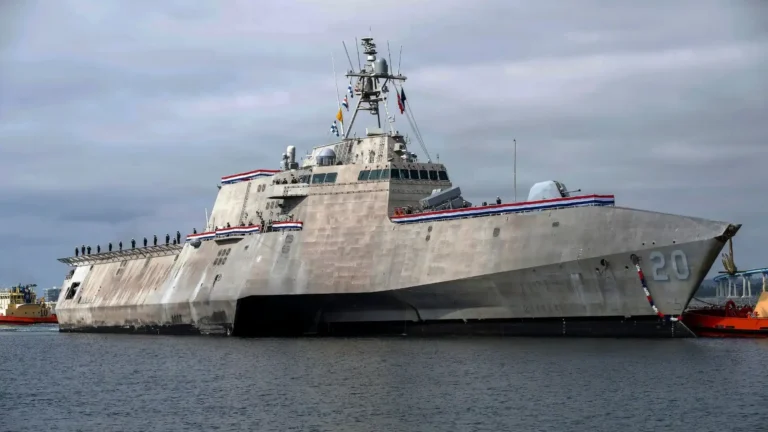
Containerized modularity is not new. The Royal Danish Navy has operated its StanFlex system since the late 1980s, and the US Navy built the Littoral Combat Ship (LCS) around swappable mission packages, an effort that suffered cost growth and integration delays before the service canceled the antisubmarine warfare package in 2022. The MMMV instead puts standard ISO containers on a far smaller hull aimed at constabulary and gray-zone tasks.
Fincantieri already sells configurable ships: the Thaon di Revel class comes in Light, Light Plus and Full fits. Santagata positioned the MMMV as a complement to frigates, corvettes and submarines, noting that the approach will not replace traditional designs and that advanced underwater surveillance, mine and submarine hunting and anti-ballistic missile capabilities will coexist with it. Chief executive Pierroberto Folgiero framed modularity as “not simply a design feature: it is a new paradigm.”
Analysis: The MMMV’s value will be decided by its payload ecosystem, not its hull. A 500-ton electric patrol ship sits well within Fincantieri’s industrial comfort zone; certifying six container families, integrating them with a common combat management system and keeping mission swaps to hours rather than weeks is where the LCS concept stalled. If Fincantieri delivers that integration, European NATO navies gain persistent, low-manning presence over cables, pipelines and EEZ chokepoints that frees frigates for high-end tasks, and export customers gain one hull that moves from constabulary patrol to mine warfare or drone strike.
Fincantieri is working on a prototype while defining the payload modules and testing them on existing platforms, according to information shared at the show. The company has named no launch customer, unit price or delivery schedule, beyond claiming short build times and competitive pricing. The next markers are a prototype hull in the water, a first Italian Navy requirement or export order, and disclosure of the sensor suite and combat management system tying the six configurations together.