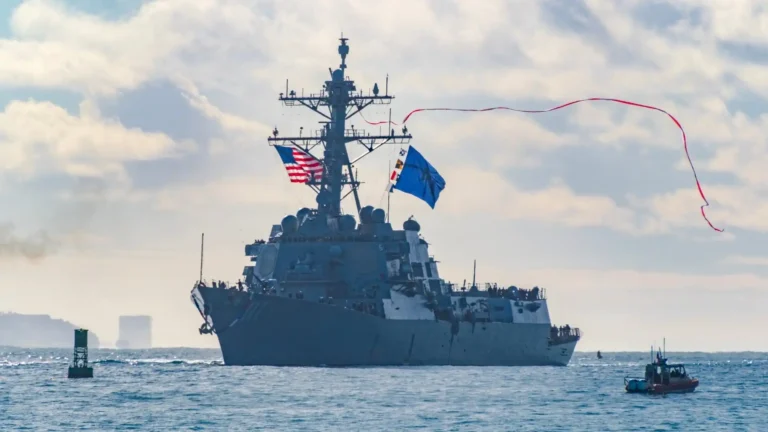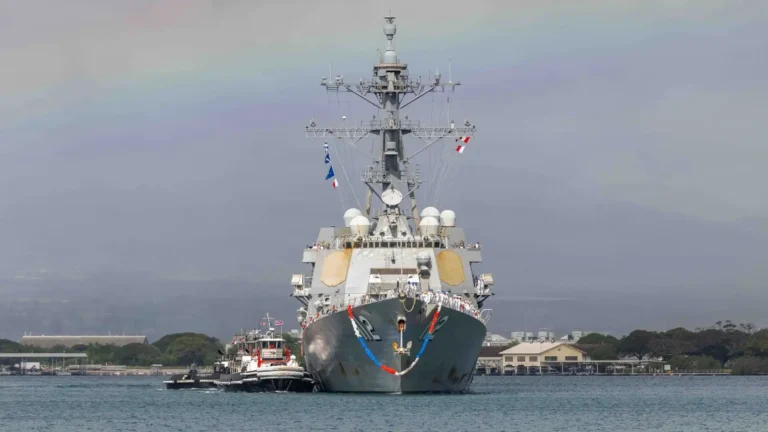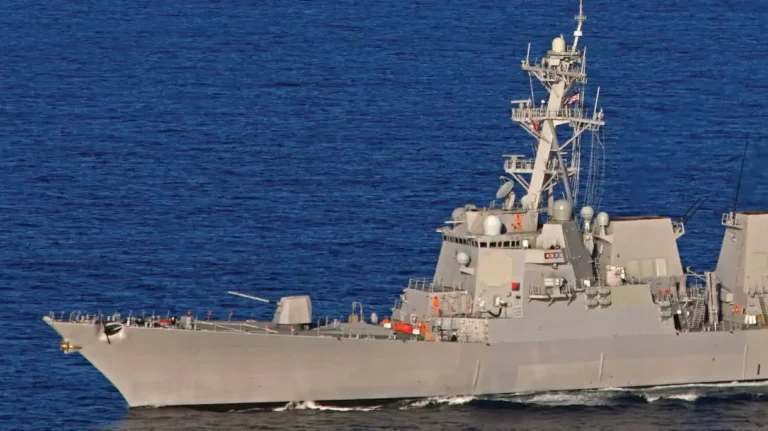
The Arleigh Burke-class guided-missile destroyer USS Bulkeley (DDG 84) took part in Mavi Balina 2026, a 12-nation anti-submarine warfare (ASW) exercise led by Türkiye in the Eastern Mediterranean from November 9 to 20, 2026. According to U.S. 6th Fleet, the Rota-based destroyer operated alongside the Turkish Navy, the Pakistan Navy and Standing NATO Maritime Group 2 (SNMG2) in the biennial drill, which is built around hunting and evading submarines.
Mavi Balina, Turkish for “Blue Whale,” is an invitation-only exercise hosted every two years by Turkish Naval Forces from Aksaz Naval Base near Marmaris. Turkish officials describe the 2026 iteration as the tenth. Bulkeley is one of five Forward-Deployed Naval Forces-Europe (FDNF-E) destroyers homeported at Naval Station Rota, Spain, and its participation places a US Aegis ship in one of the few allied events offering a large pool of real diesel-electric submarines.
Mavi Balina 2026: Twelve Nations and Eight Turkish Submarines
More than 4,500 personnel from 12 countries took part, according to Rear Adm. Ahmet İşçi, commander of the Turkish Submarine Fleet, who briefed observers aboard the frigate TCG Salihreis at Aksaz on November 13. The Turkish Naval Forces Command committed eight submarines, 11 warships, five helicopters, three maritime patrol aircraft, two unmanned aerial vehicles and one unmanned underwater vehicle, supported by three Coast Guard vessels. Spain contributed two warships through SNMG2, Greece sent one warship and Pakistan deployed one maritime patrol aircraft, while the single US warship took part independently of the NATO group, according to Turkish officials. Foreign observers and military attachés from several countries followed the exercise.
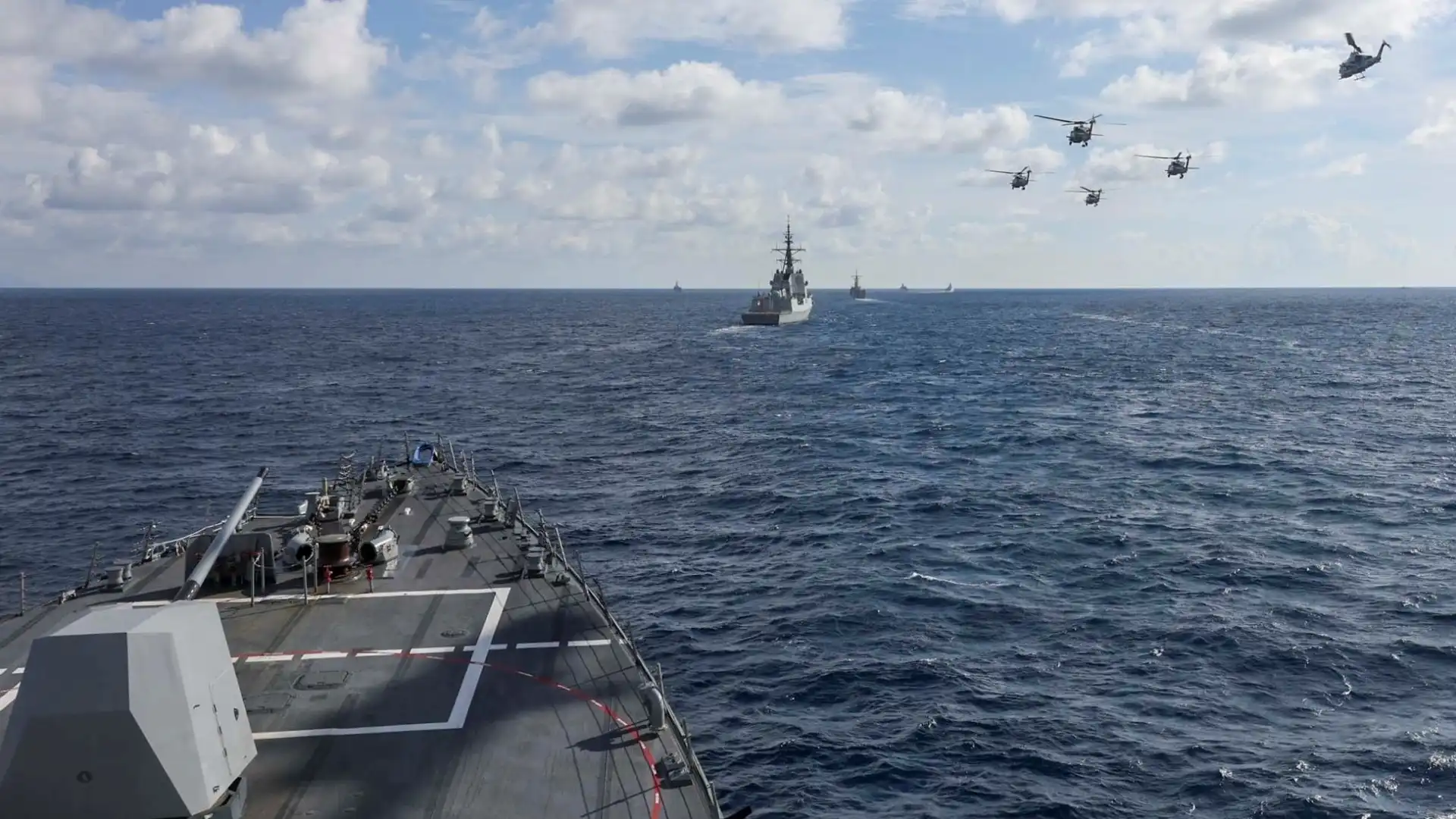
The scenario set centered on submarine and underwater attack operations, and on combined submarine and maritime air operations. According to the Navy, participants worked to refine doctrine, tactics, techniques and procedures and to improve interoperability between forces. On November 13, Turkish Navy SH-70 helicopters, the Turkish designation for the Sikorsky S-70B Seahawk, flew in formation past Bulkeley during a photo exercise. Neither side disclosed engagement outcomes or whether Bulkeley embarked a helicopter detachment.
İşçi said the Turkish fleet fields 13 active submarines, a force that combines legacy Type 209 boats with the new Reis-class, built on the German Type 214 design with air-independent propulsion. Türkiye also used the exercise to showcase two ASELSAN systems: the Deringöz autonomous underwater vehicle, rated to a 600-meter operating depth and up to 24 hours of endurance with an expandable battery, and the Kılıç kamikaze autonomous underwater vehicle, designed to detect, track and strike surface and subsurface targets.
What USS Bulkeley’s Flight IIA Suite Brings to Allied ASW
Commissioned on December 8, 2001, Bulkeley is a Flight IIA Arleigh Burke built around the Aegis combat system and the AN/SPY-1D radar. Publicly available specifications indicate a length of 155 meters, a full-load displacement of roughly 9,200 tonnes and four General Electric LM2500 gas turbines producing about 100,000 shaft horsepower for speeds above 30 knots. For ASW, the ship relies on the AN/SQQ-89 undersea warfare combat system integrating the bow-mounted AN/SQS-53C sonar, Mk 32 triple tubes for Mk 54 lightweight torpedoes, and vertically launched ASROC carried in its 96-cell Mk 41 Vertical Launching System.
The Flight IIA’s defining feature for this mission is its twin hangar, which allows the ship to operate two MH-60R Seahawk helicopters. Rota-based Helicopter Maritime Strike Squadron (HSM) 79 supports the FDNF-E destroyers. In an ASW screen, the helicopter’s dipping sonar and sonobuoys extend the search area well beyond hull sonar range, while the destroyer’s launchers provide a standoff attack option once contact is held.
Bulkeley’s recent tasking underlines the point. During its fifth FDNF-E patrol, which ended on June 1, 2026, the ship’s missions included NATO anti-submarine defense and ballistic missile defense, according to the Navy. “USS Bulkeley’s participation in Mavi Balina and other premier NATO evolutions showcases our readiness to integrate across the globe to deter adversary aggression and defend our shared interests,” said Cmdr. Michael Schelcher, the ship’s commanding officer. He added that operating with Turkish hosts and allied partners showed “we are stronger, more capable and far more lethal together.”
Analysis: Mavi Balina matters less for any single ship’s performance than for the conditions it offers. The Eastern Mediterranean is a demanding acoustic environment, with seasonal thermoclines, complex bathymetry and dense merchant traffic, and eight Turkish submarines provide a volume of quiet diesel-electric targets that few allied exercises can match. That is the threat profile 6th Fleet is most likely to meet in the region, where Russia has operated Project 636.3 Kilo-class boats armed with Kalibr cruise missiles. The presence of a Greek warship beside Turkish units, despite the two countries’ Aegean and Cyprus disputes, also shows that ASW remains an area where Alliance cooperation holds on the southern flank.
Bulkeley remains in the 6th Fleet area of operations, assigned to Commander, Task Force 65/Destroyer Squadron 60. The Navy has not disclosed the patrol’s remaining schedule. The next major allied ASW milestone is NATO’s annual Dynamic Manta exercise, typically held off Sicily in the first quarter, while the biennial cycle points to the next Mavi Balina in 2028. Turkish officials have not published the full list of the 12 participating nations.