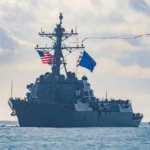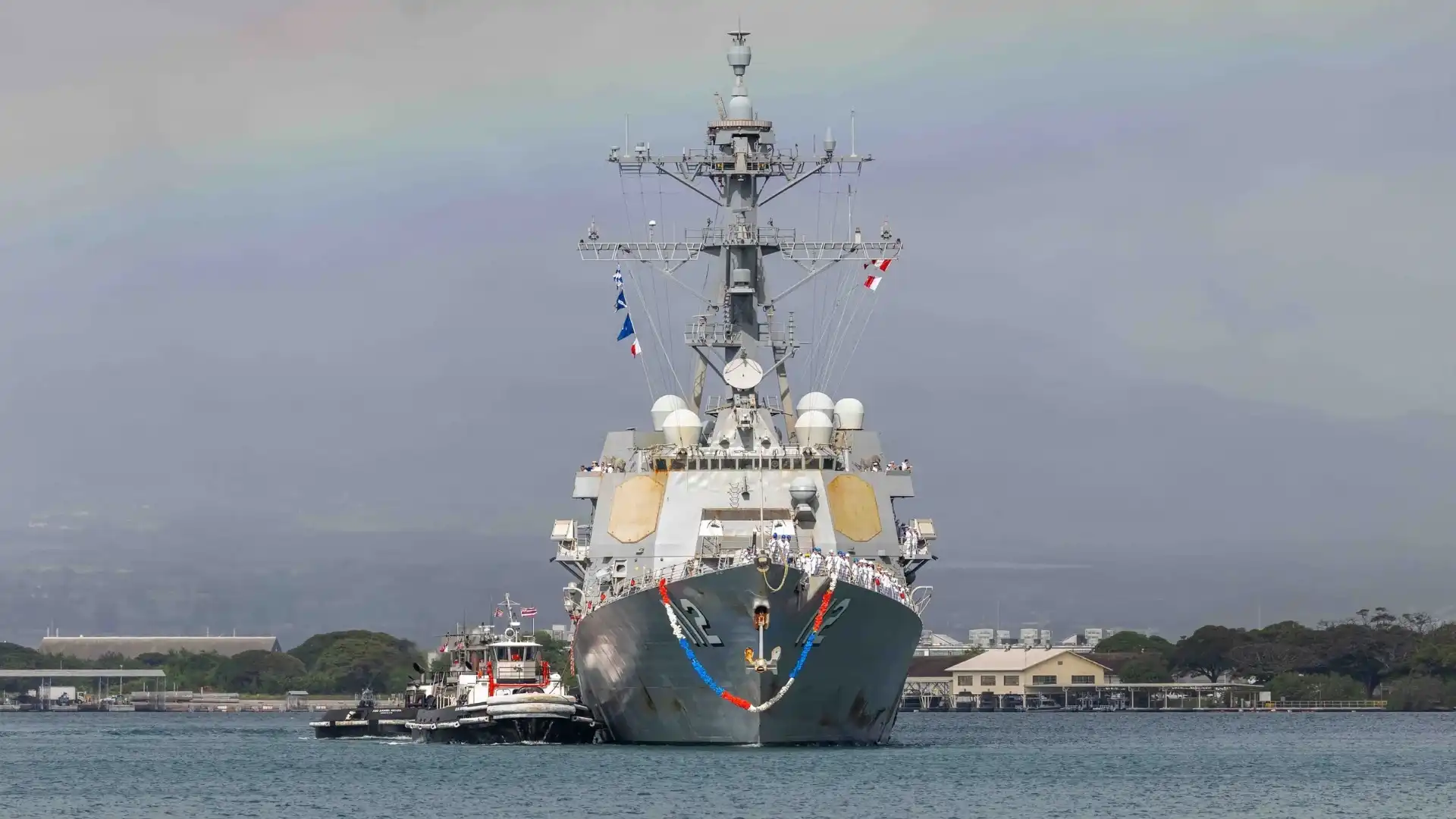
The Arleigh Burke-class guided-missile destroyer USS Michael Murphy (DDG 112) returned to its homeport of Joint Base Pearl Harbor-Hickam, Hawaii, on November 12, 2026, closing an 11-month deployment across the U.S. 3rd, 7th, and 5th Fleet areas of operations that included sustained combat during Operation Epic Fury. The Navy has awarded the ship and its crew the Presidential Unit Citation (PUC) and the Combat Action Ribbon (CAR) for Tomahawk strike missions and for defending against hostile drone and missile attacks, according to U.S. 3rd Fleet.
Michael Murphy departed Pearl Harbor on December 1, 2025, as part of Carrier Strike Group 3 (CSG-3) under Destroyer Squadron (DESRON) 21, sailing with the Nimitz-class aircraft carrier USS Abraham Lincoln (CVN 72), the destroyers USS Spruance (DDG 111) and USS Frank E. Petersen Jr. (DDG 121), and Carrier Air Wing (CVW) 9. The destroyer entered the U.S. Central Command (CENTCOM) area of responsibility in late January 2026, roughly one month before CENTCOM launched Operation Epic Fury against Iran on February 28. The Abraham Lincoln strike group left the Middle East in late August and returned to San Diego on October 8 after 321 days, but Michael Murphy remained in theater under Task Force 50 (TF-50) alongside the staffs, ships, and aircraft of CSG-10 and CSG-5, stretching its own deployment to 346 days.
USS Michael Murphy Combat Record in Operation Epic Fury
The Navy credits Michael Murphy with dozens of Tomahawk Land Attack Missile (TLAM) strikes during the campaign, without disclosing the exact number of rounds fired. CENTCOM separately confirmed that the destroyer launched Tomahawks during self-defense strikes against targets in Iran on June 10, 2026, months after the opening phase of the operation.
The ship’s second core mission was enforcement of what the Navy describes as the first naval blockade in 60 years. Washington announced the blockade of Iranian ports on April 12 after negotiations with Tehran collapsed, and enforcement began the following day. Michael Murphy operated in the North Arabian Sea, the Gulf of Oman, and the Strait of Hormuz, serving as Surface Action Group (SAG) Commander for TF-50.
In that role, the destroyer commanded and coordinated the defense of 14 U.S. and coalition vessels, including destroyers, Littoral Combat Ships (LCS), six U.S. Coast Guard Fast Response Cutters, and fleet replenishment oilers. It completed 12 contested transits of the Strait of Hormuz under threat of surface, air, and mine attack, escorting four merchant tankers through the chokepoint.
“Whether defeating incoming air and surface threats or leading operations through contested choke points, this crew never hesitated,” said Cmdr. David Nicolas, the ship’s commanding officer.
Flight IIA Endurance: 97,000 Nautical Miles at Sea
Commissioned in New York City on October 6, 2012, and homeported at Pearl Harbor, Michael Murphy is a Flight IIA destroyer built by General Dynamics Bath Iron Works and was the last DDG 51 delivered before the Navy restarted production of the class. Publicly available specifications indicate a length of 509 feet, four General Electric LM2500 gas turbines, a 96-cell Mk 41 Vertical Launching System (VLS) able to carry Tomahawk and Standard Missile family interceptors, a 5-inch Mk 45 gun, and hangars for two MH-60R Seahawk helicopters.
The deployment tested that architecture’s endurance. The ship steamed more than 97,000 nautical miles, conducted 43 replenishments-at-sea and eight combat in-port refuelings, transferring more than 8 million gallons of F-76 marine diesel and 2 million gallons of JP-5 jet fuel. It also received 1,100 pallets of food, stores, repair parts, and mail under combat conditions.
HSM-71 Detachment 2 flew 330 sorties and more than 900 mishap-free flight hours, including 273.4 combat flight hours. Before reaching CENTCOM, the destroyer conducted surface and anti-submarine warfare (ASW) operations in the South China Sea and Philippine Sea while assigned to 7th Fleet.
Analysis: Michael Murphy’s deployment shows how much of Epic Fury rested on the Arleigh Burke fleet. A single Flight IIA hull delivered long-range land attack, air and missile defense, escort of merchant shipping, and tactical command of a 14-ship surface group, often in the same operating area. The cost was time: the destroyer returned home roughly five weeks after its own carrier, keeping a Pacific Fleet combatant away from the Indo-Pacific for most of 2026. Every TLAM fired must also be replaced from a limited inventory, and Mk 41 VLS cells are still normally reloaded pierside despite at-sea reload demonstrations since 2024, a constraint that shaped how long large surface combatants could remain on station.
The Navy has not released Michael Murphy’s post-deployment maintenance schedule, the total number of Tomahawks it expended, or which unit will take over its TF-50 role. Those details, together with the condition of the hull and combat systems after 346 days of high-tempo operations, will determine when the destroyer is ready to deploy again.