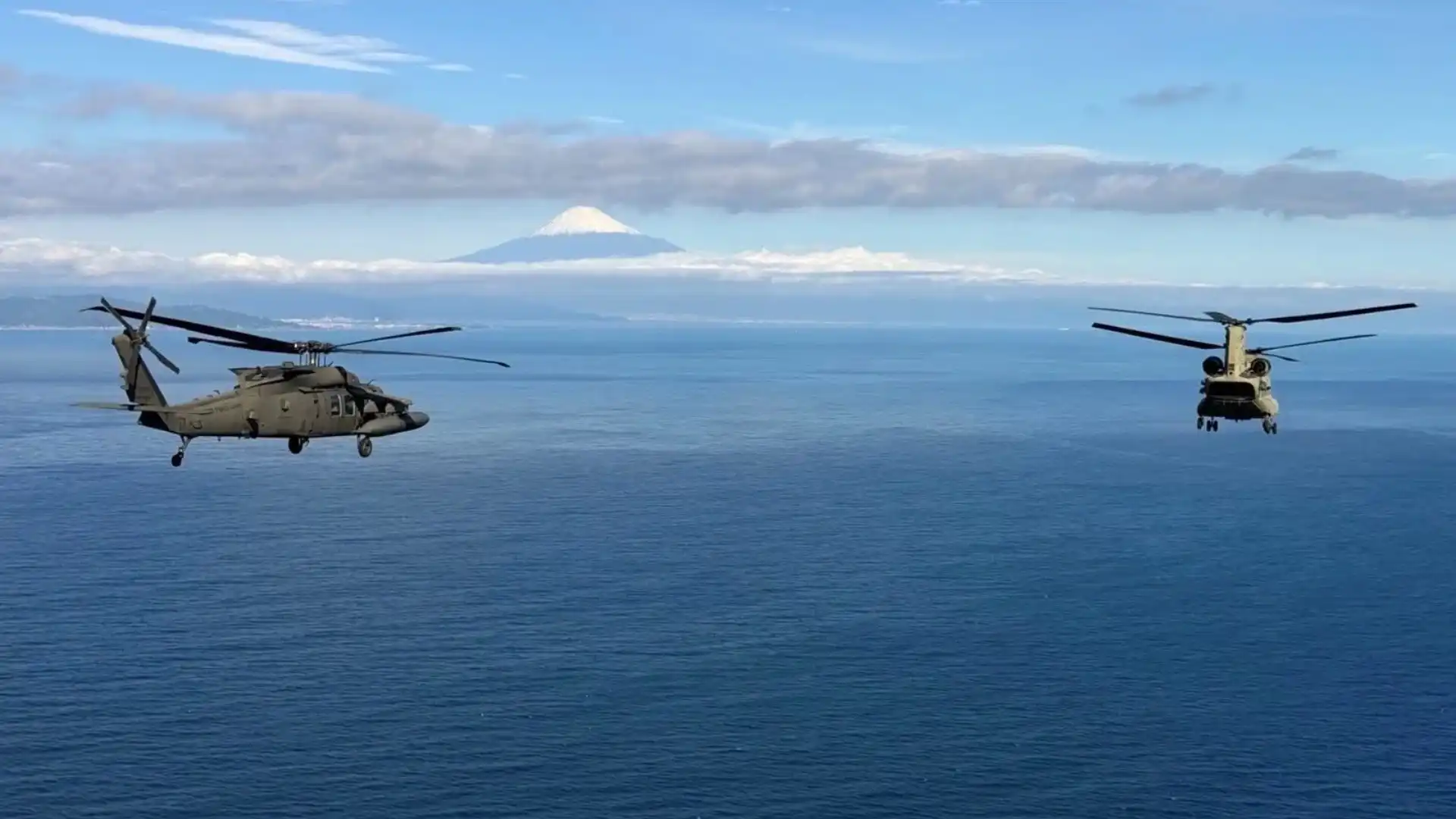
The U.S. Army’s 2nd Combat Aviation Brigade (2CAB) deployed AH-64E Apaches, UH-60 Black Hawks and CH-47 Chinooks from South Korea to Japan’s Camp Fuji for live-fire aerial gunnery, the division announced November 23, 2026. The brigade belongs to the 2nd Infantry Division/ROK-U.S. Combined Division, and the range is formally known as Combined Arms Training Center (CATC) Camp Fuji. The division billed the event as a historic first, without specifying whether that applies to the brigade or to Army rotary-wing gunnery at the range.
The deployment exercises a brigade whose primary mission is the combined defense of the Republic of Korea from a Japanese range. It caps a busy year for the unit: Apache crews completed aerial gunnery qualification on the peninsula in January, and on March 12 the brigade flew more than 1,300 miles across the Korean Peninsula during the Talon Reach culminating exercise before executing an attack and air assault mission. Col. Joshua T. Christy took command of 2CAB on June 17, 2026.
Camp Fuji Aerial Gunnery: Weapons and Roles of the 2CAB Fleet
The Army has not released the training dates, the number of aircraft involved, the battalions deployed or the munitions expended. The aircraft mix nonetheless points to a brigade-wide gunnery event rather than an attack-only qualification. Within 2CAB, the Apaches belong to the 4th Battalion, 2nd Aviation Regiment (4-2 Attack Battalion), while Black Hawks and Chinooks are fielded by the 2-2 Assault Helicopter Battalion and the 3-2 General Support Aviation Battalion.
Publicly available specifications indicate the AH-64E Apache Guardian carries an M230 30mm chain gun with up to 1,200 rounds, plus 2.75-inch Hydra 70 rockets and AGM-114 Hellfire or AGM-179 Joint Air-to-Ground Missile (JAGM) on its stub wings. Targets are acquired through the Modernized Target Acquisition and Designation Sight and, on Longbow-equipped aircraft, the AN/APG-78 fire control radar. Two General Electric T700-GE-701D turboshafts power the airframe. Whether missile shots were authorized at Fuji has not been disclosed.
For Black Hawk and Chinook crews, aerial gunnery centers on door- and ramp-mounted M240H 7.62mm machine guns. It is a semiannual requirement that progresses from academic and simulator tables to live engagements against ground targets, demanding tight coordination between pilots and crew chiefs. That proficiency underpins suppressive fire during air assault and personnel recovery, missions the brigade rehearsed during Talon Reach.
CATC Camp Fuji, in Shizuoka Prefecture, is a U.S. Marine Corps installation that schedules the Fuji Maneuver Area: roughly 34,000 acres split between the 12,000-acre North Fuji Maneuver Area and the 22,000-acre East Fuji Maneuver Area, shared with the Japan Ground Self-Defense Force (JGSDF).
From Korea to Japan: Testing 2CAB Expeditionary Reach
Moving a gunnery event offshore tests more than marksmanship. The brigade had to move aircraft, maintainers, ammunition and fuel across a national border and clear live munitions with Japanese authorities and Marine Corps range managers. The Army has not said whether the helicopters self-deployed or moved by strategic lift. The straight-line distance between Camp Humphreys and Camp Fuji is roughly 1,100 kilometers, much of it over water. During Talon Reach, the brigade relied on seven forward arming and refueling points, the kind of sustainment architecture an overwater transit would also require.
Camp Fuji is hosting a widening set of Army live fires. On October 28, 2026, Soldiers of the 1st Battalion, 17th Field Artillery Regiment fired High Mobility Artillery Rocket System (HIMARS) rockets at the range with Japan Self-Defense Force observers present. On October 20, Marines from Battalion Landing Team 1/1, 31st Marine Expeditionary Unit, employed the Neros Archer first-person-view strike drone there for the first time. U.S. Army Apaches have fired at Camp Fuji before, including during Orient Shield 2017, but this deployment brings 2CAB’s attack, assault and cargo helicopters to the complex together. The division’s announcement did not mention JGSDF participation in the aviation event.
Analysis: An Apache gunnery table has limited training value on its own; 2CAB already qualifies its crews at home. The operational significance lies in scale. Apaches from 2CAB’s 4th Battalion, 2nd Aviation Regiment already trained at Camp Akeno, Japan, during Orient Shield 24 in July 2024, including preparations for a live-fire exercise. Camp Fuji extends that to attack, assault and cargo helicopters together, with the logistics and host-nation approvals that requires. The Army’s permanent rotary-wing presence in Japan is limited to the UH-60L-equipped Aviation Battalion Japan at Camp Zama, which leaves 2CAB as the closest U.S. Army attack helicopter formation to the archipelago. Exercising that reach at brigade scale in peacetime makes a regional reinforcement option more credible.
Key unknowns remain: whether the Fuji deployment becomes a recurring rotation, whether future iterations integrate JGSDF AH-64DJP Apache crews or Marine aviation into combined fires, and whether 2CAB will rehearse a full overwater self-deployment to Japan. Official after-action details and imagery should clarify the scale of the event in the coming days.