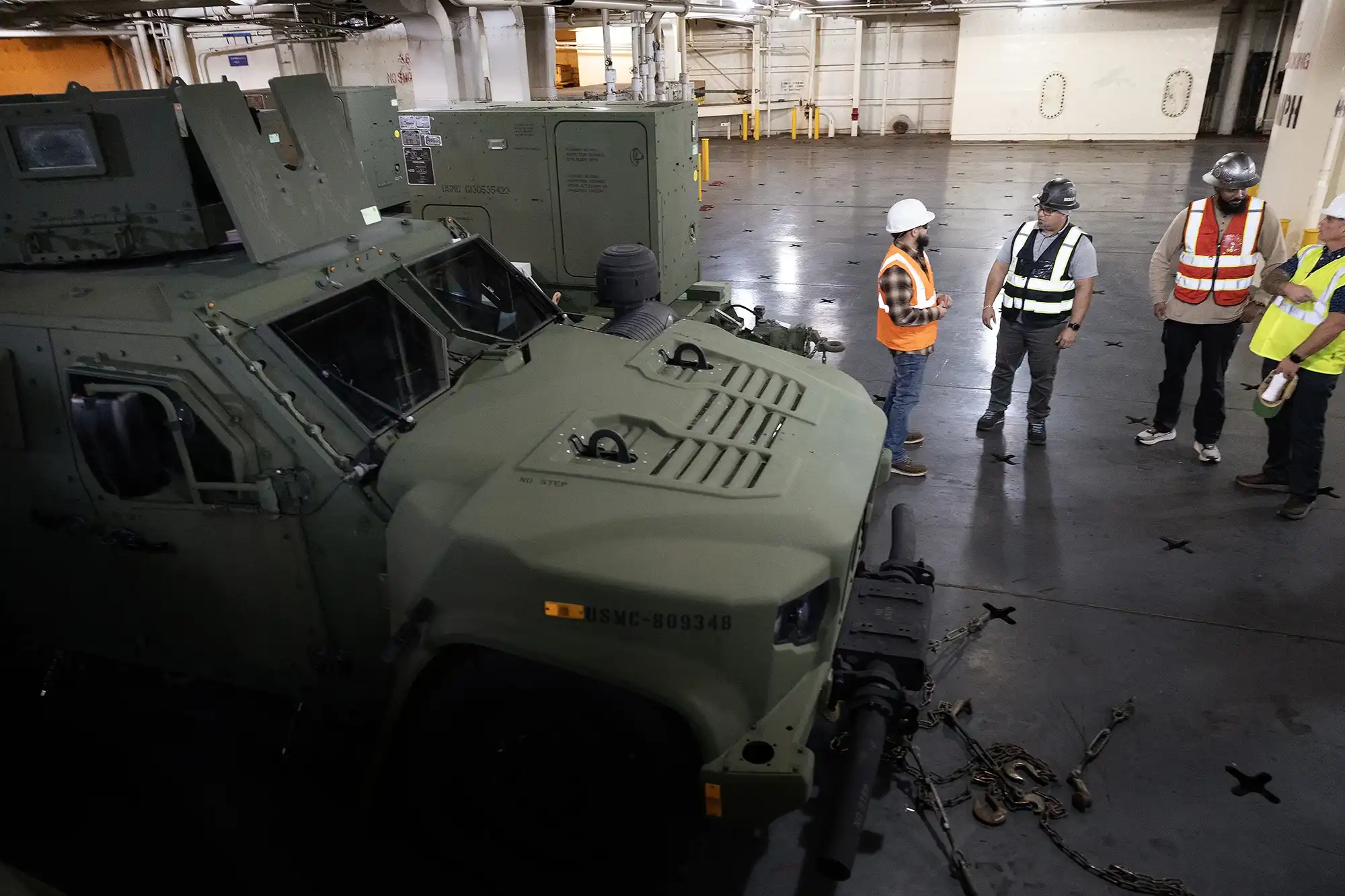
Blount Island Command (BICmd) plans to nearly double its output of Joint Light Tactical Vehicles (JLTV) over the next year, preparing hundreds of the vehicles for issue at Marine Corps Support Facility Blount Island in Jacksonville, Florida, as the US Marine Corps continues to replace its Humvee fleet. According to a Marine Corps announcement, the command hosted specialists from the Marine Corps motor transportation program office for a three-day assessment beginning November 17, 2026, focused on repair priorities, workforce training, and loading requirements for the Maritime Prepositioning Force (MPF).
The ramp-up comes at a sensitive moment for the program. The Army, which manages the joint JLTV effort, announced in May 2025 that it would end its own procurement of the vehicle, leaving the Marine Corps as the principal US buyer. The Corps intends to replace its entire Humvee fleet with JLTVs and has fielded about half of its JLTV requirement, according to the Congressional Research Service. On May 27, 2026, it issued a request for information on a potential second supplier alongside AM General, which won the follow-on production contract on February 9, 2023.
Blount Island JLTV Workload and the Maritime Prepositioning Force
BICmd, which reports to Marine Corps Logistics Command, maintains, prepares, and distributes equipment for positioning aboard ships and at sites ashore across the Corps’ global prepositioning network. Placing equipment closer to likely operating areas reduces what deploying units must move from the United States. Afloat, the network relies on Military Sealift Command (MSC) ships organized in Maritime Prepositioning Ships squadrons operating from Diego Garcia in the Indian Ocean and the Guam and Saipan area in the Western Pacific.
Prepositioning poses a different sustainment problem than direct fielding. “Everywhere else we go, equipment is getting fielded quickly to a unit,” said Jamie Tracy, product support manager for the motor transportation program office. “Here it’s going on a ship for several years or whatever the requirement may be.” Under the long-standing Maritime Prepositioning Force maintenance cycle, each prepositioning ship returns to Blount Island roughly every 36 months for a full offload.
The specialists reviewed preparations to load vehicles next year aboard MPF ships. Aboard USNS Dahl (T-AKR 312), berthed at the installation’s slipway, maintenance personnel walked the team through tie-down procedures and storage conditions. US Navy and MSC fact sheets describe Dahl as a 950-foot Watson-class large, medium-speed roll-on/roll-off ship with roughly 393,000 square feet of cargo space. MSC says its MPF ships carry equipment to sustain a Marine Air-Ground Task Force for up to 30 days.
“When we load a JLTV onto a ship, it needs to be ready for the mission,” said Davida Beck-Cameron, the command’s materiel production department director, who is coordinating technical support to strengthen the workforce’s troubleshooting and repair skills.
Repair Triage, Component Reuse, and Tire Data for Long Storage
Inside a maintenance warehouse, contracted senior logistics analyst Frank Marnell checked electrical connections and coolant hoses and helped crews interpret updated schematics. “We’re going through everything with the maintenance contractors on Blount Island to identify faults and come up with a maintenance plan that prioritizes repairs,” Marnell said. Some vehicles need extensive troubleshooting; others may need only a system update. Marnell, who began training Marines on JLTVs in 2019, is compiling recommendations for over-the-shoulder instruction to help maintainers keep pace with changing technical guidance. Tracy discussed a train-the-trainer approach with Chris Lewis, logistics lead for light tactical vehicles, to preserve that knowledge across the workforce.
The team also identified more than 50 armored windows for potential reuse on JLTVs and Medium Tactical Vehicle Replacement (MTVR) trucks to meet Marine expeditionary force requirements. Tracy reviewed parts that Marine Depot Maintenance Command could use to modify MTVRs, a redistribution that could free staging space for other equipment.
Anthony Reese, Michelin’s senior technical manager for government and defense, examined tires and gathered maintainer observations. His recommendations to the Marine Corps and Michelin will include how future tire designs could account for extended shipboard positioning.
Analysis: The JLTV entered service under a model in which vehicles move quickly to units that drive and maintain them continuously. Prepositioning inverts that model: vehicles sit for years in a ship’s hold and must work on arrival. For a vehicle whose fixes can range from deep troubleshooting to a system update, documentation becomes as important as repair capacity, hence Beck-Cameron’s emphasis on knowing “what needs repair, what work was done and how it was checked.” With Army procurement ended and the Corps exploring a second supplier, each prepositioned JLTV is a scarce asset. One that needs extensive work after offload erodes the speed advantage the MPF exists to provide.
The program office’s findings will guide sustainment support for Blount Island’s growing JLTV workload, with MPF loading scheduled for next year. Several details remain undisclosed: the baseline output against which “nearly double” is measured, the number of JLTVs earmarked for prepositioning, which squadrons will receive them, and which variants will be loaded. “We want to help Blount Island Command resolve problems, create sustainment training and implement an enduring sustainment plan,” Tracy said.