U.S. Special Operations Command (USSOCOM) has awarded The Boeing Co. a $197,279,932 firm-fixed-price order modification for the procurement of MH-47G rotary wing aircraft, according to Pentagon contract announcements published November 23, 2026. The action modifies order H9224126FE001 under basic ordering agreement W91215-16-G-0001. The full amount, drawn from fiscal 2027 Defense-wide procurement and Army aircraft procurement funds, was obligated at the time of award. Work will be performed at Boeing’s Ridley Park, Pennsylvania, rotorcraft plant and is expected to be completed by September 2031. USSOCOM, at MacDill Air Force Base, Florida, is the contracting authority.
The award follows by one year a $271.7 million USSOCOM delivery order issued November 20, 2025, which Boeing said covers five MH-47G aircraft; the Pentagon first announced that order at $877.7 million before correcting the figure the next day. The new action draws on the budget year that opened October 1, 2026. Both orders fund MH-47G procurement for the heavy-lift fleet flown by the 160th Special Operations Aviation Regiment (Airborne), the Night Stalkers. The U.S. Army Special Operations Aviation Command (USASOAC) has a stated requirement of 69 Block II aircraft to replace its legacy MH-47G fleet.
MH-47G Block II Recapitalization and the Contract Trail Since 2018
The Block II effort began with a $27 million engineering task order in July 2017 to prepare MH-47G Block II manufacturing, followed by a July 2018 order for the first four aircraft, valued by Boeing at $139.8 million, and a $194 million order for seven more in June 2019. Boeing delivered the first MH-47G Block II at Ridley Park in September 2020. Subsequent awards included $271 million for six remanufactured aircraft in December 2023, four aircraft ordered in 2024, among them a $115 million contract for two, and $240 million for five remanufactured aircraft in March 2025, with deliveries starting in 2027. That last award brought the Block II total under contract to 51, according to Boeing, which projected completion of the entire USASOAC fleet in early 2030.
The November 23 notice does not specify a quantity, nor whether the order covers new-build or remanufactured airframes. At the per-aircraft values implied by the December 2023, March 2025 and November 2025 awards, roughly $45 million to $54 million, the sum would be consistent with three to four aircraft. That is an estimate, not a contract figure. Separately, USSOCOM awarded Boeing a $55.4 million order in September 2026 to supply the Active Parallel Actuator System (APAS), a flight-control augmentation system developed with BAE Systems, and related parts for the MH-47G fleet, with work running to August 2033.
Block II Airframe, Fuel System, and Special Operations Mission Kit
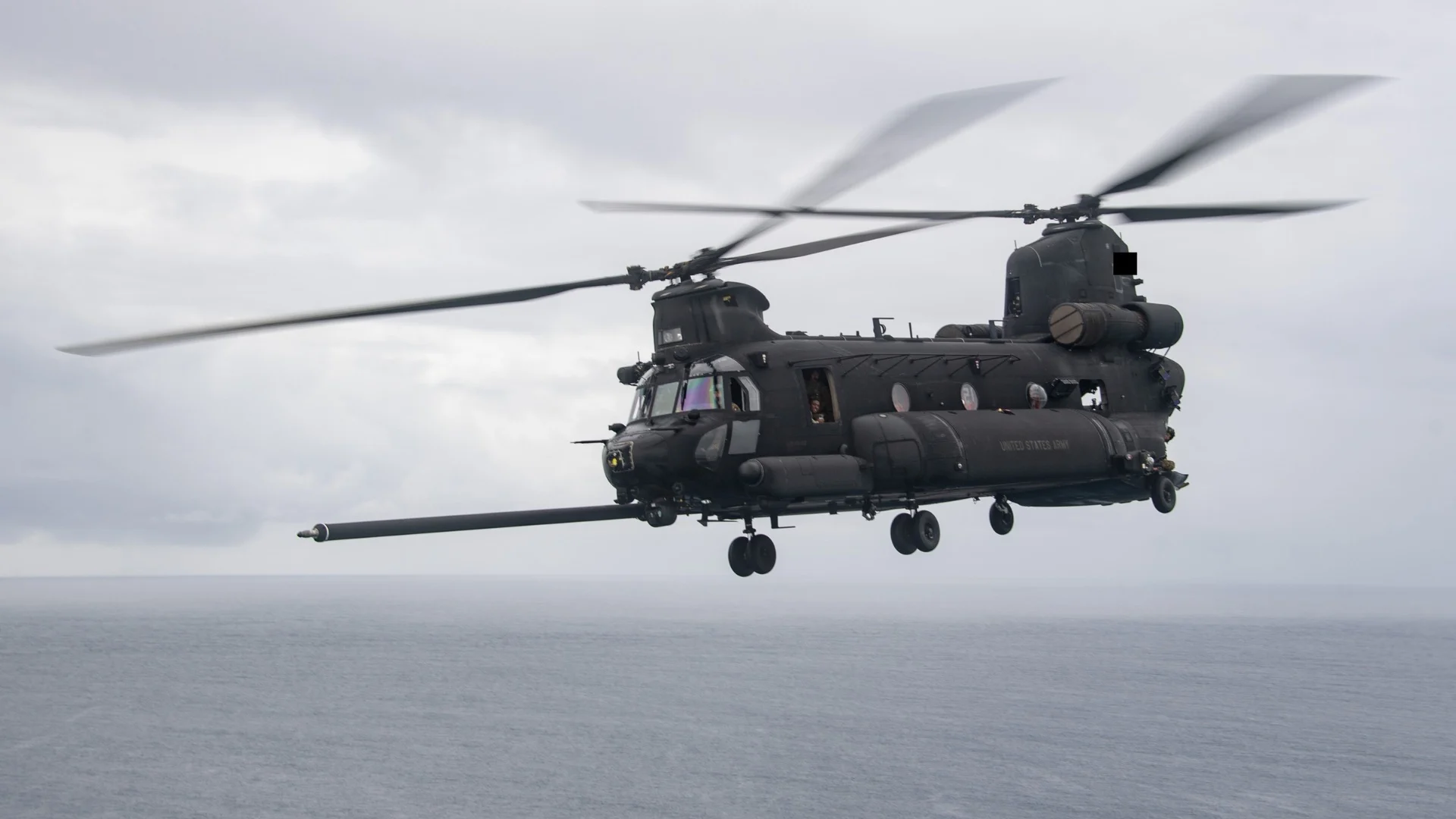
The MH-47G Block II is a derivative of the CH-47F Block II Chinook, adapted for long-range special operations infiltration, exfiltration, and resupply. Boeing cites a reinforced airframe, redesigned fuel tanks, and updated avionics as the core changes, along with a simplified fuel system and rotor blade modifications intended to reduce unscheduled maintenance. Publicly available specifications indicate a maximum gross weight of 54,000 pounds and two Honeywell T55-GA-714A turboshaft engines. The special operations configuration adds an aerial refueling probe and a multimode radar supporting terrain-following flight at low altitude in poor weather.
The fleet is operated by the 2nd, 3rd and 4th Battalions of the 160th SOAR, based respectively at Fort Campbell, Kentucky, Hunter Army Airfield, Georgia, and Joint Base Lewis-McChord, Washington. For these units, Boeing says the Block II structural and weight-reduction changes extend the aircraft’s lift and range.
Analysis: The split funding line reflects how the program is financed: Army aircraft procurement covers the service-common Chinook baseline, while Defense-wide procurement under USSOCOM pays for special operations-peculiar equipment. Obligating fiscal 2027 money in full at award, with work running to September 2031, gives Boeing a firm production horizon at Ridley Park beyond the early 2030 fleet completion date the company had projected. The gap between those dates suggests either additional airframes beyond the earlier plan or a longer delivery schedule, although the notice does not say which.
Key unknowns remain the aircraft quantity, the mix of new-build and remanufactured airframes, and the delivery schedule tied to this modification. A Boeing or USSOCOM statement confirming the count would show how close the program stands to its 69-aircraft requirement and whether the early 2030 fleet target holds.