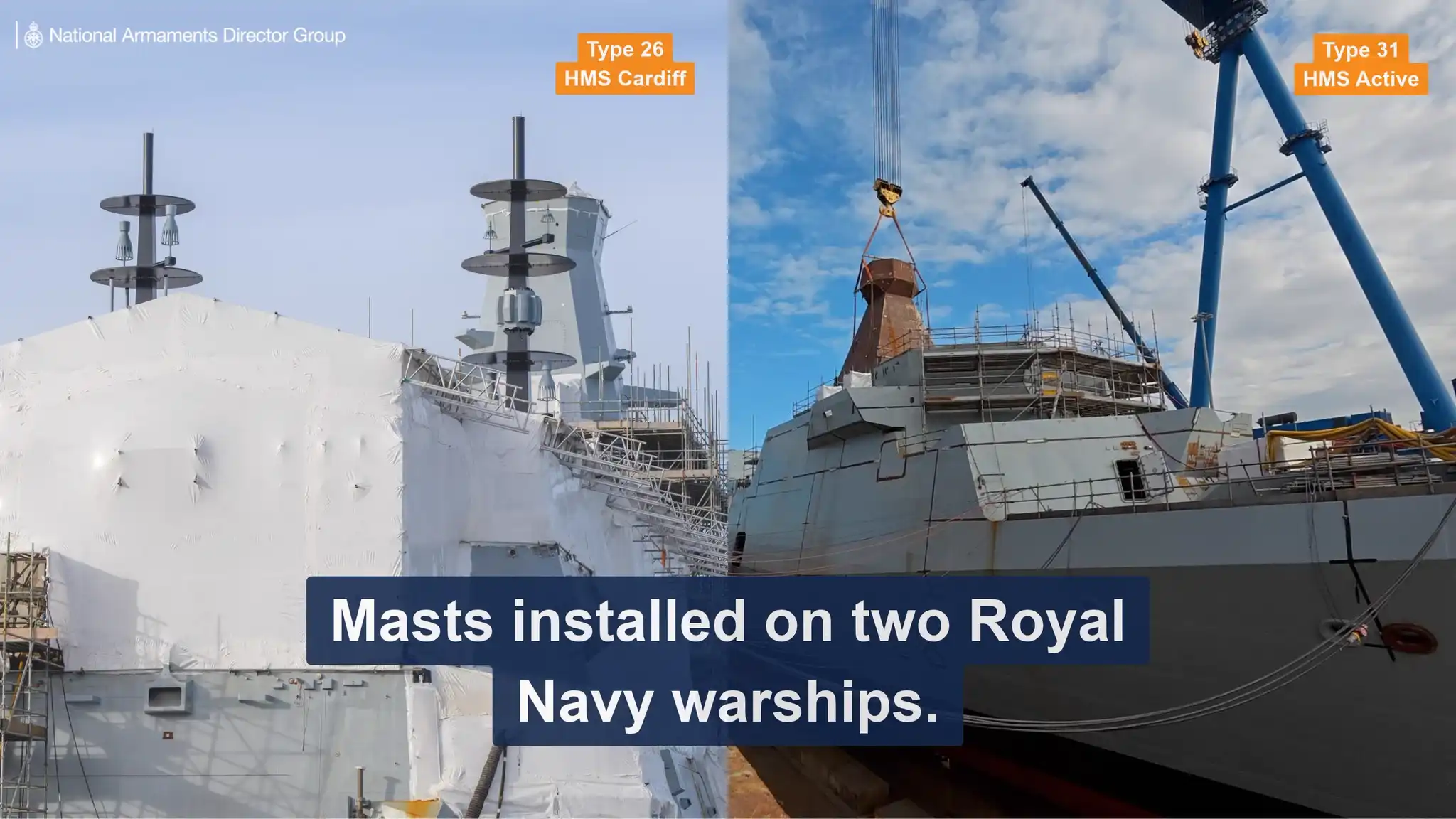
Two Royal Navy frigates building in Scotland have passed parallel topside milestones. The National Armaments Director Group (NADG) confirmed on November 23, 2026, that HMS Cardiff, the second Type 26 City-class anti-submarine frigate, has had her twin pole masts fitted in dry dock at BAE Systems’ Scotstoun yard on the Clyde, the first time a Type 26 has reached this stage in dock. At Rosyth, Babcock International has installed the forward and mid masts on HMS Active, the second of five Type 31 Inspiration-class general-purpose frigates.
The retirement of HMS Iron Duke and HMS Richmond, announced on July 13, 2026, left the Royal Navy with five active Type 23 frigates, and the eight Type 26 and five Type 31 hulls on order are the only route back to a 13-ship frigate force. Neither class has entered service. Lead ship HMS Glasgow is expected to begin contractor sea trials around the turn of the year after slipping from early 2026. The Ministry of Defence told Parliament in June 2026 that the lead Type 31, HMS Venturer, would be handed over by the end of the decade, but its August 2026 answer gave no date and said the program schedule was under continual review.
Royal Navy Frigates on the Clyde: HMS Cardiff Gets Communications Masts
Cardiff’s two 17-meter pole masts stand above the ship’s mission bay and carry her secure communications. Designed and manufactured by STS Defence, the port mast hosts 4G connectivity, ship-to-shore satellite communications, and a Global Positioning System (GPS) link, while the starboard mast carries Ultra High Frequency (UHF) and Very High Frequency (VHF) radio. Each mast provides 360-degree coverage and the frequency isolation needed to stop the frigate’s own emitters degrading its links.
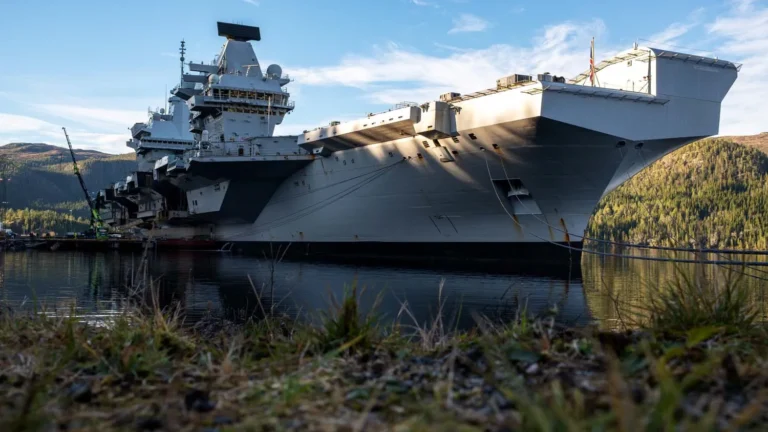
The pole masts complement the central composite mast supplied by Umoe Mandal in Norway, installed in September 2023; publicly available specifications place the Type 997 Artisan 3D radar atop it. With all three in place, Cardiff now presents her final profile. NADG’s Type 26 lead, Pat Browning, said the in-dock installation shows government and industry applying lessons learned on the program. Cardiff left her heavy-lift barge at Glen Mallan in September 2024 and was floated up in Scotstoun’s dry dock two in April 2026, where she will stay afloat for the rest of fitting out.
Publicly available specifications give the Type 26 a displacement of 6,900 tonnes, about 8,000 tonnes at full load, and a length of 149.9 meters. Its combined diesel-electric or gas (CODLOG) plant pairs a Rolls-Royce MT30 gas turbine with four MTU diesel generators, allowing quiet electric running when hunting submarines. Sensors center on the Sonar 2087 towed array and Type 2150 bow sonar, backed by 48 Sea Ceptor cells, a 24-cell Mk 41 strike-length Vertical Launching System (VLS), and a 5-inch Mk 45 gun. For an anti-submarine warfare (ASW) escort working with patrol aircraft and carrier groups, resilient communications are a core capability.
HMS Active Masts Mark Type 31 Structural Assembly at Rosyth
Babcock lifted Active’s forward and mid masts, with a combined weight of 48 tonnes, into place using Rosyth’s 68-meter Goliath crane. The company said the ship is moving through the final stages of structural assembly, with outfitting continuing in parallel. Babcock builds Type 31 modules indoors in the Venturer Hall and installs the tallest components at the outdoor crane, a sequence that frees hall space for follow-on hulls and limits weather exposure.
Active’s first steel was cut in January 2023 and her keel laid in September 2023. She rolled out of the Venturer Hall on February 25, 2026, the same day steel was cut for the fourth ship, HMS Bulldog, and entered the water in March in the first float-off conducted entirely at Rosyth.
Derived from Babcock’s Arrowhead 140 design, the Type 31 displaces about 5,700 tonnes. Publicly available specifications list a Thales TACTICOS combat management system, a Thales NS110 radar, a 57 mm Mk 110 main gun, two 40 mm Mk 4 guns, and 12 Sea Ceptor cells, with a flight deck and hangar for a Wildcat or Merlin helicopter. The Ministry of Defence intends to fit the class with the Mk 41 VLS, and Babcock holds a Capability Insertion Period contract covering all five ships.
Analysis: The paired milestones show the logic of the UK’s two-tier frigate plan: a high-end ASW combatant built deliberately on the Clyde and a lighter general-purpose hull optimized for build speed and export at Rosyth. Structural progress on the second ships is not the binding constraint, however. The pacing items are the lead ships, whose first-of-class trials must validate propulsion and combat systems before follow-on hulls become deployable capability. Until Glasgow and Venturer clear that gate, a five-frigate active force will stay stretched across North Atlantic ASW and carrier strike group escort tasking.
Cardiff now moves into sensor, weapon, and mission system installation and testing, while Active continues outfitting at Rosyth. The nearer-term indicators are the start of Glasgow’s contractor sea trials and a firm date for Venturer’s trials and handover. The Royal Navy expects Glasgow to reach Initial Operating Capability (IOC) in 2028, with all eight Type 26 ships complete by the mid-2030s, while the Ministry of Defence no longer gives a firm in-service date for the Type 31 class.