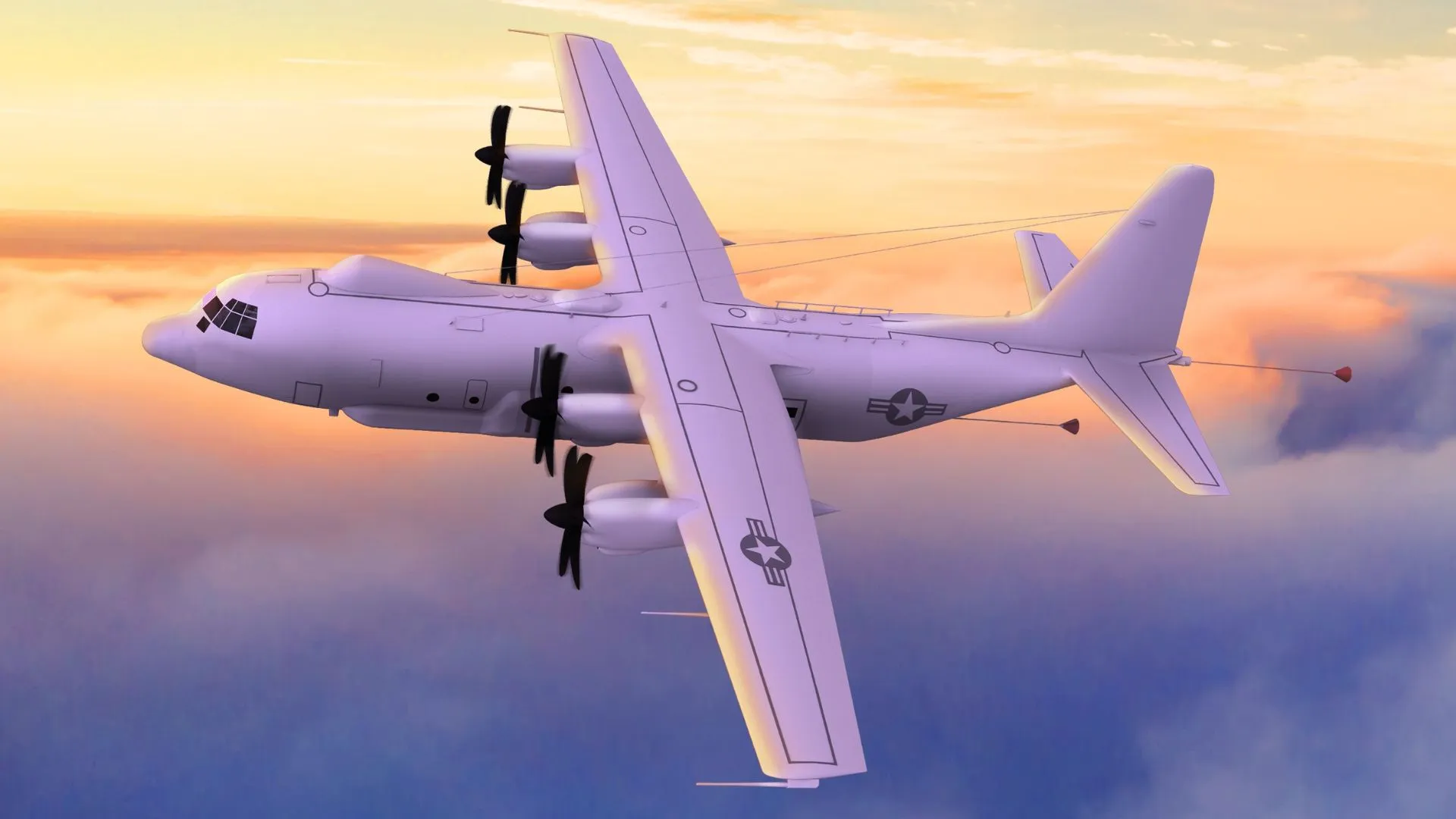
Naval Air Systems Command (NAVAIR) awarded Northrop Grumman Systems Corp. a $1,130,397,498 contract modification on November 25, 2026, to design, develop, and deliver three E-130J TACAMO system demonstration test articles (SDTAs) and initial spares. The cost-plus-incentive-fee modification, P00018 to contract N0001925C0130, supports the engineering and manufacturing development (EMD) phase of the Navy’s Take Charge and Move Out (TACAMO) recapitalization effort and runs through January 2030, according to the Pentagon contract announcement.
The E-130J Phoenix II will replace the Boeing E-6B Mercury as the airborne relay that carries emergency action messages from the National Command Authority to the Navy’s ballistic missile submarine fleet. It lands six weeks after the Navy accepted the first C-130J-30 airframe for the program from Lockheed Martin in Marietta, Georgia, on October 15, 2026, and less than five months after the Government Accountability Office (GAO) reported in July 2026 that the program’s integration risks had materialized and pushed its low-rate production decision back by roughly one year.
What the $1.13 Billion E-130J TACAMO Option Buys
The SDTA tranche was built into the original $3,459,276,000 award of December 2024, which covered three engineering development models (EDMs) plus options for up to three SDTAs and up to six aircraft in the first production lot. With this modification, the Navy has now committed to all six developmental airframes in a planned program of record of 31 E-130Js: six developmental and 25 production aircraft, replacing a current fleet of 16 E-6Bs.
Only $4,180,000 in fiscal 2027 research, development, test and evaluation funds is obligated at award, so most of the value will be funded incrementally in future budgets. The cost-plus-incentive-fee structure shares overrun risk between the government and the contractor, a standard choice while mission system integration remains immature.
Melbourne, Florida, accounts for 35% of the work, followed by Marietta, Georgia, home of the C-130J production line, at 23%. Richardson, Texas, holds 15%, Largo, Florida, 8%, and Oklahoma City, Oklahoma, 6%. Oklahoma City hosts Tinker Air Force Base, where Strategic Communications Wing 1 operates the E-6B fleet. Seven other sites hold 1% to 2% each, with 4% spread across the continental U.S. Northrop Grumman’s team includes Lockheed Martin Skunk Works, Raytheon, Crescent Systems, and Long Wave Inc., while Collins Aerospace supplies the very low frequency (VLF) transmit system and Lockheed Martin the air vehicle as directed subcontractors. The contract announcement does not specify SDTA delivery dates or whether these aircraft will later enter operational service.
From Boeing 707 to Super Hercules: Phoenix II Mission Trade-Offs
The E-130J is derived from the stretched C-130J-30. Publicly available specifications indicate the airframe is powered by four Rolls-Royce AE 2100D3 turboprops rated at 4,700 horsepower each, driving six-blade Dowty R391 composite propellers, with a fuselage 15 feet longer than the baseline C-130J. Converting it into a TACAMO platform requires VLF antenna integration, electromagnetic pulse (EMP) and cyber hardening, augmented electrical power generation, and increased cooling capacity, along with a secure cockpit-to-payload interface, nuclear-survivable flight deck avionics, and automated flight control system updates.
The E-6B, built on the Boeing 707-320 and powered by four CFM International CFM56 turbofans, relies on a dual trailing wire antenna to push VLF signals to submerged submarines; publicly available data indicate its long wire extends roughly five miles. The E-130J will carry a comparable system, but on a smaller, slower airframe. The turboprop cannot reach its orbit as quickly or fly as high as the Mercury, narrowing weather avoidance and line-of-sight margins. In exchange, it operates from shorter, austere airfields and draws on an in-production aircraft with a global support base. GAO noted that mission systems are being modified to reduce weight so they fit the C-130J-30, a sign that size, weight, power, and cooling margins remain tight. The Phoenix II is scoped for the TACAMO mission only; the E-6B’s secondary airborne command post and Minuteman III airborne launch control role is not part of the E-130J requirement.
Analysis: Exercising the SDTA option before critical design review signals that the Navy is accepting schedule concurrency to protect the transition away from an aging, out-of-production 707 fleet. That carries risk: if weight or cooling problems force redesign after the SDTAs are on contract, rework costs land on a cost-plus vehicle dependent on fiscal 2027 and 2028 appropriations. The strategic logic is nonetheless coherent. Nearly doubling the TACAMO fleet from 16 to 31 aircraft, on an airframe that can disperse to far more runways, increases the number of targets an adversary must hold at risk to sever the link to Ohio-class and future Columbia-class submarines. For the sea-based leg of the triad, numbers and dispersal answer the growing long-range strike threat to fixed bases.
The next markers are conversion and ground testing of the first EDM, a critical design review expected in late 2027, and a production decision projected for 2029, with SDTA work scheduled to conclude by January 2030 and initial operational test and evaluation projected to begin in 2033. Open questions include the E-6B retirement schedule, the final configuration of the VLF system, and whether the Navy can hold the timeline the GAO has already seen slip.