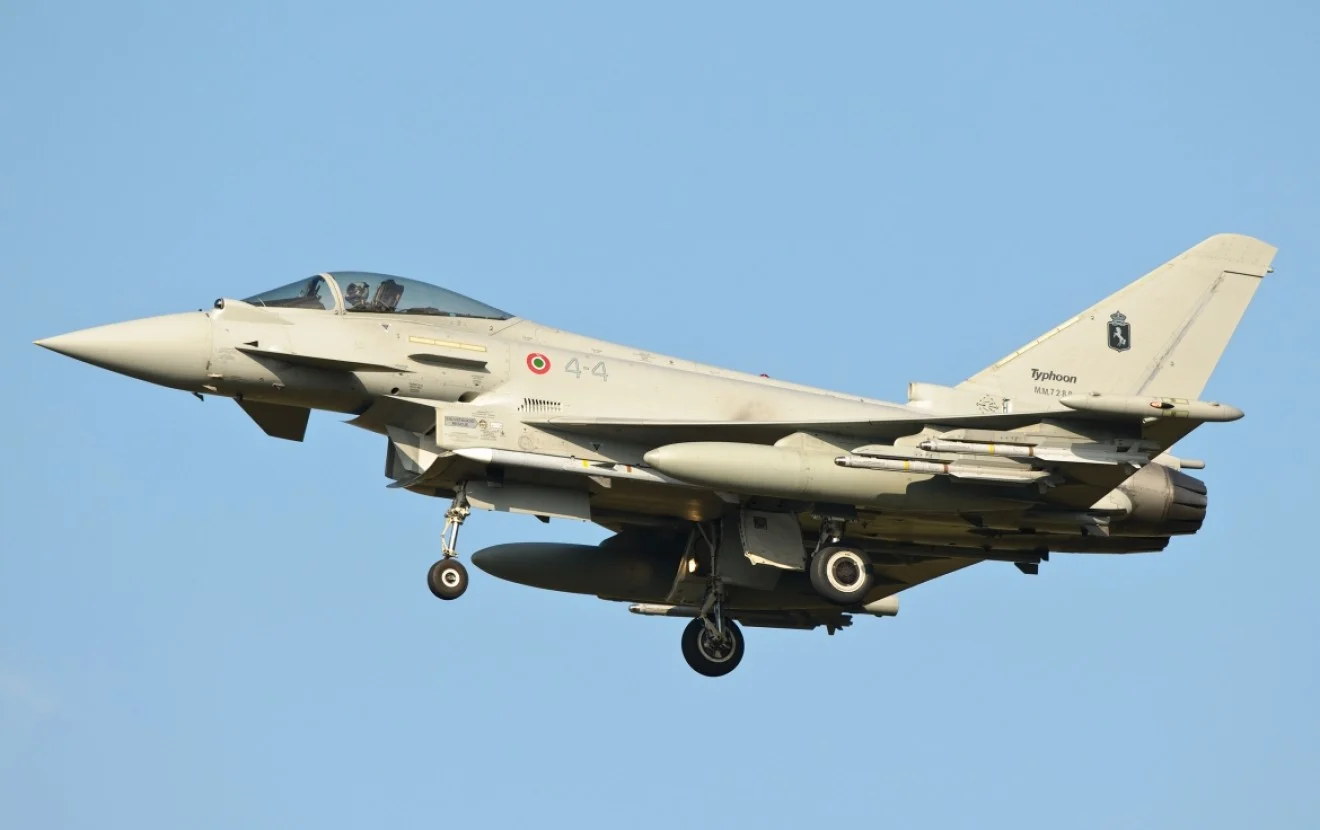
Ukraine has formally asked Italy for between 10 and 20 Eurofighter Typhoon fighters that the Italian Air Force is preparing to retire, and the two governments are negotiating, according to a November 25, 2026 report by the Italian daily La Repubblica. The government of Prime Minister Giorgia Meloni is not considering suspending the government-to-government talks, nor withdrawing the military aid package it recently approved for Kyiv, despite open friction over Ukraine’s November 22 sea drone strike on Russian vessels in Benghazi, Libya.
Rome was first reported to be evaluating a Ukrainian bid for its oldest Typhoons on November 12, one day after Economy Minister Giancarlo Giorgetti signed Italy’s 13th military aid package. Neither government has officially confirmed the talks, specified which aircraft are on the table, or set a delivery schedule. Kyiv has pursued the type since September 2024, when then-Defense Minister Rustem Umerov said “consultations are ongoing for Gripen and Eurofighter.” Ukraine currently flies two Western fighter types, the U.S.-built F-16 and the French Mirage 2000.
Ukraine Eurofighter Request Likely Centers on Italy’s Tranche 1 Jets
The aircraft in question are almost certainly Italy’s Tranche 1 jets, designated F-2000A (single-seat) and TF-2000A (two-seat) in national service. Italy took delivery of 96 Eurofighters in total, the last in October 2020. Its Tranche 1 fleet numbers 26 airframes, 16 single-seaters and 10 two-seaters. Italian reporting describes the candidate jets as aircraft being phased out because their electronics can no longer be upgraded.
On December 23, 2024, Italy signed a contract through the NATO Eurofighter and Tornado Management Agency (NETMA) for up to 24 new Tranche 4 aircraft to replace those 26 jets, a program Italian planning figures value at about €7.47 billion including logistics support over 11 years. Italian planning documents put the start of Tranche 1 retirement in 2028. The new jets will be built to the Tranche 4 standard, which adds an active electronically scanned array (AESA) radar; incompatibility with such new capabilities is a key reason for retiring the oldest airframes.
Publicly available specifications indicate the Typhoon is powered by two Eurojet EJ200 turbofans rated at 60 kN dry and 90 kN with afterburner, giving a top speed of Mach 2 and a maximum takeoff weight of 23,500 kg. Tranche 1 aircraft retain the mechanically scanned Captor-M radar and were optimized for air defense, with Italian F-2000As typically armed with AIM-120 AMRAAM and IRIS-T air-to-air missiles. That profile fits Ukraine’s most pressing mission: intercepting cruise missiles and long-range attack drones. Italian Typhoons demonstrated the role on August 14, 2026, when an F-2000A on NATO Baltic Air Policing duty shot down a Ukrainian drone that Latvia’s armed forces said had entered from Belarus, most likely diverted by Russian electronic warfare.
If included, the 10 two-seat airframes would let Ukraine run pilot conversion on its own aircraft rather than relying entirely on partner training pipelines.
Partner Consent, Engine Logistics, and the Benghazi Factor
Any transfer requires the consent of the other Eurofighter partner nations: the United Kingdom, Germany, and Spain. In Rome, Italy’s current authorization to transfer military equipment to Ukraine runs until December 31, 2026, and requires a prior policy act by parliament. League leader and Deputy Prime Minister Matteo Salvini has said his party will argue in parliament that, in 2027, Italy should focus on diplomacy rather than weapons.
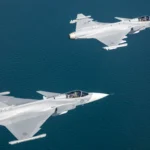
Sustainment is the second hurdle. Ukraine’s F-16s run on Pratt & Whitney F100 engines and its Mirage 2000s on Safran M53 engines. Kyiv has also contracted 16 new-build Saab Gripen E fighters for delivery in 2029 and 2030, preceded by 16 donated Gripen C/D jets expected in early 2027, bringing two more engine types. The EJ200 would add yet another family, with separate spares, tooling, and technician training.
The Benghazi strike sharpened the political backdrop. Ukraine said seven of its naval drones sank the Project 20380 corvette Merkury and hit the cargo ship Angara at the eastern Libyan port. Italian Foreign Minister Antonio Tajani called his Ukrainian counterpart, Andrii Sybiha, to complain; Sybiha replied that “self-defense is not limited to the territory under attack.” Palazzo Chigi, the prime minister’s office, fears the operation could turn the Mediterranean into a second Black Sea, with Russian reprisals against Ukrainian vessels close to Italian shores.
Analysis: Rome’s decision to wall off the Eurofighter file from its anger over Benghazi suggests the transfer is being treated as a fleet-management decision as much as a political gesture. Tranche 1 jets have limited growth margin and will leave Italian service regardless; handing them to Kyiv avoids storage or disposal costs and adds air defense capacity, although no delivery schedule has been set. The burden shifts to Kyiv. A batch of 10 to 20 aircraft is small to justify a dedicated EJ200 support chain, and running five Western engine families alongside legacy Soviet-designed fleets would stretch Ukraine’s wartime maintenance base. The value of the deal lies in near-term interceptor mass, not long-term fleet coherence.
Key unknowns remain the final number of aircraft, whether two-seaters are included, the delivery window relative to Italy’s Tranche 4 deliveries, and the positions of London, Berlin, and Madrid. The transfer must also clear the Italian parliament, where the governing coalition is divided over aid beyond 2026.