France’s Direction générale de l’armement (DGA) announced on November 26, 2026 that it is delivering the first Gobi Zephyr interceptor drones to the French armed forces, two months after ordering them from Harmattan AI. The interceptor destroys hostile drones by direct kinetic impact at up to 350 km/h within a 10-kilometer radius, carries no explosive charge, and operates by day and by night.
The DGA frames the delivery as a response to an immediate operational need to reinforce the very short-range air defense (VSHORAD) layer of the French forces. The agency ties the purchase to the spread of drones across the battlefield and to innovation cycles that now run far shorter than conventional armament programs, a mismatch that pushed it to create dedicated fast-track acquisition cells in 2026. Gobi Zephyr is the first French-designed drone interceptor delivered to French units.
Gobi Zephyr Interceptor Performance: 350 km/h and 10-Kilometer Reach
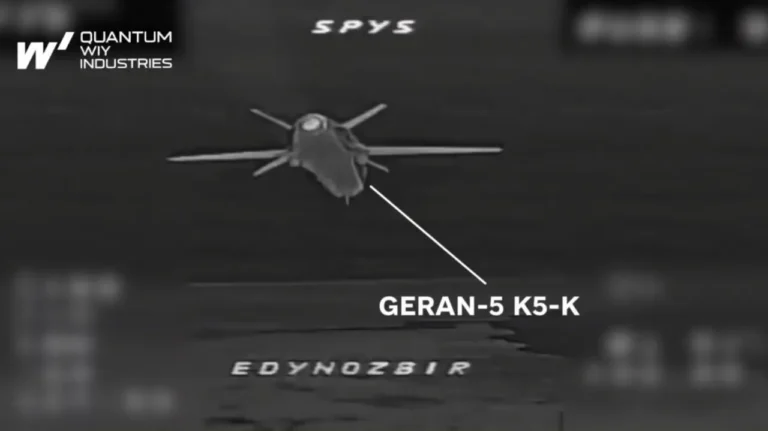
The DGA describes Gobi Zephyr as an integrated VSHORAD system, not a standalone airframe: it detects hostile drones and automatically guides the interceptor to its target. The agency credits the system with a 10-kilometer engagement radius and a top speed of 350 km/h. That speed matters against propeller-driven one-way attack drones of the Shahed-136 class, which publicly available specifications place at roughly 185 km/h, because it leaves the interceptor a wide closure margin for tail-chase engagements as well as head-on shots.
The kill mechanism is a body-to-body collision. Without a warhead, the interceptor avoids the storage, transport, and handling constraints attached to explosive munitions, and it limits the fragmentation hazard when an engagement takes place over friendly troops or protected sites. The trade-off is that a hit-to-kill design demands precise terminal guidance, since a near miss produces no effect.
On autonomy, the DGA states that the drones have a high level of operational autonomy and can down their target autonomously once a human has authorized the mission. The operator approves the engagement and the system flies the intercept, which shortens reaction time against fast or multiple targets.
The DGA release gives no mass, dimensions, or sensor details. Publicly available specifications indicate an airframe of 2.2 to 2.5 kilograms, a cruise speed of 250 km/h, and launch from a powered container within about three seconds of the firing command. Open sources describe a ground segment built around a radar, an electro-optical and infrared turret, and a command-and-control station, with onboard computer vision refining the impact point in the terminal phase, and a target set of drones weighing up to 25 kilograms. The original Gobi, unveiled in July 2025, was credited with 250 km/h and a 5-kilometer range, so the Zephyr variant doubles the reach and adds 100 km/h.
How the DGA Counter-Drone Expert Center Cut Acquisition to Two Months
The order followed an evaluation cycle at the Centre expert référent lutte anti-drone (Cerlad), the DGA’s counter-drone reference expert center. The DGA created its Centres experts référents in 2026 for short-cycle technologies, with a mandate to capture operational requirements, prototype or evaluate solutions, and execute rapid acquisitions for the forces. The ministry has said five such centers exist, including ones for counter-drone warfare, tactical and naval drones, and electronic warfare.
The contract is structured as purchase orders issued in lots, which lets the DGA buy as many interceptors as the armed forces judge necessary without renegotiating. The agency disclosed neither the contract value, nor the number of drones delivered, nor the receiving units. French press reporting at the time of the order, notified on September 23, 2026, put the first lot at 50 interceptors; the DGA has not confirmed that figure.
Harmattan AI builds the interceptors in the Île-de-France region around Paris. Founded in April 2024, the company closed a $200 million Series B round led by Dassault Aviation in January 2026. Gobi Zephyr is not the only interceptor drone in French hands: the Latvian-designed Blaze was selected earlier in 2026, according to its French integrator, which makes Gobi Zephyr the domestically designed option in a mixed inventory.
Analysis: The procurement mechanics matter as much as the airframe. An open-ended purchase-order contract lets France scale interceptor stocks at the pace of the threat, and a warhead-free drone promises a cheaper shot than a missile such as the Mistral 3 against low-cost targets, which is the cost-exchange problem every NATO air defender now faces. The limits are equally clear: the DGA has published no unit cost, no quantities, and no interception results from the Cerlad trials, so the depth of the capability cannot yet be measured from open information.
The next indicators are follow-on purchase orders, the identity of the units fielding the system, and its integration into the wider French air defense command network. Whether the DGA extends the Cerlad process to heavier interceptors for larger drone classes remains unknown. Production rates at Harmattan AI will determine how quickly a first lot becomes an operational stockpile.