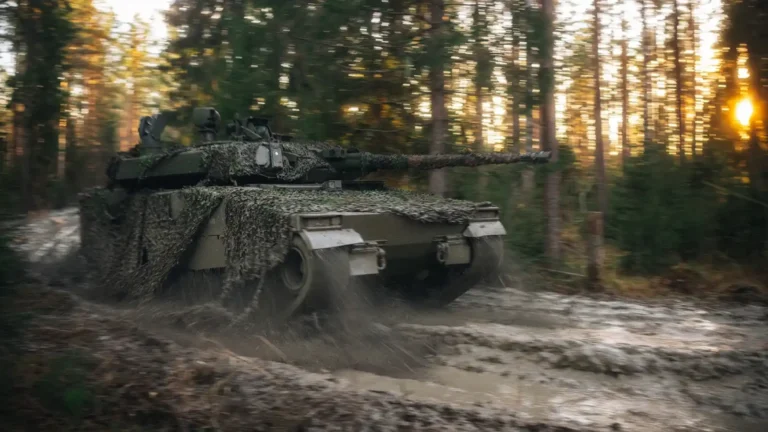
Romania’s Ministry of National Defence has called off 66 additional Lynx tracked combat vehicles from Rheinmetall under its existing framework agreement, an order valued at approximately €738 million, the German group announced on November 27, 2026. The tranche brings orders under the 298-vehicle framework to its full ceiling, with deliveries scheduled to run from 2028 to 2030.
The call-off completes the land component of a procurement Bucharest locked in on May 29, 2026, when the General Directorate for Armaments signed a €5.7 billion package with Rheinmetall under the European Union’s Security Action for Europe (SAFE) loan instrument, one day ahead of the SAFE contracting deadline. That package, the largest international order in Rheinmetall’s recent history, combined the Lynx framework with Skynex and Skyranger air defense systems, 35 mm AHEAD ammunition, and four naval vessels. The Lynx replaces the MLI-84 and MLI-84M Jderul, Romanian-built derivatives of the Soviet BMP-1 that entered service in 1985 and still equip the mechanized infantry of the Romanian Land Forces.
Romania Lynx Order: Two Call-Offs Close the 298-Vehicle Framework
The framework agreement, held by Rheinmetall’s local subsidiary Rheinmetall Automecanica SRL, carries a ceiling of €3.337 billion excluding VAT, according to the Romanian defense ministry. Romania placed a first call-off for 232 vehicles at signature, valued at roughly €2.6 billion and financed through SAFE. The 66-vehicle tranche announced this week covers the remaining balance, meaning the framework is fully committed six months after award. Neither Rheinmetall nor the ministry has specified whether the second call-off draws on SAFE loans or on national budget lines; that funding source remains unconfirmed.
A simple division puts the new order at about €11.2 million per vehicle. That figure should be read with caution: the contract value likely bundles logistics, training, spares, and integration work, and the variant mix within the 66 vehicles has not been disclosed.
Rheinmetall states that most of the Romanian fleet will consist of infantry fighting vehicles (IFVs), complemented by armored mortar carriers, command post vehicles, and medical evacuation vehicles. Earlier government statements put the specialist-variant share at 46 hulls across the full 298, although no per-variant breakdown has been published. The 2028 to 2030 delivery window is compressed for nearly 300 tracked vehicles built partly on a new national production line.
Lynx KF41 Configuration and the Mediaș Production Line
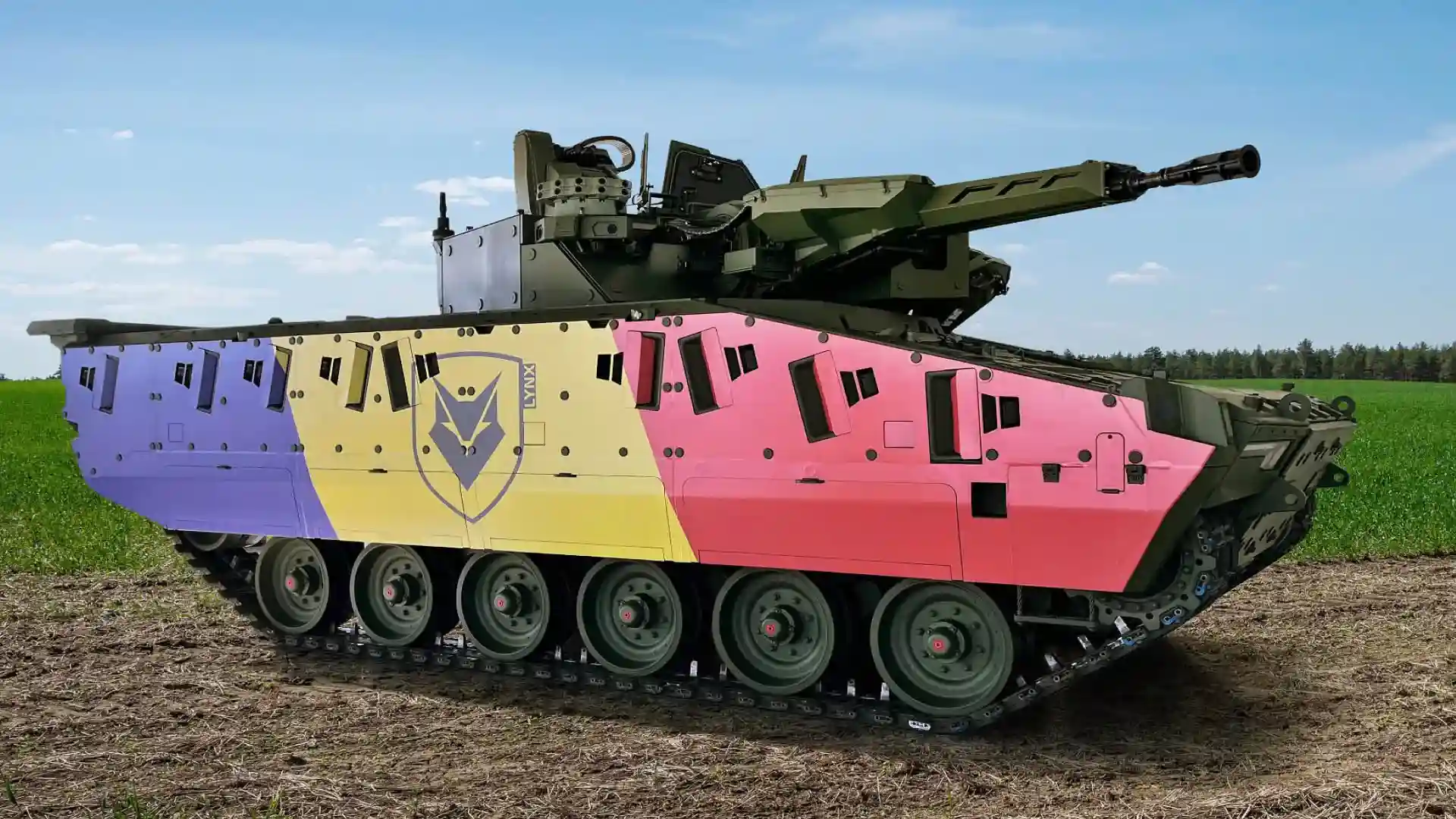
Publicly available specifications indicate the Romanian vehicles are based on the Lynx KF41, a tracked IFV in the 44 to 50 tonne class depending on protection level. Open-source reporting describes a Lance 2.0 two-person turret, with sources split between a 30 mm and a 35 mm automatic cannon, both able to fire programmable airburst ammunition, and integrated anti-tank guided missiles, most often reported as the Spike LR2. The cannon caliber has not been confirmed in official statements. On the standard KF41, power comes from a Liebherr D976 six-cylinder diesel rated at up to 1,140 hp, paired with a Renk HSWL 256 transmission, for a road speed of about 70 km/h and a range of roughly 500 km. The vehicle carries a crew of three and eight dismounts.
Compared with the MLI-84M, the step change lies in survivability and growth margin: modular armor packages, protection against mines and improvised explosive devices, and an active protection system, which Romanian reporting lists as part of the configuration. Rheinmetall offers its StrikeShield system for the Lynx. None of these configuration details were restated in this week’s announcement.
Production will be anchored at Rheinmetall Automecanica in Mediaș, the company’s long-standing Romanian subsidiary, with other national sites contributing. Rheinmetall says it is investing several hundred million euros to expand capacity, with a large share of the value added performed in Romania, thousands of new jobs, more than 200 subcontractors in the supply network, and extensive technology transfer. Mediaș becomes the third Lynx production hub after Germany and Hungary, where the Zalaegerszeg plant builds vehicles for the Hungarian Defence Forces.
Analysis: Exercising the full framework within six months signals that Bucharest treats the Lynx as a fixed, near-term commitment rather than an option to be scaled back when budgets tighten. For NATO’s eastern flank, Romania joins Hungary as a Lynx operator on the Black Sea and Carpathian axis, while Italy pursues its own Lynx-based A2CS program with Leonardo, creating a de facto regional fleet with shared training, spares, and ammunition pathways. The commonality extends beyond infantry: Romania’s Skyranger systems are slated to ride on Lynx hulls, putting maneuver forces and short-range air defense on a single chassis. The risk is industrial. Meeting a 2028 start depends on a supply network of more than 200 subcontractors reaching series quality within roughly two years, while the Lance turret is expected to be supplied from Germany.
The next milestones are publication of the variant breakdown, tooling and supplier qualification at Mediaș through 2027, and first deliveries in 2028. Further points to watch include whether Romania funds additional specialist variants beyond the 298-vehicle ceiling and how the Lynx fleet integrates with the Skyranger vehicles ordered under the same SAFE package. With the framework fully committed, schedule performance rather than contract value now becomes the metric that matters.