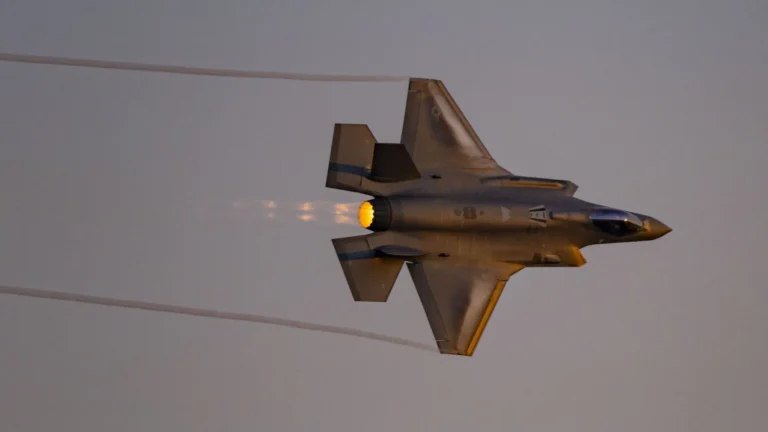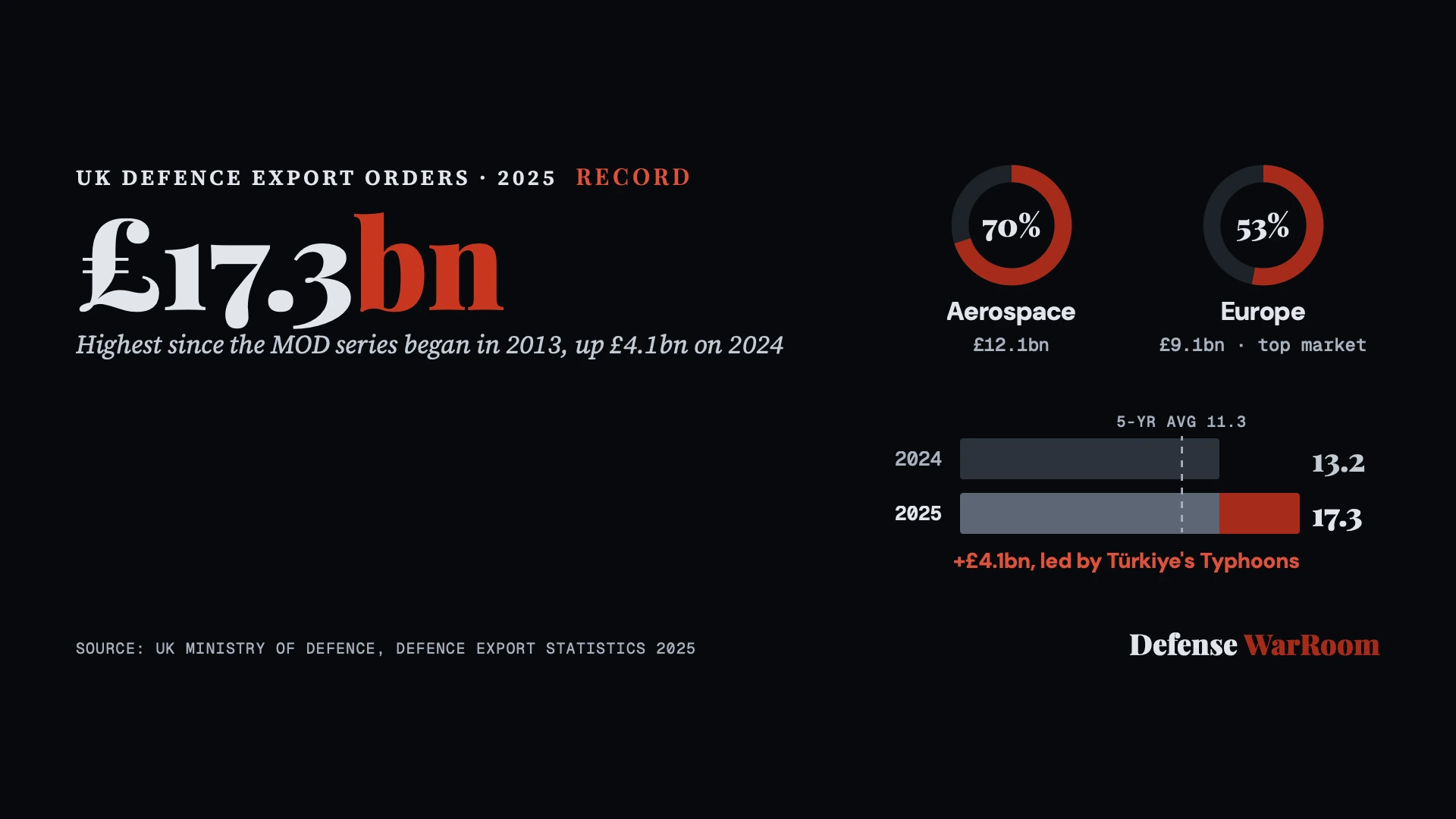
UK defence exports reached a record £17.3 billion in orders in 2025, the highest total since the Ministry of Defence (MOD) series began in 2013, according to official statistics published on November 26, 2026. The total is £4.1 billion above the 2024 figure of £13.2 billion, and more than £4 billion in new orders from Türkiye, most of them for Eurofighter Typhoon combat aircraft, account for the bulk of the increase.
The release, the 13th edition published as Official Statistics, arrives as European rearmament reshapes demand for British equipment and as London treats exports as a lever to sustain domestic production lines. The data come from a voluntary MOD survey sent to 1,390 known UK defence exporters in April 2026. The full value of each contract is booked in the year it was signed, regardless of when deliveries take place, and all figures are in nominal prices, so part of the growth reflects inflation rather than volume.
Türkiye Typhoon Order Drives Record UK Defence Exports in 2025
The Türkiye order was signed in Ankara on October 27, 2025, during Prime Minister Keir Starmer’s first visit to the Turkish capital. The UK government valued the package of 20 Typhoon aircraft with associated weapons and integration at about £5.4 billion, within a wider agreement it described as worth up to £8 billion. First deliveries are expected in 2030, making Türkiye the tenth Typhoon operator after the UK, Germany, Spain, Italy, Austria, Oman, Qatar, Kuwait, and Saudi Arabia. The contract was the first new order for UK-built Typhoons since 2017 and keeps final assembly at BAE Systems’ Warton site running into the 2030s.
The MOD survey records more than £4 billion in 2025 orders from Türkiye, below the government’s £5.4 billion headline. The release does not reconcile the two numbers. The survey captures only orders reported by UK-based companies, while Typhoon is a four-nation program with production work shared among the UK, Germany, Italy, and Spain.
Aerospace products and services generated £12.1 billion in orders, 70% of the 2025 total and £6.4 billion more than in 2024. Aerospace has been the largest product category in every year since 2013 and accounted for 57% of orders over the five years from 2021 to 2025. Land, sea, and mixed or unknown categories together accounted for the remaining £5.2 billion in 2025.
Because single contracts produce sharp swings, the MOD tracks a five-year moving average. Annual orders averaged £11.3 billion from 2021 to 2025, up 22% from the £9.3 billion average for 2020 to 2024. The MOD attributes that rise to 2025 orders running about £10 billion above the 2020 total, which drops out of the window.
Europe Extends Lead Over Middle East as Top Export Market
Europe accounted for £9.1 billion of 2025 orders, or 53% of the total, an increase of £2 billion from 2024. It is the second consecutive year Europe has ranked as the largest destination region. Until 2023, the Middle East held that position; large orders from Poland in 2024 and Türkiye in 2025 shifted the balance. The five-year average for European orders reached £4.8 billion for 2021 to 2025, a 34% increase over the 2020 to 2024 average.
The figures do not capture Norway’s selection of the Type 26 anti-submarine frigate, announced on August 31, 2025, in a program the UK government valued at £10 billion for at least five ships to be built by BAE Systems on the Clyde. With all non-aerospace orders totaling £5.2 billion in 2025, the frigate program cannot be fully reflected in this year’s data. When it enters the series depends on when industry reports the binding contract value.
Two further limits shape interpretation. Most UK support to Ukraine since 2022 has flowed as government military assistance rather than commercial contracts, so it is largely absent from the totals. Because the survey is voluntary, some firms decline to respond or submit aggregated figures, which the MOD classes as unknown, and contract values amended after signature are not revised in the statistics.
Analysis: The record rests on a narrow base. One customer and one platform supplied roughly a quarter of 2025 orders and most of the year-on-year gain, and aerospace’s 70% share sits well above its 57% five-year norm. The underlying trend is nonetheless clear: British defence exports are reorienting from Middle East customers toward European NATO members re-equipping after Russia’s 2022 invasion of Ukraine. That shift aligns UK industry with allied force structures, but it also ties export performance to a mature fourth-generation fighter while the Global Combat Air Programme (GCAP) remains in development. Under an order-based method, a year without a Typhoon-scale contract could show a sharp decline even as delivery activity rises.
The next edition, covering 2026, will show whether the Norwegian Type 26 contract and further combat aircraft orders keep the five-year average above £11 billion. Deliveries under the Türkiye order are not due to begin until 2030, so the workload behind this year’s record will be spread across the next decade. The MOD publishes the underlying annual series and regional breakdowns in an accompanying spreadsheet and Background Quality Report.