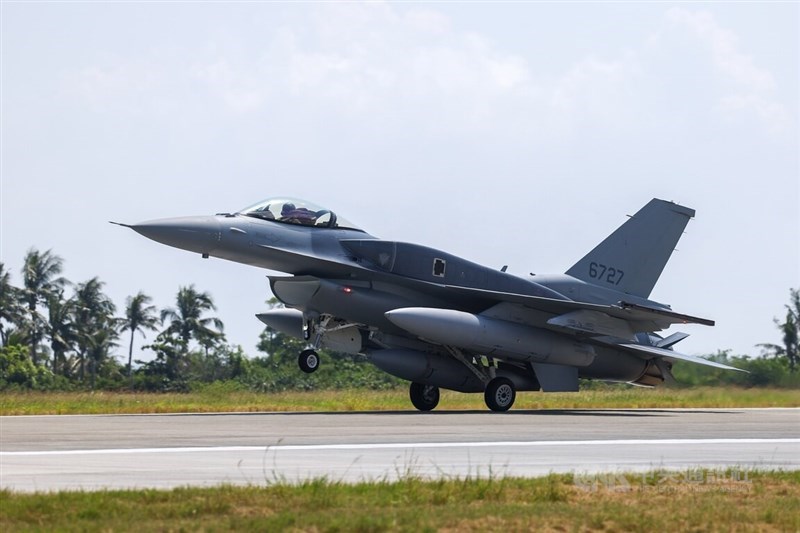
Taiwan’s Air Force took delivery of its first two new-build F-16V Block 70 fighters on October 2, 2026, when single-seat jets 6727 and 6728 landed at Chihhang Air Base in Taitung County around noon. They are the first of 66 ordered from the United States, arriving roughly three years after deliveries were due to begin.
Washington approved the $8 billion Foreign Military Sale in August 2019, during President Donald Trump’s first term, and Taipei budgeted NT$247.2 billion for 2020 through 2026, with deliveries planned for 2023 through 2026. Pandemic disruption, supply chain shortages and software integration problems, compounded by Lockheed Martin’s move of F-16 production to Greenville, South Carolina, broke that schedule. The jets arrive about a week after Trump hosted Chinese leader Xi Jinping in Washington, with a separate Taiwan arms package worth roughly $14 billion still on hold.
F-16V Block 70 Configuration: Radar, Engine and Electronic Warfare
The Block 70 is the newest production standard of the F-16C/D. Bought under the Peace Phoenix Soaring program, the new airframes join roughly 140 F-16A/B Block 20 jets that the Peace Phoenix Rising retrofit brought to a comparable F-16V standard by December 2023. The 2019 Defense Security Cooperation Agency notification covered 75 General Electric F110 engines, 75 Northrop Grumman AN/APG-83 Scalable Agile Beam Radars and 75 Link 16 terminals, with quantities above 66 covering spares.
The APG-83 is an active electronically scanned array that tracks air and surface targets simultaneously and produces high-resolution synthetic aperture radar maps, relevant to maritime strike in the Taiwan Strait. Because the retrofitted fleet flies the same radar and datalink, the Air Force gains common training, maintenance and tactics across about 200 F-16s.
Power comes from the F110-GE-129 turbofan, rated at about 29,000 lb of thrust with afterburner against roughly 23,000 lb for the Pratt & Whitney F100-PW-220 in Taiwan’s legacy jets, according to a researcher at the Institute for National Defense and Security Research. That margin absorbs conformal fuel tanks, which extend range without occupying underwing stations, aided by strengthened landing gear. Publicly available Lockheed Martin specifications add a 12,000-hour structural service life and automatic ground collision avoidance. The trade-off is a second engine sustainment chain in the F-16 fleet.
The 2019 notification listed the L3Harris AN/ALQ-211A(V)4 electronic warfare suite, BAE Systems AN/ALE-47 dispensers and 120 ALE-50 towed decoys. Taiwan’s current configuration specifies the L3Harris AN/ALQ-254(V)1 Viper Shield, which drew legislative scrutiny in June 2026 over a 2012 Legislative Yuan equipment requirement, and whether the internal suite is fitted to the first two aircraft remains unconfirmed. A separate NT$42.83 billion budget for pods, missiles and munitions runs from 2022 to 2030, with types and quantities classified.
Pacific Ferry Delays, Acceptance Testing and Pilot Conversion at Chihhang
The ferry flight became its own hurdle. The pair departed the continental United States on August 17 and staged through Hawaii, with in-flight refueling and a maintenance stop planned along the route. The Air Force had expected them by late August or early September, but they remained in Hawaii for weeks, and local media reported they turned back shortly after departing for Guam. No official explanation was given. No official link has been established between the hold and preparations for the Trump-Xi summit, although the timing drew attention in Taipei. Taiwan’s first F-16s made the same crossing in 1997 with 19 aerial refuelings.
Arrival does not equal capability. At Chihhang, the jets will undergo ground inspections and Air Force testing before formal transfer of ownership, while pilots and maintainers convert to the type. The base sits on the island’s east coast, facing the open Pacific where Chinese aircraft and ships have operated during large-scale exercises around Taiwan, and the government says the new jets will reinforce air defense on that flank.
Production is now the pacing item. Lockheed Martin unveiled the first Taiwanese Block 70 at Greenville in March 2025 and has since run two shifts, with the line operating up to 20 hours a day. Military sources cited by Taiwanese media in 2025 put output at about three aircraft per month. Defense Minister Wellington Koo said on October 2 that more F-16Vs will arrive before the end of the year, without giving a number, and that additional aircraft have already cleared testing.
Analysis: The Block 70 will not close the numerical gap with the People’s Liberation Army Air Force, whose J-10C and J-16 fighters field AESA radars and the PL-15 long-range air-to-air missile. Its value lies in commonality: about 200 F-16s sharing the APG-83 and Link 16 give Taiwan one networked fighter backbone for near-daily intercepts and wartime defensive counter-air. Two factors now constrain that value more than airframe output. Delivery tempo has become entangled with Washington’s China diplomacy, with the $14 billion package openly treated as leverage. And the classified munitions buy and unresolved Viper Shield question will decide whether the jets arrive as complete weapon systems or as airframes awaiting their combat fit.
Near-term milestones are formal acceptance of 6727 and 6728 and the number of jets reaching Chihhang before December 31, 2026. A decision on the $14 billion package, which includes Patriot systems and may be split into smaller tranches according to a U.S. official, is not expected before Trump and Xi meet again at the Group of 20 summit in the United States in December. The remaining 64 jets are due through 2027 and 2028.