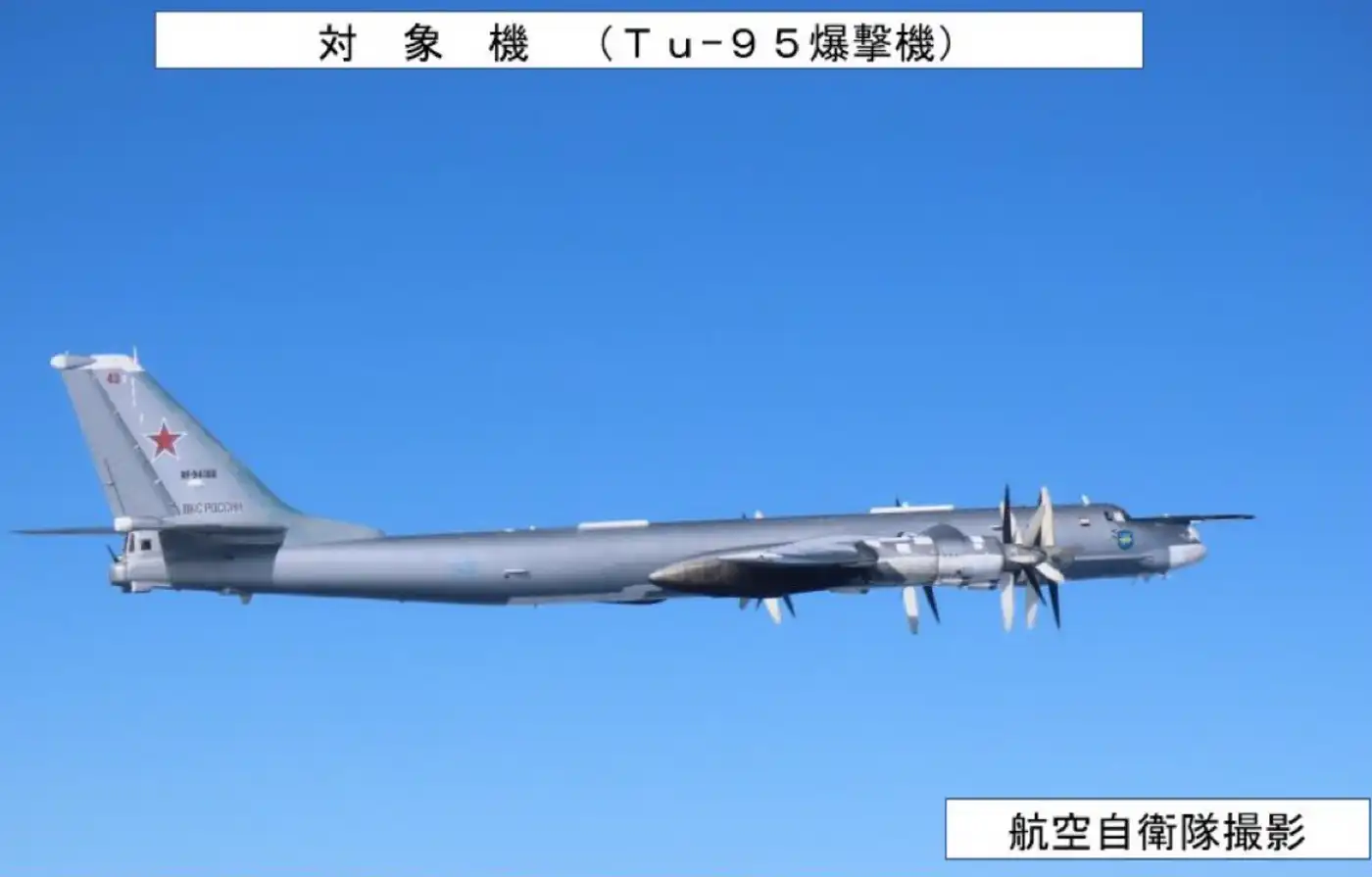
Two Russian Tu-95 bombers flew north between Taiwan and Japan’s Yonaguni Island on November 19, 2026, and joined two Tu-142 maritime patrol aircraft over the East China Sea, Japan’s Ministry of Defense said. The bombers then crossed the Tsushima Strait toward the Asian mainland. The Japan Air Self-Defense Force (JASDF) scrambled fighters from its Southwestern Air Defense Force and other units in response.
The flight came two days after Tokyo reported the first Russian violation of its airspace since September 2024. On November 17, Defense Minister Shinjiro Koizumi said one suspected Russian aircraft entered Japanese airspace northwest of Okinoshima, an island off Fukuoka Prefecture, from about 4:07 a.m. to 4:10 a.m., followed by a second from about 4:09 a.m. to 4:12 a.m. Koizumi called the incursion a serious infringement of Japanese sovereignty, and Tokyo lodged a protest through diplomatic channels. Later that day, two Tu-95MS bombers and two Il-76 transports landed at Da Nang International Airport in central Vietnam.
Russian Tu-95 Bombers Join Tu-142s Over the East China Sea
According to the ministry’s account and the route map released with it, the two Tu-95s arrived from the Pacific and threaded the gap between Yonaguni and Taiwan, a corridor roughly 110 kilometers (68 miles) wide that separates Japan’s westernmost inhabited island from the Taiwanese coast. The bombers then tracked northeast across the East China Sea. The two Tu-142s flew south from the Sea of Japan, transited the Tsushima Strait, linked up with the bombers over the East China Sea, then crossed the strait a second time heading back toward the mainland. The bombers also exited through the Tsushima Strait.
The ministry did not say how many fighters launched, where the Tu-95s began their flight, or whether any aircraft entered Japanese territorial airspace.
The Tu-95MS, known to NATO as Bear-H, is the cruise missile carrier variant of the Soviet-era turboprop bomber and remains a backbone of the air leg of Russia’s nuclear triad. Publicly available specifications indicate four Kuznetsov NK-12MP turboprops rated at roughly 11,000 kW (about 15,000 shp) each, driving contra-rotating propellers, a maximum speed near 830 km/h, and an unrefueled range commonly cited above 10,000 kilometers. Its primary armament is the Kh-55 family and the Kh-101 conventional and Kh-102 nuclear air-launched cruise missiles; the modernized Tu-95MSM carries up to eight Kh-101s on underwing pylons. With missile reach reported in the thousands of kilometers, the bomber does not need to approach a target to hold it at risk.
The Tu-142 shares the same airframe but serves as a long-range anti-submarine warfare and maritime patrol platform, carrying search radar, sonobuoys, and torpedoes. Pairing it with bombers combines a strike aircraft with a sensor platform designed to find submarines and surface ships. Russia has flown that combination in this corridor before: in June 2026, two Tu-95s and two Tu-142s joined two Chinese H-6 bombers for a patrol around Japan, according to Japan’s Joint Staff Office.
From Okinoshima to Da Nang: A Week of Russian Long-Range Flights
The November 19 route mirrored the November 17 track in reverse. The aircraft that entered airspace near Okinoshima continued through the Tsushima Strait, passed between Yonaguni and Taiwan, and headed south into the Pacific. Two days later, the Tu-95s came out of the Pacific and flew north through the same gap.
Satellite imagery published by open-source aviation analyst AviVector, along with photos shared by local spotters, placed the Da Nang bombers, registered RF-94202 and RF-94188, at the civilian airport alongside their two Il-76 support aircraft. The bombers reportedly departed from Ukrainka Air Base in Russia’s Amur region. Neither Moscow nor Hanoi had explained the visit as of November 17. Russian bomber visits to Southeast Asia are rare: on December 5, 2017, two Tu-95MS bombers landed on Biak Island, Indonesia, where two Il-76MD transports had arrived the day before.
Japan has not said whether the Tu-95s it intercepted on November 19 were the aircraft that landed in Vietnam, and that link remains unconfirmed. The reverse routing and timing are consistent with a return leg, but no official source has stated it, and Russia’s Defense Ministry has not commented on the November 19 flight.
Analysis: Taken together, the three flights show Russian Long-Range Aviation using the Tsushima Strait and the Yonaguni gap as a north-south transit corridor linking the Sea of Japan to the Pacific and, apparently, to Southeast Asia. Both are chokepoints on the first island chain that Japan has spent a decade fortifying, with Ground Self-Defense Force surveillance and electronic warfare units now on Yonaguni. Russian bombers in that gap operate inside the airspace Tokyo and Washington plan around for a Taiwan contingency, and they add load to a Southwestern Air Defense Force that already handles much of the JASDF’s response to Chinese air activity.
Key unknowns remain. Tokyo has not identified the aircraft that violated its airspace on November 17, and Moscow and Hanoi have yet to explain the Vietnam deployment. Russia and China flew joint bomber patrols near Japan in December 2025 and June 2026; another combined sortie in the coming weeks would show whether this week’s activity is a standalone signal or part of a wider pattern.