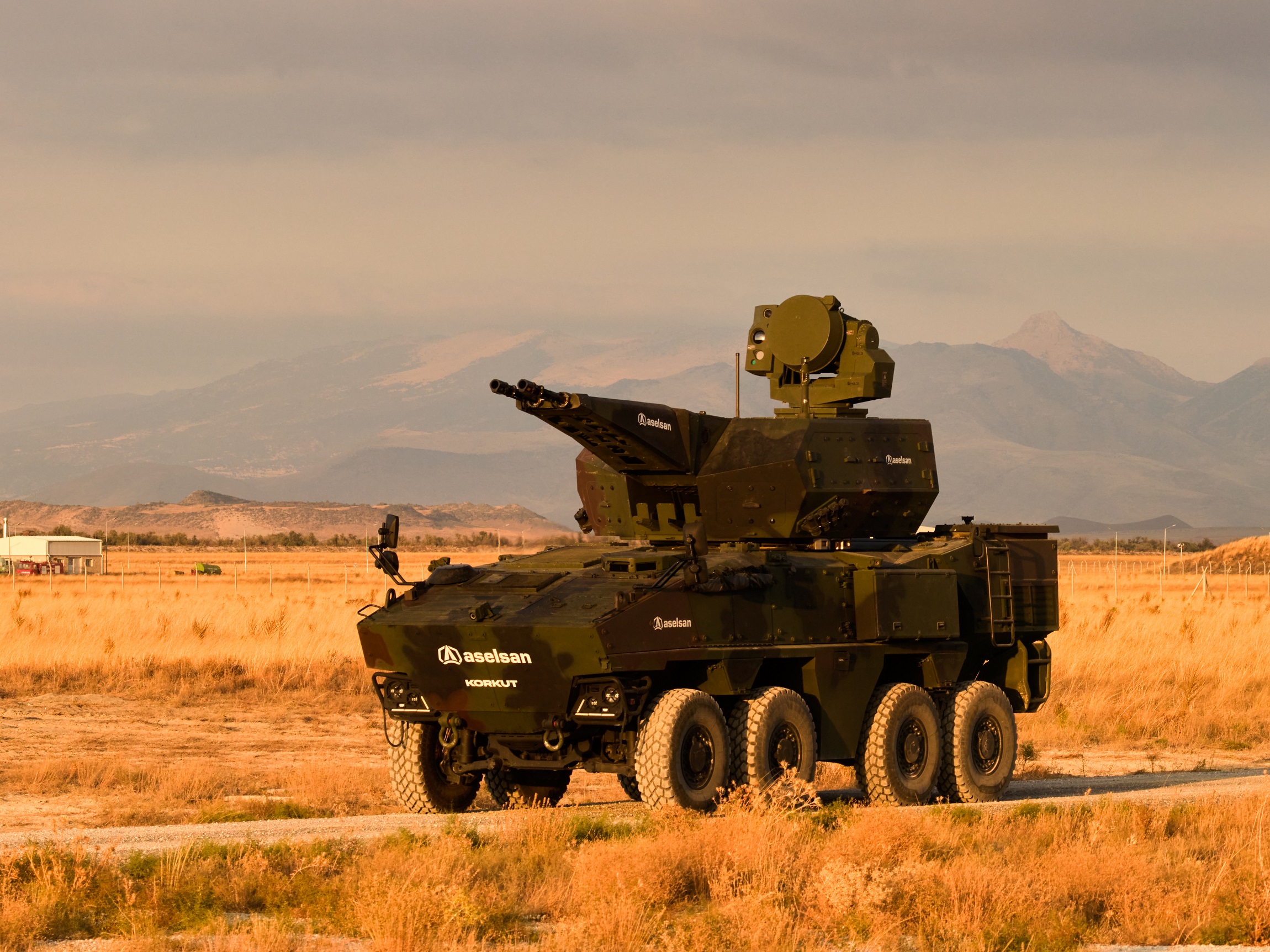
ASELSAN and the Presidency of Defense Industries of the Republic of Türkiye (SSB) signed contracts worth €2.46 billion, roughly $2.9 billion, on October 5, 2026, for the procurement of Hybrid Air Defense Systems, the company disclosed through Türkiye’s Public Disclosure Platform (KAP) and on social media.
The package is nearly 50% larger than the €1.65 billion air defense contract ASELSAN signed with the SSB in 2025, and it is the third major air defense deal the company has announced in five days. The SSB tied the purchase to Steel Dome, the layered national air defense architecture approved by the Defense Industry Executive Committee in August 2024, stating that the program “is growing even stronger with each new contract.” The disclosure did not name the systems, quantities, delivery schedule, or receiving service branch.
GÜRZ and the ASELSAN Hybrid Air Defense Concept
ASELSAN markets one system under the hybrid air defense label: GÜRZ, a mobile short-range air defense (SHORAD) platform that combines gun and missile interceptors on a single vehicle. The KAP filing does not identify GÜRZ by name, but the wording matches ASELSAN’s own designation for the system, and Turkish defense reporting links the contract to it. The plural “systems” in the filing leaves open whether other configurations fall under the same award.
GÜRZ debuted as a prototype at IDEF 2023 on an 8×8 armored wheeled chassis, and its series-production configuration appeared for the first time at SAHA 2026 in May. The design merges capabilities from two fielded ASELSAN programs, the HİSAR missile family and the KORKUT 35mm self-propelled anti-aircraft gun. The series vehicle pairs a KORKUT-derived 35mm cannon firing programmable airburst ammunition with rear launchers holding four missiles, either Roketsan SUNGUR or ASELSAN/TÜBİTAK SAGE GÖKSUR. Publicly available specifications indicate an effective range of about 4 km for the gun and up to 8 km for SUNGUR-class missiles, creating two overlapping engagement envelopes against UAVs, loitering munitions, helicopters, and cruise missiles.
Prototype vehicles carried four AESA search and fire-control radars with IFF at the corners for 360-degree coverage, plus electro-optical sensors and a datalink. ASELSAN has also shown soft-kill options, including jamming and its GÖKBERK laser weapon, with an onboard command-and-control station assigning effectors by target range, speed, and threat level. That self-contained kill chain separates GÜRZ from KORKUT, whose weapon vehicles depend on a separate command vehicle carrying the battery’s search radar.
The concept places GÜRZ in the same class as Russia’s Pantsir-S1, built instead to NATO interoperability standards. ASELSAN General Manager Ahmet Akyol said in May 2026 that series improvements were complete, operational validation had begun, and the system would enter Turkish Armed Forces service in 2027. A live-fire test reported in September 2026 saw a GÖKSUR missile engage a target tracked by the vehicle’s own sensors. Turkish reporting indicates Land Forces and Air Force requirements for 6×6 and 8×8 variants; neither the services nor vehicle counts are confirmed for this contract.
How the Contract Fits Steel Dome and ASELSAN’s Backlog
Steel Dome integrates sensors and effectors across all altitude bands under the HAKİM command-and-control layer, which ASELSAN develops along with most of the architecture’s radars and communications. The company describes the lowest tier as a counter-drone and very-short-range layer built on Dronedef elements, KORKUT, GÜRZ-type systems, and radars, while the upper tiers rely on HİSAR-A+, HİSAR-O+, and the SİPER long-range system, now in serial production. In that structure, GÜRZ bridges dedicated counter-drone assets and HİSAR medium-altitude batteries, providing mobile cover for maneuver units and high-value sites.
The October 5 award follows a run of air defense contracts. On October 1, ASELSAN disclosed €1.0085 billion in additional SSB contracts for ongoing serial production of long-range air defense systems. Turkish reporting also cites a €488.5 million air defense export contract with an undisclosed foreign customer on October 2, and a €1.2342 billion agreement with Roketsan on September 23 for air defense subcomponents. The three air defense awards announced since October 1 total roughly €4 billion.
That volume lands on an order book that was already expanding. ASELSAN reported more than $4 billion in 2025 revenue and $9.6 billion in new orders, with €2.76 billion in air defense contracts forming its largest intake that year. The company has invested $1.5 billion in a dedicated Steel Dome production facility, and the SSB accounted for 30.6% of ASELSAN’s net sales in its latest income statement, according to the company’s October 1 disclosure. That concentration makes SSB funding cycles the primary driver of ASELSAN’s near-term production planning.
Analysis: The contract shows Ankara funding the lowest and most saturated tier of Steel Dome at a scale comparable to its long-range investments. Operational experience in Ukraine and the Middle East has shown that massed drone and loitering-munition raids exhaust costly interceptors quickly. A vehicle that engages first with 35mm airburst rounds and commits a missile only when necessary improves the cost-exchange ratio that defines counter-UAS warfare. For NATO, a member state producing an integrated gun-missile SHORAD in volume addresses a gap European armies have acknowledged since 2022. Large domestic serial production also strengthens ASELSAN’s export case with Gulf and European buyers.
Key unknowns remain the vehicle count, the 6×6 and 8×8 split, the receiving services, and the delivery window. Earlier Steel Dome awards carried delivery schedules between 2027 and 2032, and ASELSAN expects GÜRZ in service in 2027. The next markers are a detailed statement on quantities, first acceptance deliveries to Turkish units, and whether domestic serial production yields a first GÜRZ export order.