Ukraine’s Defense Minister Yevhen Khmara handed German Chancellor Friedrich Merz a list of priority weapons in Kyiv on October 4, 2026, including munitions for F-16 fighters and missiles for the IRIS-T and Patriot air defense systems, according to Ukraine’s Ministry of Defense. The talks centered on Russian jet-powered drones and ballistic missiles, and Khmara later signed five procurement documents with German defense companies.
The meeting came during Merz’s unannounced visit to Kyiv, five days after the chancellor said in Berlin that air defense had become Ukraine’s weakest point ahead of a potentially very difficult winter. Germany is Ukraine’s largest military backer: the Ukrainian Defense Ministry puts Berlin’s 2026 assistance at €11.5 billion, about a third of all military aid this year. President Volodymyr Zelensky said Russia launched more than 1,900 attack drones, 1,700 aerial bombs and 25 missiles over the preceding week, including more than 800 jet-powered drones.
Ukraine Air Defense Requests: IRIS-T, Patriot and F-16 Munitions
Khmara’s list maps onto three engagement layers. At the lowest, Ukrainian F-16s have become the most effective counter to jet-powered drones, according to Zelensky, who said Kyiv is working to secure 5,000 to 6,000 rounds of 20mm ammunition per day for the fleet. Publicly available specifications indicate the F-16’s M61A1 Vulcan cannon carries about 500 rounds and fires up to 6,000 rounds per minute, so the daily target equals roughly ten to twelve full gun loads. Every gun kill preserves an air-to-air missile that Ukraine cannot afford to spend on a drone.
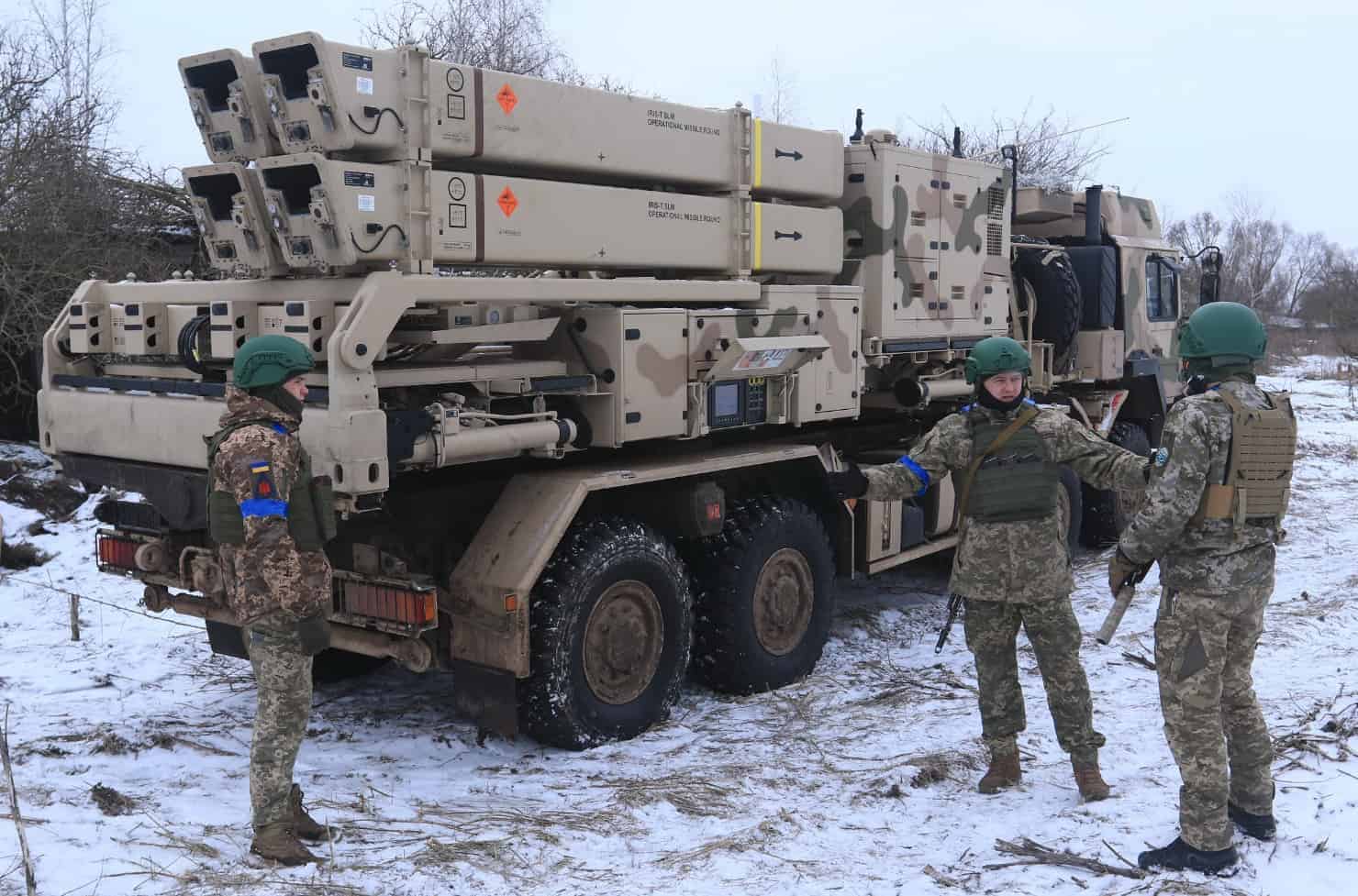
The middle layer is IRIS-T SLM, Diehl Defence’s medium-range system that Ukraine first fielded in October 2022. Publicly available specifications credit its missile with a range of up to 40 kilometers and a ceiling of 20 kilometers, using an imaging infrared seeker, thrust vector control and datalink midcourse updates. A fire unit pairs three eight-round launchers and a fire control center with Hensoldt’s TRML-4D active electronically scanned array radar, rated to detect targets at up to 250 kilometers and track up to 1,500 at once. Open-source estimates put an export IRIS-T SLM round at roughly €400,000 or more, which makes every engagement against a mass-produced drone costly in both money and magazine depth.
The upper layer is Patriot. Alongside the Franco-Italian SAMP/T, Patriot batteries firing PAC-3 MSE hit-to-kill interceptors are Ukraine’s only means of defeating ballistic threats such as the Iskander-M and the air-launched Kh-47M2 Kinzhal. Zelensky said Russia holds up to 700 ballistic missiles in reserve and produces 130 to 140 per month. If those figures hold, Moscow can sustain ballistic salvos against cities and the power grid at a rate that keeps Ukrainian demand for Patriot interceptors ahead of partner deliveries.
Diehl, Hensoldt and Quantum Systems Deals Target the Jet Drone Threat
The industrial track ran in parallel. After the Ukrainian-German Business Forum in Kyiv, which focused on moving from individual projects to a joint scale-up program and then systematic joint production, Khmara signed five documents with German firms. Three memorandums with Diehl Defence cover the purchase of thousands of IRIS-T missiles, additional IRIS-T fire units and missiles, and joint work on precision-guided artillery ammunition. A Hensoldt memorandum covers tactical radars and surveillance systems. A letter of intent with Quantum Systems provides for testing and procuring interceptor drones designed to defeat jet-powered Shahed-type munitions.
No values, quantities or delivery schedules were disclosed for the five documents, and the Hensoldt memorandum names no radar models. It is also unclear whether the new IRIS-T fire units are SLM or the shorter-range SLS variant. Memorandums of this kind typically precede firm orders: Ukraine’s €2.2 billion contract with Diehl Defence for four additional IRIS-T SL systems in May 2025 followed a memorandum signed two months earlier.
Merz attached new money. Germany announced a package worth more than €1.3 billion, including €1 billion in military aid that finances interceptor drone production, thousands of IRIS-T missiles and additional fire units, plus about €350 million for energy infrastructure. Quantum Systems will receive German financing to build tens of thousands of interceptors in Ukraine. Zelensky valued the 15 security documents signed during the visit at more than €8.5 billion.
The interceptor focus tracks a shift in the threat. Jet-powered Shahed derivatives such as the Geran-3, which open-source reporting credits with at least double the speed of the piston-engine Geran-2, compress engagement windows for mobile fire teams and outpace many interceptor drones built for slower targets.
Analysis: The October 4 package shows Germany moving from donor of finished systems to co-investor in a layered, cost-driven air defense architecture. Interceptor drones and F-16 gunfire are meant to absorb the jet drone mass, IRIS-T covers cruise missiles and drones over cities, and scarce Patriot rounds are held for ballistic threats. Producing interceptors inside Ukraine shortens supply lines and lets designs evolve as fast as Russian drones do, a model relevant to NATO members facing the same drone families. The gap remains the top tier: Berlin can fund and broker Patriot interceptors, but supply still depends on US-led production lines.
The next decision point is the European Council in Brussels on October 15 and 16, where Merz said further support for Ukraine, including budget assistance, is under discussion. Indicators to watch include the conversion of the five documents into funded contracts with delivery dates, Quantum Systems trial results against jet-powered targets, and whether the Patriot interceptors on Khmara’s list arrive before winter strikes on the grid intensify.