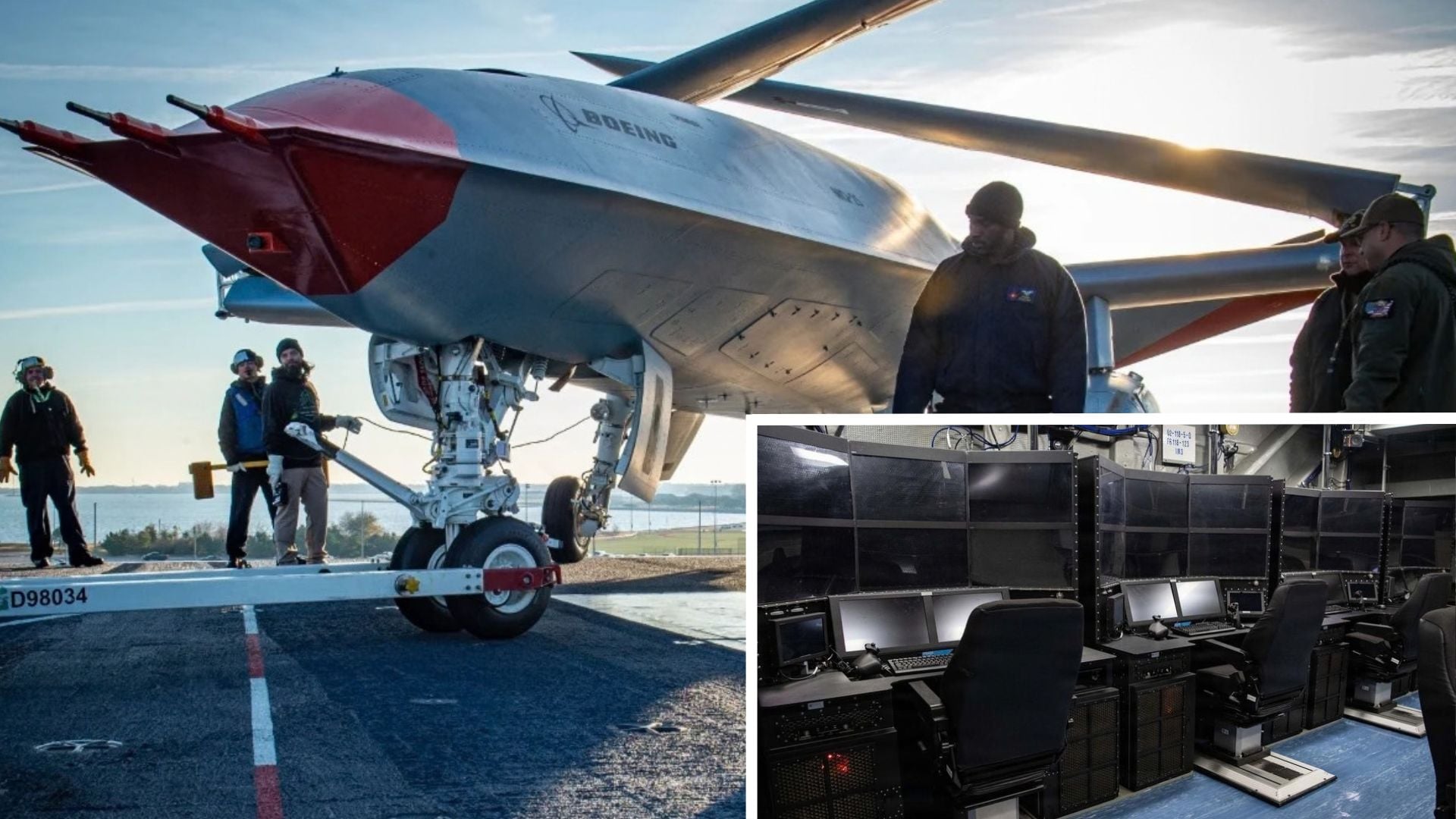
The US Navy has made USS Ronald Reagan (CVN 76) its second aircraft carrier ready to fly the Boeing MQ-25A Stingray unmanned aerial refueler, after a Lockheed Martin Unmanned Air Warfare Center (UAWC) was installed during the ship’s 17-month maintenance period at Puget Sound Naval Shipyard in Bremerton, Washington. The Navy announced the milestone on October 1, 2026, one day after Lockheed Martin disclosed it.
Reagan joins USS Theodore Roosevelt (CVN 71), whose UAWC became the first fully operational and deployable MQ-25 installation in March 2026, according to Pentagon acquisition reporting. That report set the end of August 2026 as Reagan’s target, and Lockheed Martin says the ground control station went aboard that month. The shipboard infrastructure now runs well ahead of the aircraft: the first MQ-25A engineering development model flew on April 25, 2026, the program cleared Milestone C for low-rate initial production in May 2026, and initial operational capability (IOC), defined as three deployable aircraft with trained crews, is set for 2029.
Inside the MQ-25A Stingray Control Center Aboard USS Ronald Reagan
The UAWC is the compartment from which air vehicle pilots will command the Stingray at sea, and the Navy describes it as the operational hub for MQ-25A command and control. Its core is an MD-5C ground control station that pairs the government’s command, control, communications, computers and intelligence (C4I) network with Lockheed Martin Skunk Works computing hardware and Multi-Domain Combat System (MDCX) software, which provides mission planning and execution. Government-furnished communications and networking equipment complete the suite. Earlier Pentagon acquisition documents referred to an MD-5E configuration; the Navy has not publicly explained the difference between the two designations.
Operators do not fly the Stingray with stick inputs. They issue commands, and the aircraft executes taxi, takeoff, flight and landing autonomously. The Navy has developed shore, at-sea and expeditionary variants of the MD-5, so the aircraft can be controlled from land sites or ships. The air vehicle and ground control station first connected during integration checkout testing in October 2025, a prerequisite for the April first flight in Illinois.
Reagan’s shipyard schedule shaped the installation. Because the carrier spent 17 months in a docking planned incremental availability (DPIA), the Navy installed 11 modifications concurrently instead of spreading them across a multiyear, phased approach. Since the ship left the yard in late August, its crew has run pier-side and at-sea test events to validate the center’s readiness. Capt. Daniel Fucito, program manager for the Unmanned Carrier Aviation program office (PMA-268), credited the joint Navy and Lockheed Martin team and said both carriers are now ready to fly the MQ-25A.
How the MQ-25A Tanker Frees Super Hornets for Strike Missions
The Stingray is a Group 5 unmanned aircraft powered by a single Rolls-Royce AE 3007N turbofan. Publicly available specifications indicate a length of about 51 feet, a wingspan of about 75 feet that folds to roughly 31 feet for deck handling, and an offload of about 15,000 pounds of fuel to receivers 500 nautical miles from the carrier. Boeing lists the F/A-18E/F Super Hornet, F-35C Lightning II and E-2D Advanced Hawkeye among the aircraft it will refuel. Maritime intelligence, surveillance and reconnaissance (ISR) is a secondary mission. The design traces to the Carrier-Based Aerial Refueling System (CBARS) requirement, which narrowed the Navy’s earlier Unmanned Carrier-Launched Airborne Surveillance and Strike (UCLASS) concept to a tanker-first aircraft; Boeing won the engineering and manufacturing development contract in August 2018. Fuel transfer relies on an underwing hose-and-drogue aerial refueling store, which publicly available information indicates is of the same family Super Hornets carry for buddy tanking.
The operational case rests on the air wing’s tanking burden. Today, Super Hornets carrying buddy refueling stores fly the organic tanker mission, which previously reported Navy estimates put at 25 to 30 percent of Super Hornet sorties. Each of those sorties consumes airframe life on fighters the Navy needs for strike, escort and fleet air defense. Moving the mission to an unmanned airframe returns those jets to combat roles and extends the radius of the air wing without pulling strike aircraft off the schedule. That reach carries more weight as long-range anti-ship missiles push carriers to operate farther from contested coastlines, stretching the distance fighters must cover to reach their targets.
Analysis: Both MQ-25A-ready carriers belong to the Pacific Fleet, with Theodore Roosevelt homeported in San Diego and Reagan in Bremerton, placing the first unmanned tanker capability where distance and anti-access threats make organic refueling most valuable. Two deployable control centers exist three years before IOC, while the aircraft has flown only from land and a qualification-tested MDCX software build, funded under a Naval Air Systems Command contract worth up to $57.7 million announced September 30, is due by September 2027. Ship readiness is no longer the constraint; software qualification and carrier suitability testing are. The Navy also frames the UAWC as the command and control template for future unmanned carrier aircraft, including collaborative combat aircraft (CCA).
Near-term milestones include the transfer of MQ-25A test aircraft to Naval Air Station Patuxent River, planned for late 2026, for envelope expansion and carrier qualification preparation, followed by the first shipboard launch and recovery. The Navy has not disclosed which carrier will host initial at-sea trials, when a Stingray detachment will embark operationally, or which ship receives the next UAWC. IOC remains set for 2029.