Saudi-backed Yemeni government forces launched a ground offensive on October 5, 2026, to retake the Bab al-Mandab Strait from the Iranian-backed Houthi movement, as the Saudi-led coalition committed 100 combat aircraft to the opening strikes of Operation Dawn of Yemen. Government officials claimed control of Dhubab district and the strait. Houthi-run media denied any advance, and neither account could be independently verified.
The operation puts into motion the all-out campaign announced on October 4 by Rashad al-Alimi, chairman of the Presidential Leadership Council (PLC), to recover all territory lost to the Houthis since they seized Sanaa in 2014. Its immediate objective is to reverse the Houthi offensive of September 10 and 11, which took Mokha, Dhubab and Perim Island and returned the group to the strait’s eastern shore after nearly a decade. Fighting reignited in July after the 2022 truce collapsed; the World Health Organization counts more than 800 dead since early August, and the World Food Program more than 150,000 displaced.
Operation Dawn of Yemen: 100 Jets and a Flanking Push on Dhubab
Colonel Majid al-Nuzaili, spokesman for the government’s armed forces, said in an Arabic-language post on X that troops had “executed a flanking operation to gain control over the Bab al-Mandab Strait.” He said the Giants Brigades and the Saudi-funded Nation’s Shield Forces had seized Dhubab airport and cut the Dhubab-Mokha coastal road.
Al-Nuzaili said hundreds of Houthi fighters were encircled in Dhubab and had been called on to surrender, while others escaped by boat. Yemen’s deputy defense minister went further, claiming “full control” of the strait and of Perim, known locally as Mayun Island. Houthi-aligned media called the reports completely untrue.
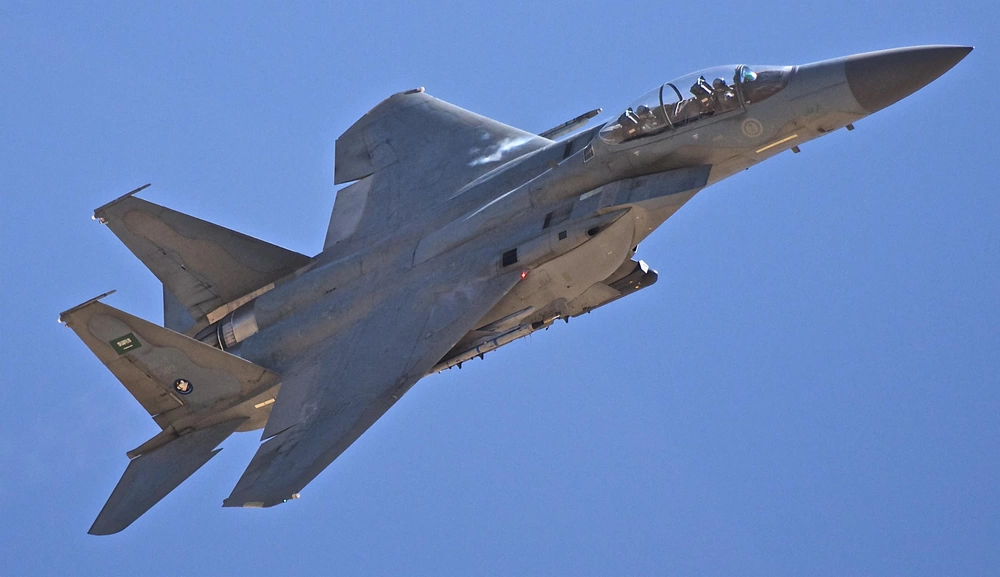
In the air, Major General Turki al-Maliki, spokesman for the Saudi-led coalition, said 100 fighter jets flew in the dawn launch of the operation and had destroyed 324 “high-value targets.” He said coalition aircraft were covering the strait and supporting ground units around the clock. The coalition did not disclose aircraft types or say whether air forces other than Saudi Arabia’s took part. Publicly available data indicate that the Royal Saudi Air Force strike fleet centers on the Boeing F-15SA and the Eurofighter Typhoon. A wave of that size suggests an effort to suppress Houthi missile and drone launchers on the high ground overlooking the strait before ground units consolidate.
More than 200 U.S. intelligence and military analysts are working in Saudi command centers, helping analyze and select targets for Riyadh’s Yemeni allies, and U.S. aircraft are refueling Saudi jets flying defensive air patrols, according to current and former U.S. officials speaking anonymously to reporters. President Trump turned down Saudi requests in September for U.S. forces to strike Houthi-held targets directly. U.S. Central Command declined to comment.
What Bab al-Mandab Control Means for Saudi Red Sea Oil Exports
Publicly available geographic data put the strait at roughly 32 kilometers wide at its narrowest. Perim divides it into a narrow eastern channel of about 3 kilometers and a western channel of roughly 25 kilometers that carries most deep-draft traffic. A force holding Perim and the high ground around Dhubab can cover both lanes with short-range weapons, which makes the claimed encirclement on the island as significant as the advance on Dhubab.
With the Strait of Hormuz contested by the U.S.-Israeli war with Iran, now in its eighth month, Saudi Arabia has leaned on its Red Sea coast as the alternative export route, fed by the East-West pipeline to Yanbu, which publicly available figures rate at about 7 million barrels per day. Cargoes from Yanbu bound for Asian buyers must exit the Red Sea through Bab al-Mandab. The Houthis declared a blockade on Saudi shipping in the Red Sea in July, and an attack shut the pipeline before tankers resumed loading.
The Houthi arsenal keeps that route exposed regardless of who holds the shoreline. Open-source assessments credit the group with shore-launched anti-ship ballistic and cruise missiles, one-way attack drones and explosive uncrewed surface vessels, all employed against commercial shipping during its 2023 to 2025 Red Sea campaign. On October 3, the Houthis claimed a missile and drone strike that set fires at an Aramco facility in Riyadh; video showed a refinery fire in the city, while al-Maliki called the claim misleading. Houthi official Mohammed al-Bukhaiti has warned that Saudi strikes will draw attacks on the kingdom’s oil facilities.
Inland, Houthi forces captured Al-Turbah, a town on the main Taiz-Aden road, on October 4, according to Yemeni officials, further isolating Taiz.
Analysis: Operation Dawn of Yemen tests whether Riyadh can secure a Red Sea alternative to Hormuz without direct U.S. firepower. The American contribution, targeting support and aerial refueling, mirrors the model behind the 2015 intervention, which never produced a decisive result. Retaking Dhubab and Perim would push Houthi forces back from the waterline, but missile and drone units in the highlands can still reach the shipping lanes from well inland. The operational measure of success will be tanker traffic and war-risk insurance through the strait, not the line of control on the coast.
The next indicators are independent confirmation of government control over Dhubab and Perim, whether the coalition can sustain its air tempo beyond the opening wave, and whether the Houthis act on threats against Saudi energy infrastructure. Still unknown: whether other coalition air forces will join, whether Washington will widen its role, and how government forces will relieve Taiz while pushing north toward Mokha.