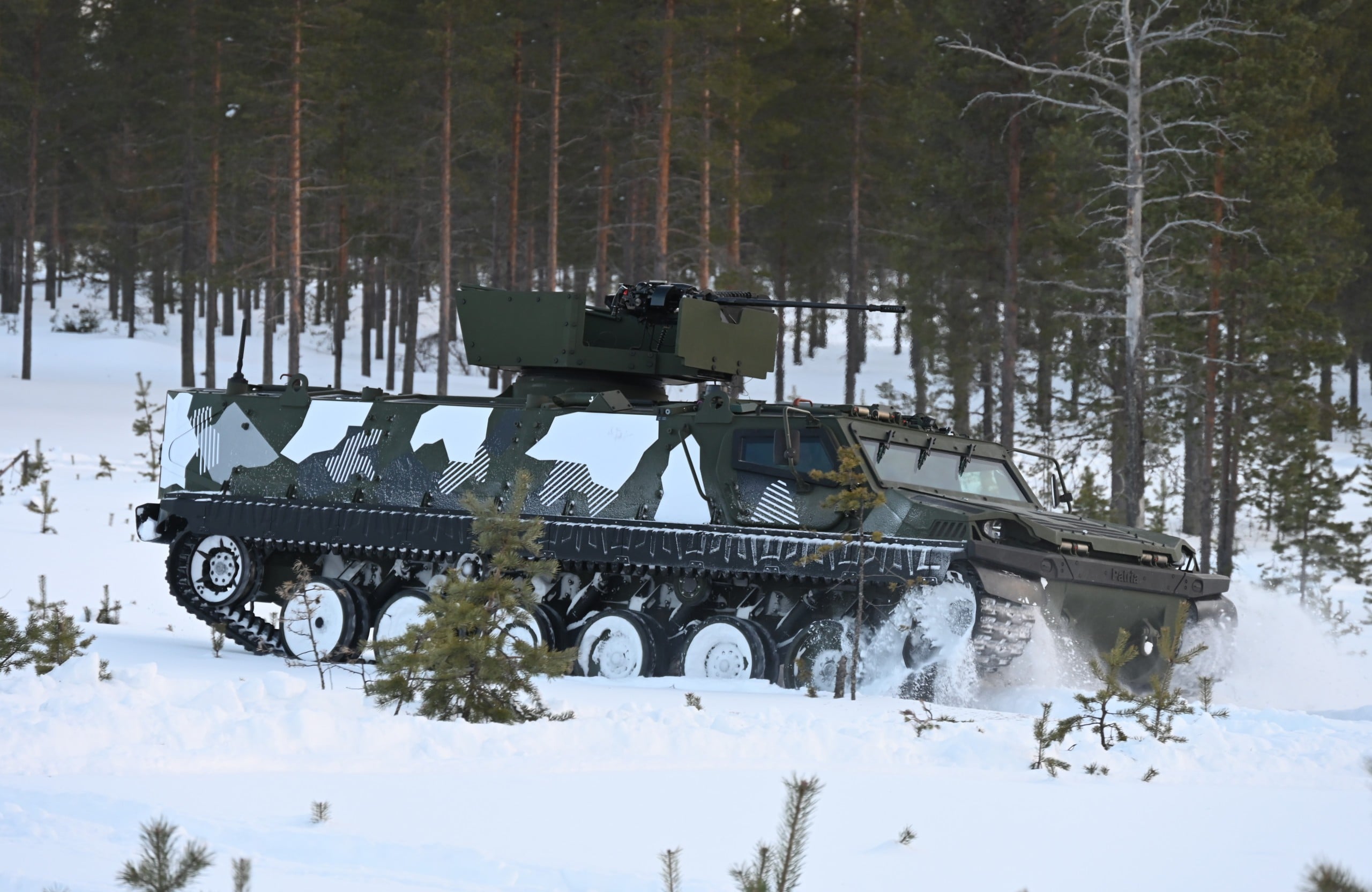
RENK Group AG has secured a €30 million (roughly $35 million) follow-on order from Patria for HSWL 076 transmissions to equip the TRACKX tracked vehicle family, the Augsburg, Germany-based propulsion manufacturer announced on October 6, 2026. Deliveries are scheduled to begin in 2027. RENK did not disclose how many transmissions the order covers.
The contract builds on an initial pre-production batch Patria ordered at the beginning of 2026, and RENK describes the new award as significantly more comprehensive. It arrives days after Finland and Sweden initiated their first TRACKX procurements at the end of September, moving the light tracked armored personnel carrier (APC) from development into the acquisition cycle. Developed under the European Future Highly Mobile Augmented Armoured Systems (FAMOUS) program, co-funded by the European Defence Fund (EDF), TRACKX is positioned by Patria as a replacement for aging M113 and MT-LB tracked carriers.
Patria TRACKX Moves From Pre-Series Batch Toward Serial Production
The procurement sequence accelerated through 2026. On June 15, the Finnish Defence Forces and Sweden’s Defence Materiel Administration (FMV) signed an Implementation Arrangement at Eurosatory in Paris covering pre-series procurement preparation and technology cooperation. On July 7, Finland, Norway, and Latvia signed a statement of intent at the NATO summit in Ankara, Türkiye, to share field-trial results and explore joint procurement and development. According to the Finnish Ministry of Defence, a multinational program modeled on the Common Armoured Vehicle System (CAVS), the framework built around the Patria 6×6, is being prepared under Finnish leadership.
The first contracts followed in late September. Sweden is buying five pre-series vehicles for testing and evaluation, while Finland has not disclosed its quantity. The two countries also signed a letter of intent covering potential serial production. Vehicle deliveries start in 2027, followed by field trials, some conducted jointly.
Michael Masur, CEO of RENK’s Vehicle Mobility Solutions (VMS) division, called the Finnish and Swedish buys “a key step towards series production for TRACKX.” Neither company has published unit numbers or pricing, so public information does not establish whether the €30 million is sized for pre-series vehicles alone or anticipates serial output.
HSWL 076 Transmission Specifications and TRACKX Mobility Design
RENK developed the HSWL 076 with Patria over roughly two years and unveiled it at DSEI in London in September 2025. The transmission weighs around 700 kg, supports road speeds of up to 90 km/h, and integrates propulsion, steering, and braking in a single digitally controlled drivetrain. It carries an integrated digital interface and monitoring systems and is prepared for hybrid drives. RENK says it was designed to meet UN ECE R79 steering and ECE R13 braking regulations, which eases peacetime road movement. RENK now rates it for vehicles in the 10 to 20 tonne class, revised from the 13 to 21 tonne band quoted at launch.
TRACKX sits in the middle of that envelope. Patria lists an empty weight of 12 tonnes, a payload of 3.5 tonnes, and a combat weight of 15.5 tonnes, with a driver, a commander, and up to 10 dismounts on blast-attenuating seats. A 269 kW (about 360 hp) engine delivers 80 km/h on roads and a range of up to 500 km, leaving the transmission 10 km/h of headroom. Protection is rated at STANAG 4569 Level 1 against ballistic and mine threats.
The vehicle runs on 56 cm-wide rubber tracks with independently adjustable hydropneumatic suspension at each road wheel, producing a nearly flat underside free of torsion bars. It swims at 4 km/h on track propulsion, climbs 60 percent gradients, and crosses 2 m gaps. Publicly available specifications for the M113A3 and MT-LB indicate road speeds in the low-to-mid 60 km/h range, giving TRACKX an advantage of roughly 15 km/h or more on hard surfaces, a practical gain for units moving between dispersed positions.
Drive-by-Wire Heavy UGV Concept Extends the HSWL 076 Roadmap
The same architecture underpins a second line of effort. At Eurosatory 2026, held in Paris from June 15 to 19, RENK and Patria displayed a heavy unmanned ground vehicle (UGV) showcase model combining the TRACKX platform with the HSWL 076 and RENK’s drive-by-wire mobility architecture. Because steering, braking, and propulsion are commanded electronically, RENK says the drivetrain supports remote operation, platooning, crew-sharing concepts, and future autonomous functions without a fundamental redesign of the vehicle. The architecture is pitched for crewed, optionally crewed, and purpose-built uncrewed tracked vehicles, including retrofits.
Patria President and CEO Panu Routila tied the concept to lessons from Ukraine, calling unmanned systems a “battlefield necessity” and stressing commonality between Patria’s crewed and uncrewed vehicles. A shared transmission, spares pool, and maintenance pipeline across APCs and robotic variants would lower the sustainment cost of fielding UGVs at scale. The concept has not moved beyond a showcase model: neither company has disclosed UGV payload, mission modules, or autonomy level, and no customer has been announced.
Analysis: The order represents roughly 2 percent of RENK’s approximately €1.4 billion in fiscal 2025 revenue, so its weight is strategic rather than financial. If Finland replicates the CAVS model around TRACKX, the HSWL 076 becomes the drivetrain baseline for a multinational fleet replacing M113 and MT-LB carriers on NATO’s northern flank, with pooled life-cycle support sustaining spares and overhaul demand across the fleet’s service life. The drive-by-wire layer widens that position: as armies move toward optionally crewed and robotic tracked vehicles, the transmission becomes the interface autonomy kits command, giving RENK a stake in the uncrewed transition whichever software or sensor suppliers win that work.
Transmission deliveries under the new order begin in 2027, alongside the first Finnish and Swedish pre-series vehicles and the field trials that follow. The next decision points are the joint procurement arrangement Finland is assembling with Norway and Latvia, which targets national serial orders from 2027, and Patria’s transition to serial production in 2027 or 2028. Open questions include the transmission quantity on order, Finland’s pre-series numbers, whether Norway and Latvia convert intent into contracts, and whether an unmanned TRACKX attracts a launch customer.