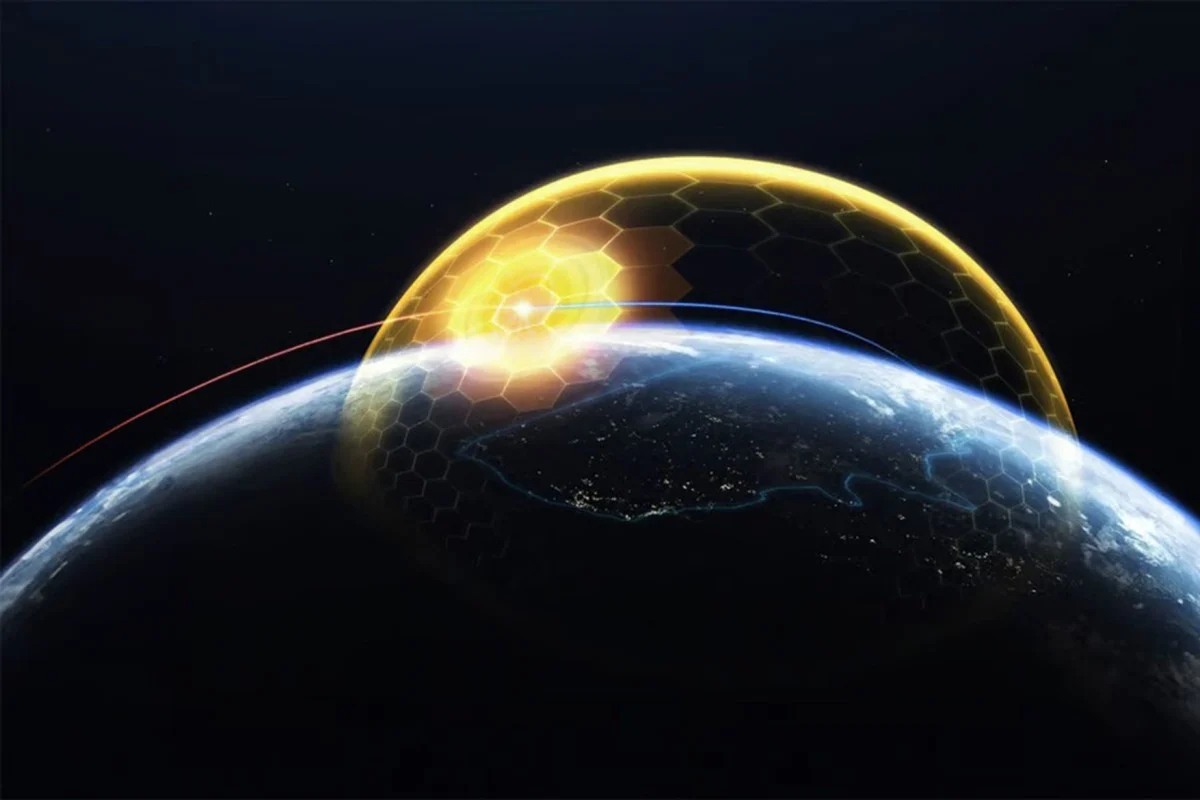
The U.S. Space Force is on course to test Golden Dome space-based interceptors before December 31, 2026, with on-orbit flight demonstrations to follow in 2027. The step would move kinetic kill vehicles toward low Earth orbit for the first time, even as the program confronts a fiscal 2027 funding cliff that its director warns could stop it.
Golden Dome for America began with a January 27, 2025, executive order directing the Defense Department to build a layered shield against ballistic, hypersonic, and cruise missile threats from boost phase through terminal descent. The administration funded the effort almost entirely through budget reconciliation rather than regular appropriations, a route that let work start fast but left the program without a discretionary baseline. That choice now defines the fiscal 2027 fight.
Golden Dome Missile Defense Nears First Space Interceptor Tests
The Golden Dome missile defense architecture is built to detect, track, and destroy missiles across every phase of flight, integrating satellite sensors, command-and-control networks, and interceptors on land, at sea, and in orbit. The orbital layer is the program’s defining break from existing capability. Today’s space assets provide warning, detection, tracking, and communication; Golden Dome would place kinetic weapons in low Earth orbit able to engage a missile shortly after launch.
Space Systems Command has awarded about $3.2 billion in other transaction authority agreements to 12 companies, including Anduril Industries, Lockheed Martin, Northrop Grumman, Raytheon, SpaceX, and True Anomaly, to build space-based interceptor prototypes. The contenders cleared the first of four gates in the Space Force’s prize-based competition in mid-2026, and an initial June test demonstrated sensor-to-interceptor data transfer and propulsion. The first test sequence is scheduled before the end of 2026, with orbital flight demonstrations expected in 2027 and integration into the wider architecture targeted for 2028.
Feasibility hinges on physics that scale badly. Because interceptors in low Earth orbit move constantly, only a fraction of the constellation sits over any threat at once, so continuous coverage demands large numbers. The Congressional Budget Office modeled a notional design requiring roughly 7,800 satellites, each costing an estimated $22 million with a five-year service life before orbital decay forces replacement. Even that constellation could engage only about 10 intercontinental ballistic missiles at the same time, by the office’s assessment. This mismatch between interceptors on orbit and the threats they can service, the absentee ratio, is the core constraint on the layer the executive order treats as essential.
Reconciliation Funding Leaves Golden Dome Exposed in FY27
The 2025 reconciliation law, the One Big Beautiful Bill Act, provided about $25 billion to launch Golden Dome in fiscal 2026; program director and Space Force General Michael Guetlein says roughly 90 percent is already obligated. For fiscal 2027, the Pentagon requested about $17.5 billion but placed less than $400 million in the base budget. The remaining 97 percent sits in a $350 billion reconciliation package facing resistance on Capitol Hill.
Reconciliation lets Congress move money on a simple majority, without a filibuster, which is why the administration used it. The drawback is structural. A program funded this way has no prior-year discretionary baseline, so a continuing resolution, which holds spending at previously enacted levels, offers nothing to fall back on. With the fiscal year starting October 1, 2026, and appropriations unfinished, Golden Dome could run dry even as its contractors hit their technical marks.
Guetlein put the stakes plainly at a defense symposium in Huntsville, Alabama, warning that without a fix, there is no Golden Dome because there is no funding. He said the department is weighing contingencies, including reshuffling other funds, though no decision has been made, and some space capabilities could shift to Space Force accounts. Congressional appetite for another reconciliation bill looks thin, with senior Senate Republicans signaling in June that another such measure is unlikely. Tens of billions in live contracts and a 20-company industrial base now hang on how Congress resolves a financing problem it has not faced in this form.
The Cost Gap: From $252 Billion to $3.6 Trillion
Cost estimates for Golden Dome span more than an order of magnitude, and the spread is itself a signal. President Trump initially set the price near $175 billion; Guetlein has cited about $185 billion over 10 years. The Congressional Budget Office estimated in 2025 that the space-based interceptor layer alone could cost $161 billion to $542 billion over 20 years. In May 2026 it raised its assessment of a broadly compliant national missile defense system to roughly $1.2 trillion over two decades, with acquisition accounting for just over $1 trillion. The space-based interceptor constellation drove about 60 percent of the total and close to 70 percent of acquisition.
A 2025 American Enterprise Institute analysis modeling six architectures ranged from $252 billion for a limited tactical defense against drones and cruise missiles to $3.6 trillion for a robust shield against all threats. Its author, Todd Harrison, argued the executive order’s requirements align with the most expensive option, not the administration’s figure.
The divergence reflects an architecture that has not been fixed. The budget office noted the Defense Department has released few details on which platforms, and how many, will compose Golden Dome, and built its estimate on a notional design. Guetlein counters that independent estimates do not describe the system being built. Until the Pentagon sets coverage area, threat set, and interceptor counts, the cost cannot be bounded, and each choice moves the figure by hundreds of billions of dollars.
Analysis: Golden Dome’s near-term risk is fiscal, not technical. Contractors are meeting design and test milestones, and kinetic intercept from orbit is demonstrable in principle. What remains unproven is the program’s financial foundation. The trillion-dollar range between official and independent estimates is not analytical noise; it measures how much of the architecture is still undecided, because cost tracks directly to coverage, threat set, and constellation size. A program this large, routed deliberately around annual appropriations, has concentrated its vulnerability in one budget mechanism. The fiscal 2027 decision, not the 2027 flight demonstrations, is the test of whether Golden Dome scales or stalls.
The next markers are concrete. Initial interceptor testing is due before December 31, 2026, followed by on-orbit demonstrations in 2027 and planned integration into the wider architecture in 2028. The nearer decision point is October 1, 2026, when Congress must advance the reconciliation package, find another funding path, or accept a stall. Pentagon leaders are weighing whether to move existing money to sustain work in the interim. The architecture’s final shape, its coverage, threat priorities, and interceptor totals, remains the largest unknown, setting both the program’s cost and its credibility.