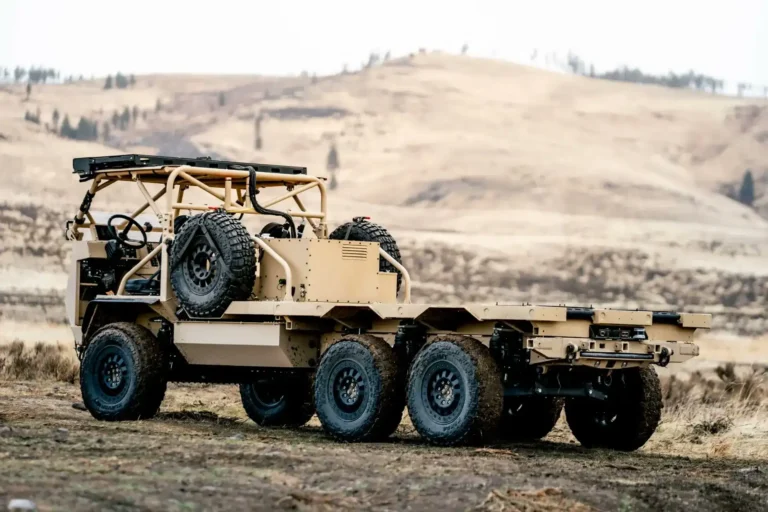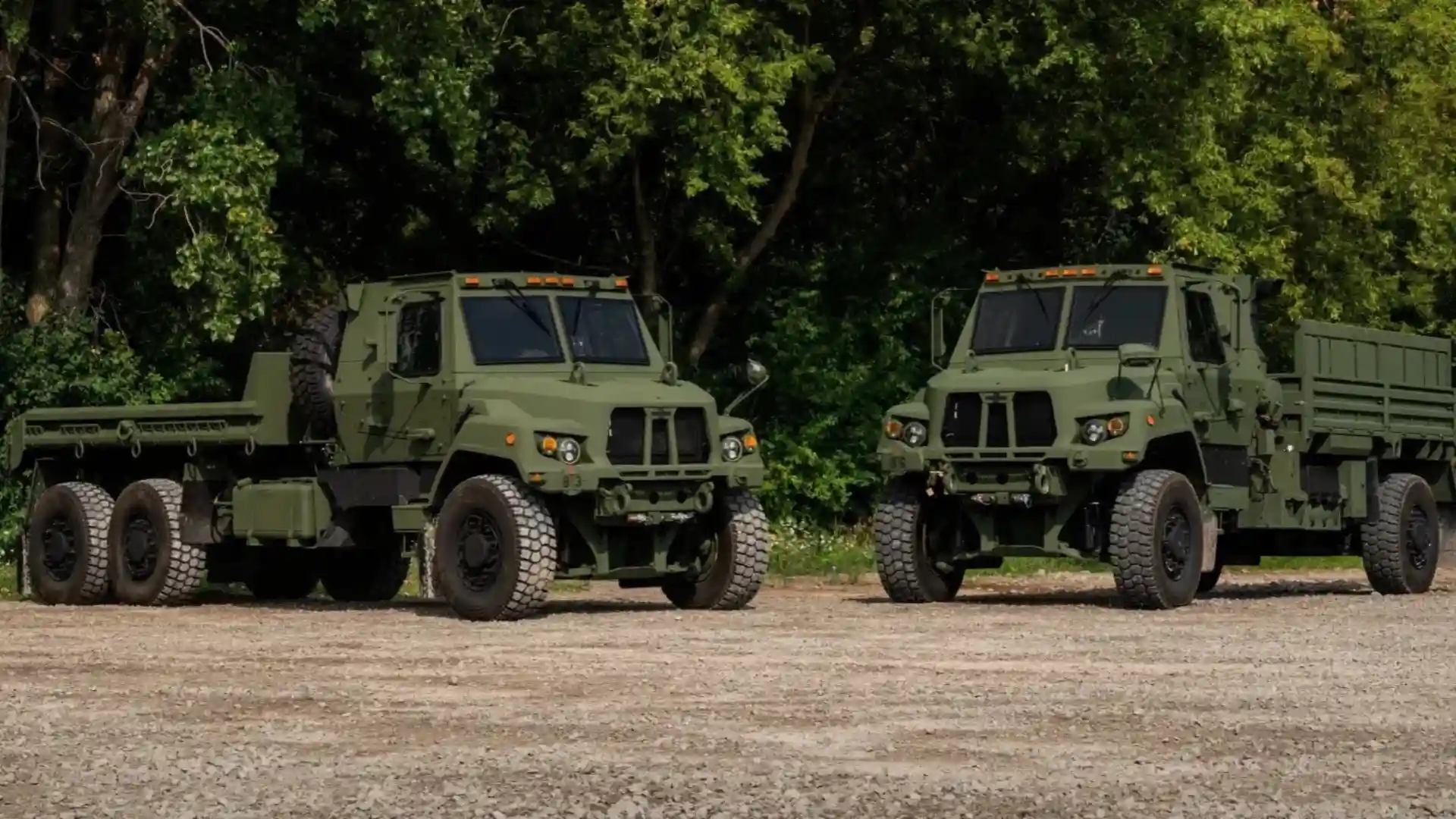
Oshkosh Defense announced on November 10, 2026, that the US Army has placed an additional $31 million order for Family of Medium Tactical Vehicles (FMTV) A2 Low-Velocity Airdrop (LVAD) cargo trucks in 4×4 and 6×6 configurations. The award lifts cumulative Army orders for the airdroppable variant to 953 vehicles, according to the company.
The order follows more than $75 million in FMTV A2 LVAD orders placed earlier in 2026. On January 20, Oshkosh announced a contract for 97 LVAD cargo trucks in both configurations, bundled with Arctic kits for extreme-cold operations; on February 5, it disclosed a $25 million order for additional 4×4 cargo trucks and kits, when cumulative orders stood at 797. The program upgrades the Army’s existing LVAD fleet for airborne and rapidly deploying units, including the Mobile Brigade Combat Teams (MBCTs) cited in the January award.
FMTV A2 LVAD Design: Collapsible Cabs and Post-Drop Armor
The FMTV A2 LVAD family comprises three variants, according to the Pentagon’s Director, Operational Test and Evaluation (DOT&E): a 3-ton cargo truck on the 4×4 Light Medium Tactical Vehicle (LMTV) chassis, an 8-ton cargo truck on the 6×6 Medium Tactical Vehicle (MTV) chassis, and a 7-ton MTV dump truck. The current orders cover the two cargo variants. Earlier LMTV and MTV models carried 2.5 and 5 tons, respectively.
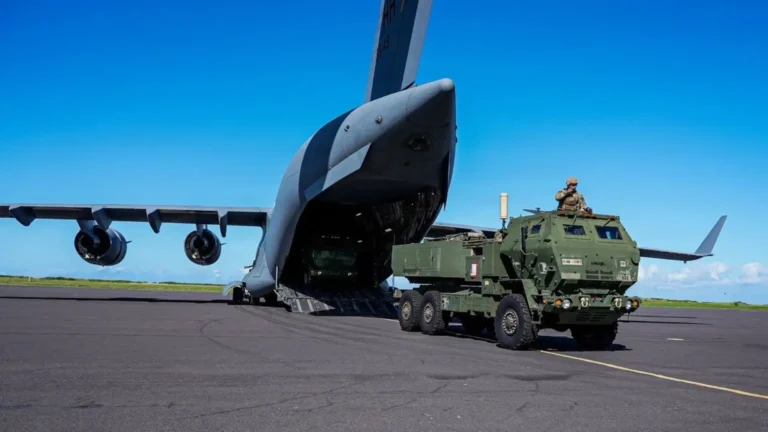
What separates the LVAD trucks from standard FMTV A2 vehicles is the cab. All three variants share a non-armored, collapsible cab that allows loading aboard US Air Force C-130 Hercules and C-17 Globemaster III transports for airdrop. Armor must be installed after the drop to restore kinetic protection. Live fire testing at Aberdeen Proving Ground, Maryland, between December 2023 and June 2024 found that the armored LVAD cab delivers the same survivability as non-LVAD armored FMTV A2 trucks against kinetic threats, including side and underbody improvised explosive devices.
Beneath the cab, the LVAD variants share the A2 upgrades listed by DOT&E: increased engine horsepower, an adjustable suspension system, higher wheel and cargo capacity, an upgraded data bus with a simplified electrical system that improves diagnostics and troubleshooting, increased electrical power capacity, and Electronic Stability Control integrated into the anti-lock braking system. For airborne units, the result is a truck that lands as a full logistics asset rather than a stripped-down shuttle.
C-17 and C-130 Airdrop Certification and Contract Timeline
The 6×6 MTV cargo variant led the test program. After rigging and simulated airdrop impact trials at Fort Bragg, North Carolina, then named Fort Liberty, the Army conducted three live drops: December 2023 from a C-17, January 2024 from a C-130, and February 2024 from a C-17. All three succeeded without major vehicle damage, and after each drop soldiers drove the truck 30 miles over paved and unpaved terrain. The 4×4 cargo variant completed three consecutive successful airdrops in early 2025 at Yuma Proving Ground, Arizona.
DOT&E’s fiscal 2024 annual report projected a full materiel release decision in the third quarter of fiscal 2026; that milestone has not been publicly confirmed. On the contract side, Oshkosh secured a three-year extension in June 2025 that allows the Army to keep ordering FMTV A2 trucks, including all three LVAD variants, through February 2028. The extension also allows production and fielding to continue into 2030, and the Army plans to award a follow-on production contract in fiscal 2028, according to a 2025 Army industry briefing.
Jeff Heggemeier, Vice President and General Manager at Oshkosh Defense, said each order reflects “the Army’s continued investment in a proven capability that supports the evolving needs of the changing battlefield,” adding that the truck’s flexibility “allows it to be adapted to various mission sets.”
Analysis: The value of the FMTV A2 LVAD lies in decoupling airborne sustainment from airfields. A force that can parachute an 8-ton-class cargo truck alongside its troops can move supplies off the drop zone without waiting for a runway to be seized or repaired, a requirement in any scenario where an adversary can hold airfields at risk. Modest, regular orders point to incremental replacement of the legacy fleet rather than a surge buy, keeping the line warm ahead of the 2028 recompete. The trade-off remains the post-drop armor requirement: until crews fit protection kits, LVAD trucks operate unarmored at the most exposed phase of an airborne assault.
Oshkosh has not disclosed unit quantities, delivery schedules or the 4×4 and 6×6 split for the latest order, and the Army has not published an acquisition objective for LVAD trucks, leaving open how close the 953 ordered vehicles come to the end state. The next decision point is the follow-on FMTV A2 production competition expected in fiscal 2028, which will determine whether Oshkosh retains the medium truck franchise as LVAD deliveries continue.