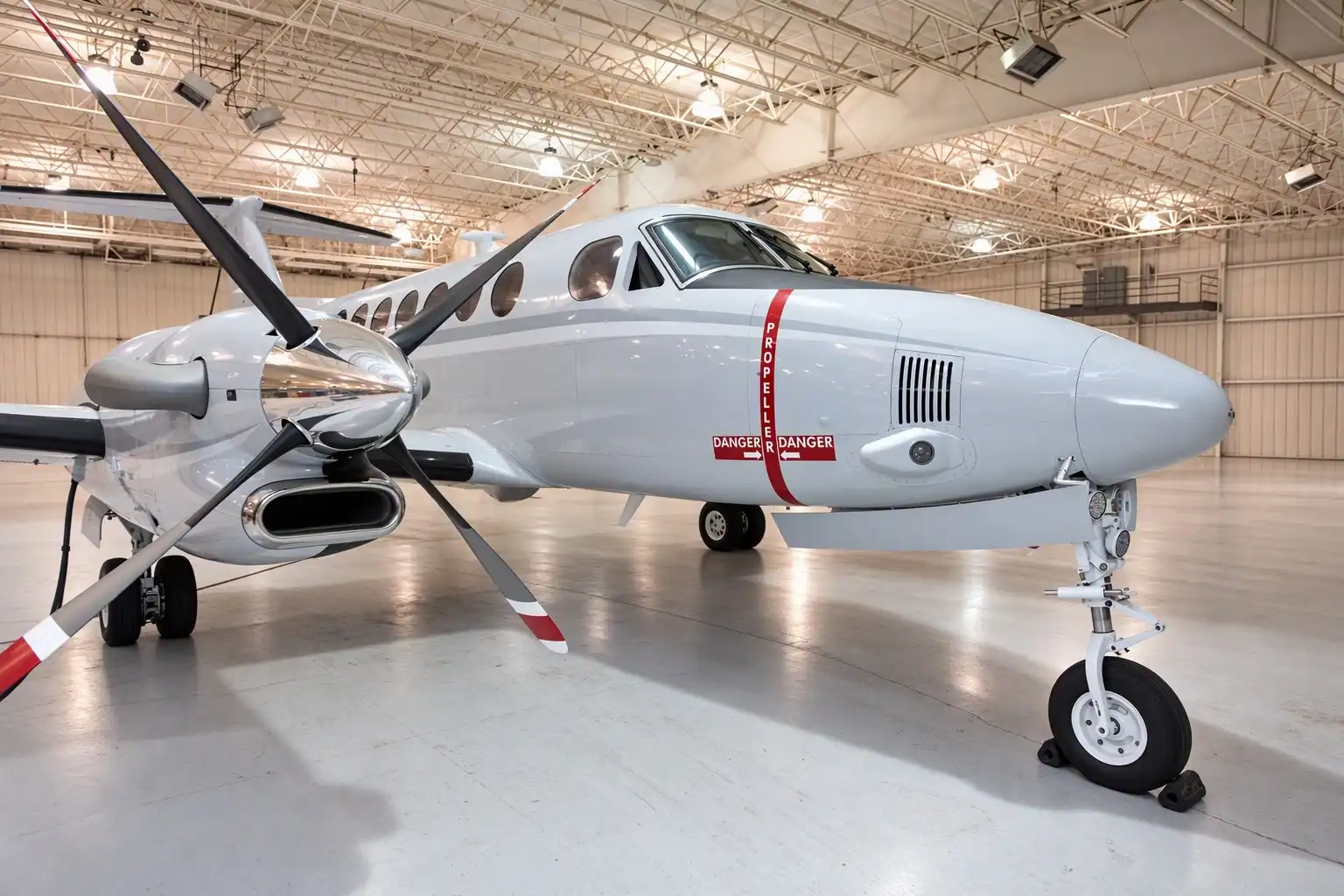
Naval Air Systems Command (NAVAIR) awarded Textron Aviation an $18.6 million firm-fixed-price contract on September 28, 2026, for one UC-12W+ aircraft, a militarized Beechcraft King Air 360CER, together with an initial package of spare parts for the U.S. Marine Corps. Textron Aviation disclosed the award on November 9, 2026. The aircraft is scheduled for delivery in 2028.
The order feeds the Marine Corps’ Operational Support Airlift (OSA) community, which moves high-priority passengers and cargo on short notice between and within theaters. The UC-12W entered service in 2010, two years after the Corps contracted for six King Air 350-based airframes in July 2008. The service now operates nine UC-12W and UC-12W+ aircraft against a projected fleet of 30, and is using them to replace legacy, nondeployable UC-12F, UC-12M and UC-35D utility aircraft. The UC-12F and UC-12M, both King Air 200 derivatives, entered service in 1986 and 1987.
Marine Corps UC-12W+ Contract Terms and Fleet Recapitalization Path
The Defense Department contract announcement puts the exact value at $18,557,557 and lists December 2029 as the completion date, which runs past the 2028 aircraft delivery. The award was made without competition: NAVAIR’s May 2026 synopsis cited 10 U.S.C. 3204(a)(1) and FAR 6.302-1 and identified Textron as the sole designer, developer and manufacturer of the UC-12W+. The Tactical Airlift Program Office (PMA-207) at Naval Air Station Patuxent River, Maryland, manages the requirement. Textron will perform 80 percent of the work in Wichita, Kansas, and 20 percent in Chihuahua, Mexico.
With this award, four UC-12W+ aircraft are now in production, all expected to deliver in 2028. Assuming no attrition, that would lift the active inventory to 13, still 17 airframes short of the program objective.
A larger vehicle is in preparation. In September 2025, NAVAIR announced its intent to negotiate a sole-source, multi-year contract with Textron for up to 17 UC-12W aircraft, covering production, non-recurring engineering, engineering change proposals and initial spares. That agreement carries a five-year ordering period, with an anticipated start in the first quarter of fiscal year 2027. NAVAIR has not published its value.
The fleet flies from several Marine Corps Air Stations and transportation squadrons, including Camp Pendleton, California. Neither NAVAIR nor Textron has said which unit will receive the new aircraft.
Inside the UC-12W+: King Air 360CER Power, Range and Mission Kit
The UC-12W+ is built on the King Air 360CER, the cargo-door, extended-range configuration of the King Air 360 twin turboprop. It pairs extended-range fuel tanks and a large cargo door with a Collins Aerospace Pro Line Fusion flight deck and two Pratt & Whitney Canada PT6A-60A engines. Publicly available specifications for the King Air 360ER rate each PT6A-60A at 1,050 shaft horsepower and list a 16,500 lb maximum takeoff weight, a useful load of about 7,145 lb, a 303 knot maximum cruise speed, a 35,000 ft ceiling and a ferry range of roughly 2,690 nautical miles.
Those figures define the gap with the aircraft being retired. The UC-12F and UC-12M fly on PT6A-42 engines with a 13,500 lb maximum gross takeoff weight, 3,000 lb below the UC-12W family. NAVAIR has previously credited the UC-12W’s extended-range tanks with stretching operational range at maximum payload from 800 nautical miles to 1,500 nautical miles, a margin that matters for Marine units spread across the Western Pacific.
Mission equipment includes secure military avionics and communications, night-vision-compatible lighting, weather detection, gravel-runway protection and aircraft survivability systems. Textron has not identified the specific survivability suite. The standard cabin seats eight passengers and converts to cargo, mixed-use or medical evacuation layouts with litters; the number of litter stations has not been disclosed. Gravel protection and survivability equipment are what separate the UC-12W+ from the nondeployable types it replaces, allowing it to operate from austere strips and in threat-exposed theaters rather than staying confined to garrison routes.
Analysis: The UC-12W+ fills a lift tier that Force Design and Expeditionary Advanced Base Operations make more relevant, not less. Dispersed Marine units generate steady demand for small-lot movement of personnel, repair parts and casualties, missions that would otherwise divert KC-130J tankers or MV-22B tiltrotors from higher-value tasks. A commercial-derivative turboprop with survivability equipment and a gravel kit absorbs that demand without consuming tactical lift. The constraint is pace: single-aircraft buys leave the program below half of its 30-aircraft objective in 2028, and the planned multi-year contract for up to 17 aircraft would close that gap only if fully exercised.
The next markers are the multi-year contract award, expected in the first quarter of fiscal 2027, and the UC-12W+ procurement quantities in the fiscal 2027 and 2028 budget requests. Delivery of the four aircraft in production is due in 2028. Still unknown are the multi-year contract’s value, the survivability suite configuration and the retirement schedule for the remaining UC-12F, UC-12M and UC-35D airframes.