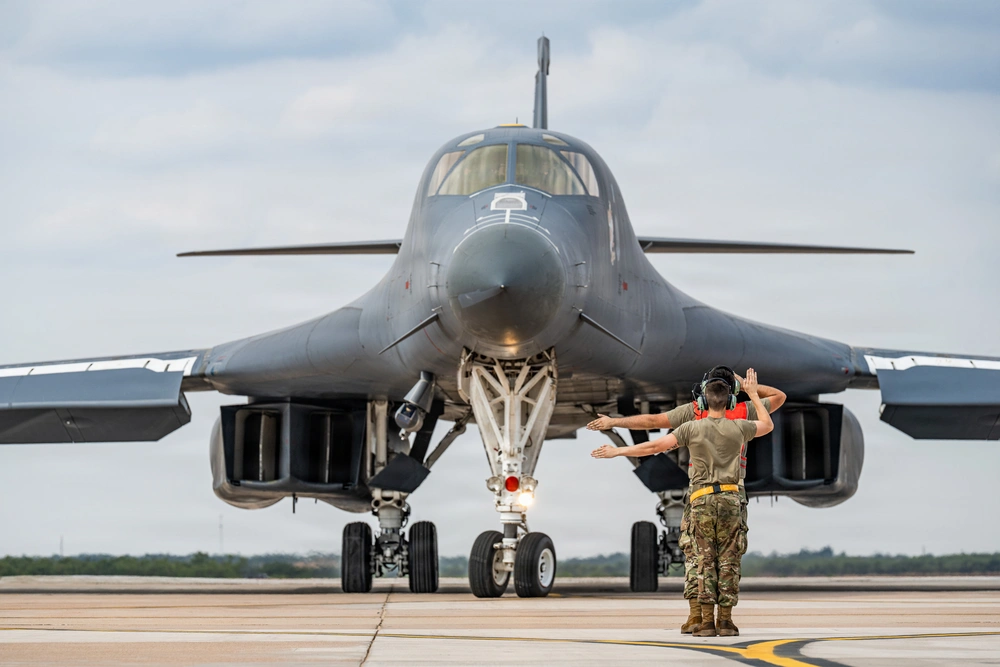
British counter-terrorism police arrested five men early on September 27, 2026, after officers intercepted three vehicles heading toward Royal Air Force (RAF) Fairford, the Gloucestershire airfield that has anchored U.S. Air Force bomber strikes on Iran since late February 2026. Gloucestershire Constabulary declared a major incident, evacuated roughly 85 households in nearby Whelford, and deployed Army bomb disposal teams to examine the vehicles inside a 400-meter cordon.
Fairford operates under a U.K.-owned, U.S.-operated arrangement dating to the Cold War and has hosted Bomber Task Force rotations of B-52 Stratofortress and B-1B Lancer aircraft for years. Its role sharpened after February 28, 2026, when the United States and Israel opened a war against Iran and the British government authorized American bombers to strike Iranian targets from the base. Iran’s Islamic Revolutionary Guard Corps (IRGC) warned in July 2026 that any British base used against Iranian territory was a legitimate target, naming Fairford’s bomber flights directly. Security around the airfield had already tightened in the days before Sunday’s arrests.
RAF Fairford Arrests: Timeline of the Overnight Raid
Gloucestershire Constabulary said officers received a call shortly before 1 a.m. reporting three vans traveling toward the base. Armed response units located the vehicles in Whelford and arrested five men on suspicion of offenses under the Explosives Act. The Metropolitan Police’s Counter Terrorism Policing command, which leads terrorism investigations across England and Wales, then rearrested the men on suspicion of preparing a terrorist act, a more serious offense that does not require an attack to have been carried out.
Assistant Chief Constable Richard Ocone said the vehicles were secured inside a 400-meter cordon while military ordnance specialists conducted their examination, and that around 85 households were moved to a nearby recreation center as a precaution. Deputy Assistant Commissioner Vicki Evans of Counter Terrorism Policing said the investigation remained in its early stages, with all five men still in custody.
Authorities have released no information on the men’s identities, nationalities, or a suspected motive, and no formal charges beyond the initial arrests had been announced as of Sunday afternoon. Police have not confirmed whether the vehicle examination recovered a viable explosive device, only that the operation was ongoing and the area was contained. The escalation from an Explosives Act arrest, an informal reference to the Explosive Substances Act 1883, to a Section 5 Terrorism Act 2006 arrest for preparing a terrorist act is a common investigative sequence in the United Kingdom: the narrower explosives offense can be established quickly at the roadside, while the broader terrorism charge, which itself carries a maximum sentence of life imprisonment, requires more time to establish intent.
RAF Fairford’s Bomber Missions Since the Iran War Began
Fairford has anchored U.S. Bomber Task Force deployments to Europe for decades, rotating B-52 Stratofortress and B-1B Lancer aircraft through the base alongside periodic U-2 reconnaissance detachments, all under the 501st Combat Support Wing, the U.S. Air Force unit responsible for American installations across the United Kingdom. That peacetime rotation model changed after February 28, 2026, when the United States and Israel launched a joint air campaign against Iranian missile and nuclear infrastructure. The British government, then led by Prime Minister Keir Starmer, granted the U.S. military permission to use Fairford for what it described as specific and limited strikes on Iranian targets, an arrangement that Starmer’s successor, Prime Minister Andy Burnham, has maintained.
Iran’s Islamic Revolutionary Guard Corps escalated its rhetoric toward the arrangement in July 2026, warning that any British installation used against Iranian territory would become a legitimate target and citing bomber flights originating from Fairford specifically. A U.S. Air Force spokesperson said the 501st Combat Support Wing and its sister wings across the United Kingdom ‘remain vigilant’ and continuously reassess the measures needed to protect service members, civilians, and contractors, while declining to detail specific force protection changes. Local officials, including member of Parliament Roz Savage, credited emergency services with a swift response, and Defense Secretary Wes Streeting said the country’s armed forces and emergency response teams remained on standby around the clock.
The base has drawn scrutiny before: peace activists breached its perimeter during the 2003 Iraq invasion, and Fairford has hosted periodic anti-war demonstrations at its main gate since. Sunday’s arrests mark the first time an approach to the base has triggered a terrorism-linked cordon since the Iran campaign began.
Analysis: The Whelford arrests expose a structural weakness in expeditionary air campaigns staged from allied soil: the host nation absorbs a domestic security burden the campaigning power’s homeland would not otherwise bear. Fairford remains a permeable, decades-old fixture in rural Gloucestershire rather than a hardened installation, so its perimeter depends on civilian policing and public tips, the chain that produced Sunday’s response. With Iran’s Revolutionary Guard Corps naming Fairford’s bomber flights directly in July 2026, British and American planners now face pressure to harden or disperse Bomber Task Force rotations while the Iran campaign continues.
Neither force has disclosed the men’s identities, nationality, or a specific motive, and it remains unclear whether the vehicle examination will support a viable explosives charge. The cordon stays active while ordnance specialists finish their work, a process that typically resolves within days. A charging decision, expected once forensic teams and initial interviews conclude, will mark the next milestone and will likely shape how tightly Britain polices the perimeter around Fairford for the remainder of the Iran campaign.