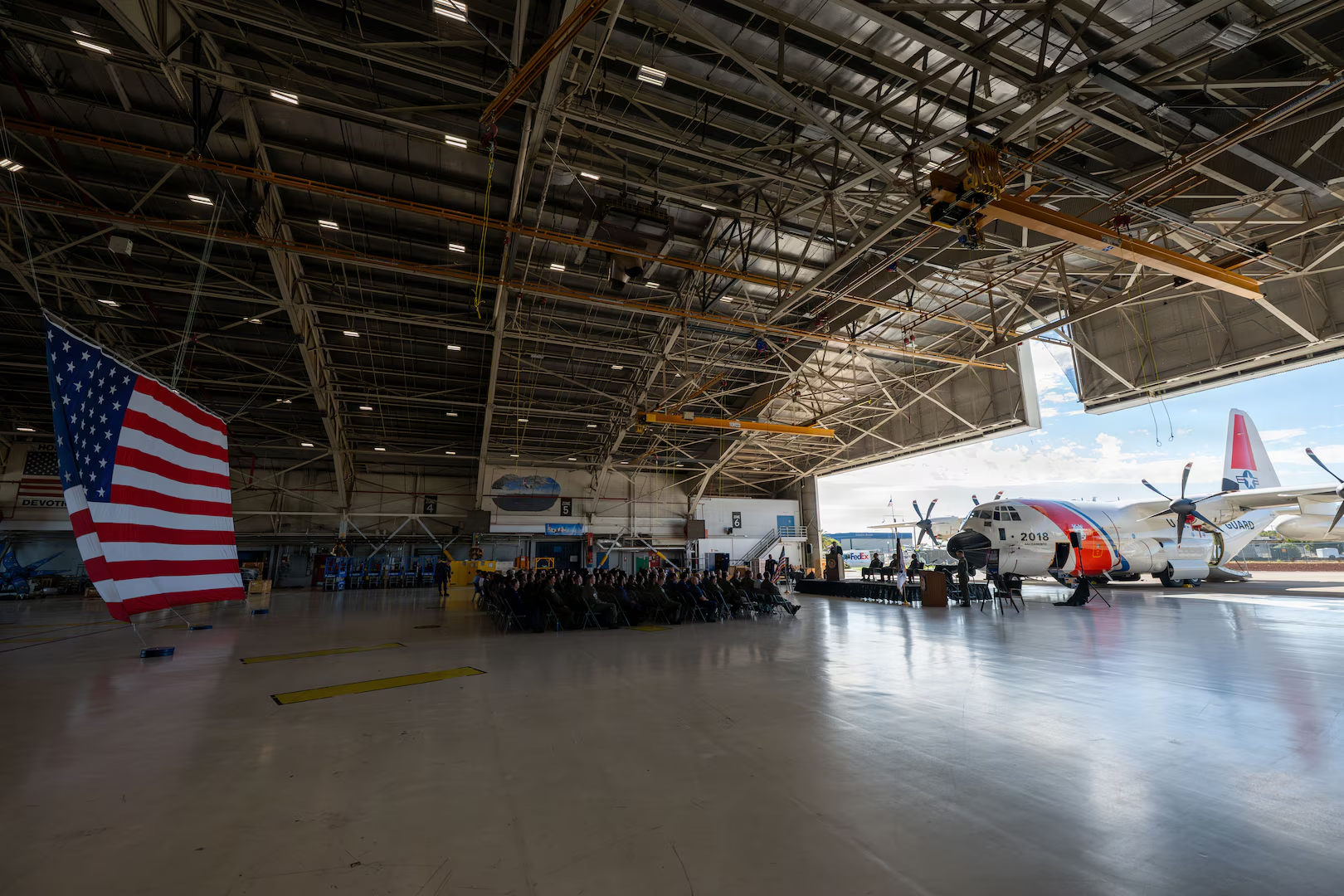
The U.S. Coast Guard marked the delivery of its first HC-130J Super Hercules to Air Station Sacramento, California, at a ceremony on September 10, 2026, starting the unit’s transition away from the C-27J Spartan. The aircraft, designated CGNR-2018, is the 18th missionized HC-130J in the fleet. Sacramento becomes the fourth air station to fly the type, joining Elizabeth City, North Carolina; Kodiak, Alaska; and Barbers Point, Hawaii.
The delivery returns the Hercules to a station that flew the HC-130H from 1978 until June 2016, when the C-27J took over. Sacramento received the first of 14 Spartans transferred from the Air Force under the Fiscal Year 2014 National Defense Authorization Act. The Coast Guard’s Minotaur missionization effort for the type, however, never advanced beyond a prototype first flown at Naval Air Station Patuxent River, Maryland, in September 2023. The service’s fiscal 2026 budget justification plans a 10-aircraft C-27J fleet and acknowledges the airframes were never outfitted to support Coast Guard missions.
Coast Guard HC-130J Range, Sensors, and Minotaur Mission System
The performance gap between the two aircraft defines the upgrade. Coast Guard figures rate the HC-130J at 320 knots true airspeed, 4,900 nautical miles of range, and more than 20 hours of endurance. The C-27J is rated at 290 knots, 2,675 nautical miles, and 12 hours. That is roughly 83 percent more range and at least 67 percent more endurance per sortie, margins that translate into time on station over distant patrol areas.
The airframe is a Lockheed Martin C-130J built in Marietta, Georgia. Publicly available specifications indicate four Rolls-Royce AE 2100D3 turboprops driving six-bladed Dowty R391 composite propellers and a service ceiling of 33,000 feet. The Coast Guard variant measures 97 feet 9 inches long with a 132-foot 7-inch wingspan. The second Sacramento airframe, CGNR-2019, is the first Coast Guard C-130J to receive the Block 8.1 upgrade on the production line, adding enhanced approach and landing systems, expanded diagnostics, and civil GPS.
Mission capability comes from missionization at L3Harris in Waco, Texas. The Minotaur Mission System Suite is a government-owned open architecture developed with the Navy. It fuses radar, sensor, and communications data into a single picture that crews process in flight and share in near real time with cutters, aircraft, and shore command centers. The package includes:
- a nose-mounted electro-optical/infrared (EO/IR) turret
- dual mission system operator stations on the flight deck
- Automatic Identification System (AIS) and direction-finding equipment
- a belly-mounted, 360-degree multimode surface search radar procured as the AN/APY-11, a derivative of the ELTA EL/M-2022A
The Coast Guard says the configuration lets the aircraft serve as an on-scene command-and-control node or as a surveillance asset that can detect, classify, and identify contacts.
Reconciliation Funding and the Sacramento HC-130J Delivery Timeline
The transition draws on the $24.593 billion the Coast Guard received through fiscal 2025 budget reconciliation. Of that total, $1.142 billion covers fixed-wing aircraft, training simulators, related equipment, and program management. The Senate Commerce Committee’s section-by-section summary tied that sum to six C-130Js and one simulator, and linked it to operational shortfalls from the C-27J program’s closeout. The Coast Guard now holds appropriations for 25 HC-130Js and is using part of the money to open HC-130J operations at two more air stations. Sacramento is the first; the service has not publicly named the second.
Deliveries to Sacramento are sequential and slow:
- CGNR-2018 was accepted in February 2026 after missionization in Waco.
- CGNR-2019, accepted from Lockheed Martin in April 2026, is now in missionization, with delivery expected in spring 2027.
- The third and fourth Sacramento aircraft, both reconciliation-funded, are not expected to begin arriving until fiscal 2030.
The Coast Guard has not published a Sacramento-specific C-27J drawdown schedule. Open-source reporting drawn from budget documents points to retirement of the Spartan fleet by the end of fiscal 2028.
The missionization line is also heading toward recompetition. A Department of Homeland Security acquisition planning forecast published in September 2026 lists a follow-on requirement worth more than $100 million. L3Harris is the incumbent under a $151.9 million firm-fixed-price contract awarded in 2015. The base requirement covers four aircraft, three for the Coast Guard and one for U.S. Customs and Border Protection’s Air and Marine Operations. The solicitation is targeted for July 2027, with award anticipated in the third quarter of fiscal 2028.
Analysis: The HC-130J gives Sacramento an aircraft equipped for its mission set, but the delivery math creates a capacity gap. The station’s end state of four HC-130Js replaces a Spartan complement that reached six aircraft in 2017. On paper, the trade holds: four aircraft each rated for more than 20 hours offer more aggregate endurance than six limited to 12. The risk sits in the interval. If the C-27J leaves service by fiscal 2028 as reported, Sacramento could fly just two HC-130Js for up to two years, a fleet in which a single maintenance event halves available lift. Vice Adm. Joseph Buzzella, commander of Coast Guard Pacific Area, tied the aircraft to interdicting migrant and narcotics flows through the nation’s maritime approaches. The service has not said how it will sustain that patrol demand during the gap.
The next milestone is the spring 2027 arrival of CGNR-2019, doubling Sacramento’s HC-130J inventory. After that, the decision points are the pace of C-27J retirements, the selection of the second new HC-130J air station, and the missionization recompete. Deliveries from fiscal 2030 will complete the station’s conversion.