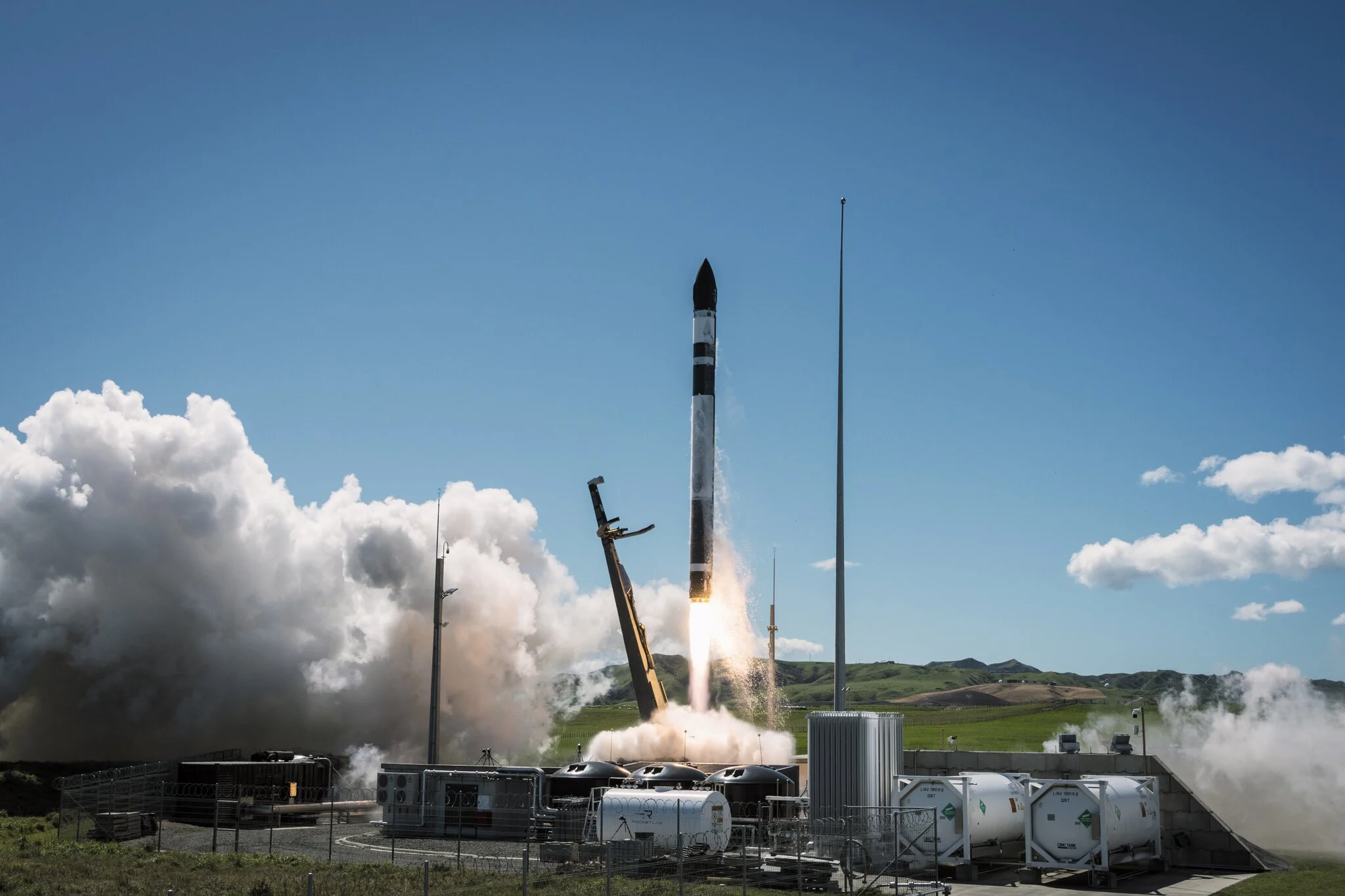
Rocket Lab launched its 97th Electron rocket on September 26, 2026, placing the 13th StriX synthetic aperture radar (SAR) satellite for Japanese operator Synspective directly into a 559-kilometer low Earth orbit. The Owlright Owlright Owlright mission lifted off at 12:39 p.m. local time from Rocket Lab Launch Complex 1 on New Zealand’s Māhia Peninsula and was the company’s 18th launch of 2026, according to Rocket Lab.
The payload carries defense weight. In February 2026, Synspective executed a 105.6 billion yen (roughly $680 million) subcontract to supply small-SAR imagery to the Japan Ministry of Defense (MoD) Satellite Constellation Project, a Private Finance Initiative (PFI) valued at 283.1 billion yen including tax and running through March 31, 2031. The flight came a decade after Launch Complex 1 opened in September 2016, as Rocket Lab works toward Neutron’s first flight and the close of its pending Iridium Communications acquisition, valued at about $8.0 billion in enterprise value.
Rocket Lab Electron Performance Behind the StriX Deployment Campaign
Electron is a two-stage, 18-meter, 1.2-meter-diameter vehicle with a wet mass of about 13,000 kilograms and carbon composite structures, including its propellant tanks. The first stage runs nine sea-level Rutherford engines rated at about 24 kN (5,600 lbf) each, and a single vacuum-optimized Rutherford powers the second stage. Rutherford uses an electric pump-fed cycle: battery-driven brushless motors spin the propellant pumps in place of a gas-generator turbopump, and major engine components are 3D-printed. Publicly available specifications indicate a payload capacity of up to 300 kilograms to low Earth orbit and roughly 200 kilograms to a 500-kilometer sun-synchronous orbit. A Kick Stage handles final orbit insertion.
That insertion precision is why Synspective flies dedicated rather than rideshare. Each StriX occupies a specific orbital plane and phasing slot that governs constellation revisit, and a dedicated Electron puts the spacecraft there on the operator’s schedule rather than a primary customer’s. Rocket Lab says Electron has delivered all 13 StriX spacecraft since December 2020 without a loss, a count that includes the StriX-α and StriX-β demonstrators, and that 14 more dedicated launches remain on the manifest through the end of the decade.
The 100 percent figure describes the Synspective campaign, not the vehicle: Electron has recorded four failures in 97 flights, most recently in September 2023. Synspective has also diversified, booking two StriX on a 2027 SpaceX rideshare and 10 more through a multi-launch agreement with Exolaunch starting in 2027. Cadence remains Electron’s core argument. The Synspective mission was Rocket Lab’s fourth launch in 25 days and left the company three launches short of its 2025 total of 21 with a full quarter remaining.
StriX X-Band SAR and Japan’s Defense Satellite Constellation Project
StriX is a 100-kilogram-class X-band SAR spacecraft operating at 9.65 GHz with a deployable antenna about 5 meters long, a design that traces to the Japanese government’s ImPACT research program. The StriX-α and StriX-β demonstrators massed about 150 kilograms. Published mode specifications give 3-meter resolution across a 30-kilometer swath in Stripmap and 1-meter resolution across a 10-kilometer swath in Sliding Spotlight, with single VV polarization; open-source reporting credits a newer Staring Spotlight mode with sub-meter resolution. Synspective puts the satellite’s mass at roughly one-tenth that of conventional large SAR spacecraft. X-band radar images through cloud and darkness, the conditions that most limit optical reconnaissance over maritime approaches. Synspective’s published roadmap says a full 30-satellite constellation would allow observation of any point on Earth within about two hours.
That profile explains Tokyo’s buy. The MoD contracted Tri-Sat Constellation, a special purpose company formed by Mitsubishi Electric, SKY Perfect JSAT and Mitsui & Co., to deliver persistent imagery intelligence from privately operated satellites. Synspective and iQPS supply SAR imagery; Axelspace supplies optical. Japan’s December 2022 defense buildup plan ties a satellite constellation to detecting and tracking targets for the stand-off missile capability the Japan Self-Defense Forces are building. Under the PFI model, the MoD buys imagery rather than spacecraft, which shifts deployment risk, launch risk included, onto contractors. Each StriX that reaches orbit on schedule adds revisit capacity to a service Synspective must sustain through 2031.
Analysis: The mission shows how allied sovereign ISR now rests on launch supply chains outside the buyer’s borders. Japan has had no operational small launcher since the final Epsilon failed in October 2022, and JAXA’s Epsilon S, set back by second-stage motor explosions during ground tests in July 2023 and November 2024, has yet to fly. A U.S.-owned rocket flying from New Zealand is therefore the principal path to orbit for a constellation now tied to Japanese defense targeting. The same production line builds HASTE, the suborbital variant carrying up to 700 kilograms at more than 7.5 kilometers per second, backed by a $190 million, 20-flight block buy under the Pentagon’s MACH-TB 2.0 hypersonic test program. For defense customers, Electron’s value lies less in its 300-kilogram capacity than in cadence and orbit control.
Synspective’s remaining 14 Electron missions must track its late-2020s target of about 30 satellites while it meets MoD delivery obligations. Rocket Lab targets Neutron’s delivery to Launch Complex 3 in Virginia in the fourth quarter of 2026 but concedes the window for a first launch this year is narrowing, following a January first-stage tank failure in hydrostatic testing. The Iridium deal, approved by Iridium stockholders on September 24, still requires regulatory clearance ahead of a targeted mid-2027 close.