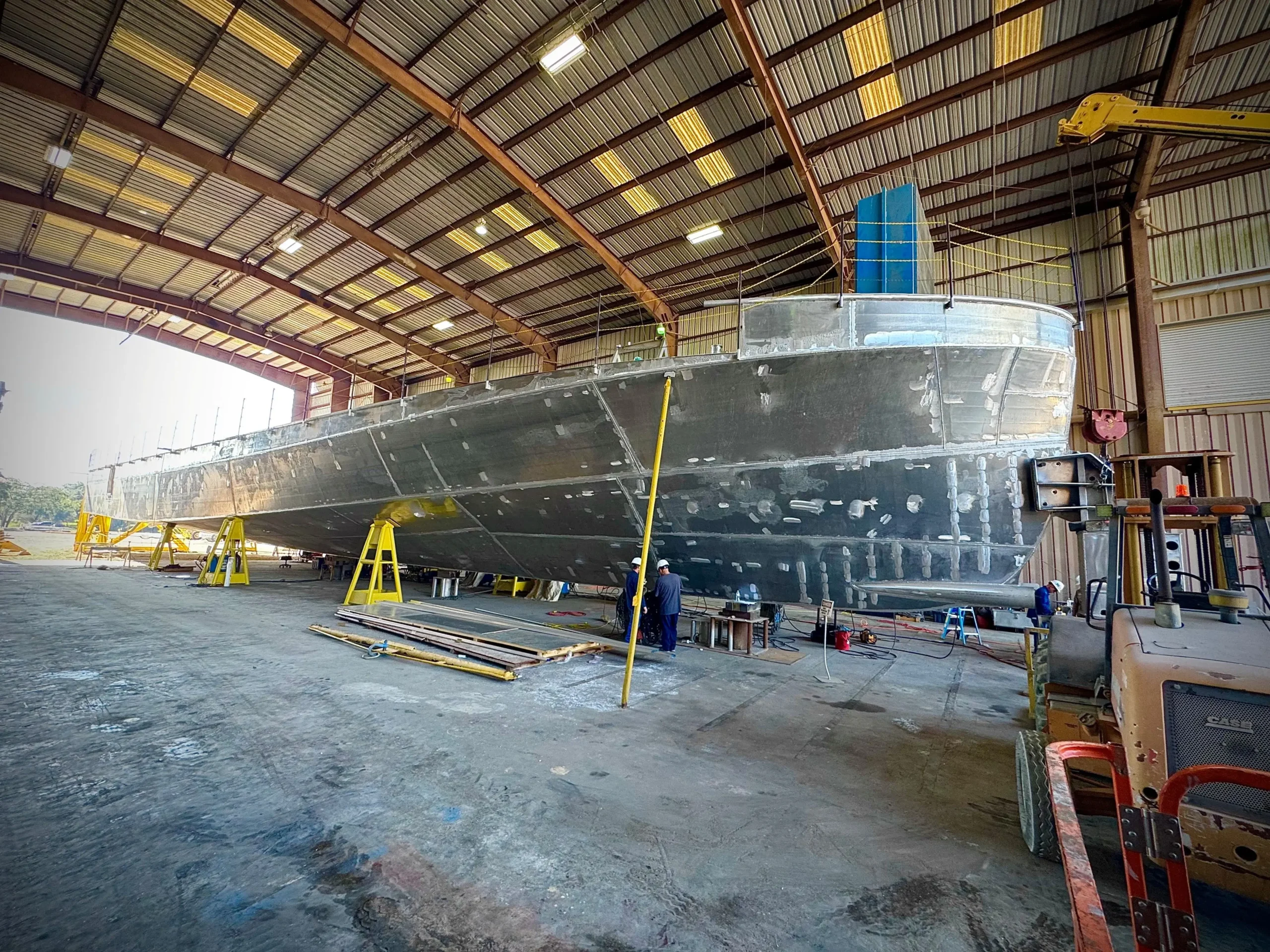
The U.S. Navy has awarded HII an agreement to build 10 ROMULUS unmanned surface vessels (USVs) under Phase I of the Medium Unmanned Surface Vessel (MUSV) program, the company announced on September 29, 2026. Saronic Technologies and Galliano Marine Service received parallel agreements for 10 hulls each, for an initial buy of 30 vessels averaging $40 million per hull, according to the Navy.
The awards, issued as other transaction authority (OTA) agreements, move the Navy’s drone ship ambitions from prototyping into series production after years of experimenting with optionally crewed demonstrators. The Navy did not disclose individual agreement values; the $40 million average implies roughly $1.2 billion across all 30 hulls, funded by the 2025 One Big Beautiful Bill Act reconciliation law. Production begins immediately, with first deliveries expected as early as the fourth quarter of Fiscal Year 2027, between July and September 2027.
ROMULUS USV Design, Payload Capacity, and Odyssey Autonomy Architecture
HII has not specified which ROMULUS variant the Navy ordered. Publicly available specifications for the flagship ROMULUS 190, unveiled in September 2025, indicate a 190-foot (58-meter) vessel built on a commercial-standard hull derived from an offshore crew support boat, developed with naval architecture firm Incat Crowther and Beier Integrated Systems. The design targets speeds above 25 knots and a minimum range of 2,500 nautical miles while carrying four 40-foot ISO containers.
Those figures track the Navy’s Phase I threshold: 2,500 nautical miles at 25 knots in Sea State 4 while carrying 25 metric tons of payload in at least two 40-foot containers. The Navy has kept initial mission sets vague, but HII markets ROMULUS for intelligence, surveillance and reconnaissance, counter-drone defense, mine countermeasures, strike, and the launch and recovery of unmanned underwater and aerial vehicles. Containerized modules let one hull design serve all of them.
The core of HII’s offer is software. Its Odyssey Autonomous Control Solutions (ACS) suite, which the company describes as combat-tested, manages perception, navigation, payloads and coordination with crewed and uncrewed platforms. The same software runs on HII’s REMUS unmanned underwater vehicles (UUVs), of which the company has delivered more than 750 to customers in over 30 countries. Its open architecture accepts new sensors, command-and-control (C2) tools and AI algorithms without vessel redesign.
Phase I testing required each candidate to run roughly 26 hours over more than 360 nautical miles with a single C2 operator input. HII says Odyssey, supported by partners Applied Intuition, Greenroom Robotics and Rodi Marine, completed a 420-nautical-mile, 28-hour endurance mission during 13 days of Navy-monitored trials in the Gulf of America, meeting all success criteria. HII has not stated whether those trials used a production-representative ROMULUS hull.
Louisiana Production Model and the Wider MUSV Competition
HII is distributing ROMULUS construction across Gulf Coast partners rather than its Ingalls or Newport News yards: Breaux Brothers Enterprises in Loreauville, Halimar Shipyard in Morgan City, and Bayou Metal Supply & Manufacturing, all in Louisiana. Major assemblies are built in parallel before final integration. HII is also adding 10,000 square feet to its 40,000-square-foot unmanned systems campus, which produces both REMUS and ROMULUS. In 2025, company executives projected building up to six hulls concurrently and delivering four or five per year once production matures.
Andy Green, president of HII Mission Technologies, framed the challenge plainly: “Unmanned vessels ultimately must be built, integrated, tested and sustained as part of a fleet.”
HII competes against two very different builders. Saronic, a venture-backed autonomy company, will build its Marauder design in Franklin, Louisiana. Galliano Marine Service, which does business as Edison Chouest, will build in Houma and has not publicly identified its design. Leidos, PacMar Technologies and Sea Machines also met Phase I test requirements, while Birdon did not. All six successful companies receive a $15 million award and access to the Drones.mil Maritime Marketplace, making them eligible for follow-on production agreements.
The Navy has already opened a Phase II call for solutions that drops the high-speed and at-sea refueling requirements. It caps length at 295 feet and displacement at 5,000 metric tons, and requires at least 10 days of unmanned operations carrying two twenty-foot equivalent unit (TEU) payloads of 24,000 kilograms each. Evaluations can begin as early as November 16, 2026, with proposals assessed on a rolling basis for five years.
Analysis: The award validates HII’s 2025 decision to fund ROMULUS partners, suppliers and infrastructure before any contract existed, an effort CEO Chris Kastner tied to the Navy’s “hedge strategy.” HII is also the only major naval prime among the three winners, but its position is not protected. Phase II lowers the entry barrier, and follow-on orders will flow through a rolling marketplace rather than a single program of record. At $40 million per hull, MUSV buys volume over exquisite capability. HII’s edge is autonomy software fielded across hundreds of UUVs; its exposure is schedule, since a projected four to five deliveries per year leaves little margin if the Navy’s demand grows.
Next milestones are Phase II evaluations from November 16 and first deliveries in late 2027. Key unknowns remain: the value of HII’s individual agreement, the ROMULUS variant and payload configuration ordered, and the first operational mission set. A lawsuit by Blue Water Autonomy and Saildrone, alleging the Navy departed from its own Phase I selection criteria, is still pending, and Navy officials concede budgets will shape how far MUSV scales beyond 30 hulls.