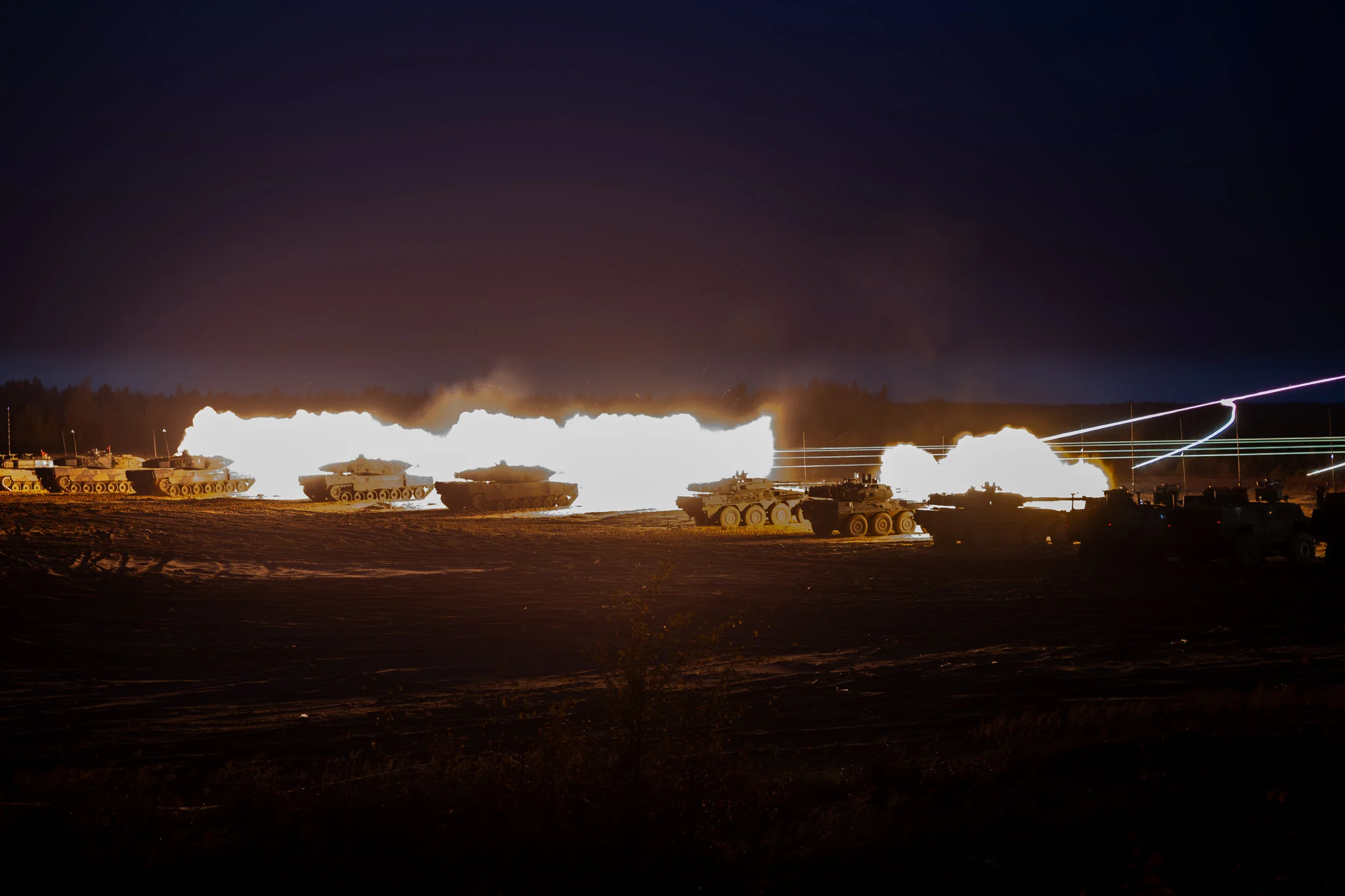
Tank crews of the 19th rotation of the Polish Military Contingent Latvia have completed Exercise Oak Fire at the Ādaži training area, a live-fire event in which they trained alongside Canadian, Spanish, Italian and Danish units on offensive tasks, fire control and night operations, according to Poland’s Operational Command of the Armed Forces.
Organized by NATO Multinational Brigade Latvia (MNB-LVA), Oak Fire ran in mid-October 2026, with the Polish tank company in the field from October 13 to 16. The exercise sits within NATO’s Forward Land Forces (FLF) posture on the eastern flank, the successor to the battlegroups set up after the 2016 Warsaw summit. Canada serves as framework nation for the brigade, which draws troops from 14 allied countries, reports to Multinational Division North, and reached full combat readiness in 2026 according to Latvia’s Ministry of Defence.
Exercise Oak Fire Tests Allied Gunnery by Day and Night
The stated aim of Exercise Oak Fire was to verify the multinational battlegroup’s ability to conduct combat operations and to refine weapons employment under near-operational conditions. Crews fired in daylight and after dark, and residents of Ādaži, Kadaga and surrounding areas were warned of elevated noise between 8:00 a.m. and 11:00 p.m. throughout the firing window.
Polish tankers executed offensive tasks, practiced fire control and coordinated maneuver with allied subunits, including over difficult terrain at night. Changing light directly affects terrain observation, target recognition and engagement timelines, which makes night serials the most demanding phase of any gunnery cycle for a mixed national formation.
The Polish command also identified cooperation between land and air components as a central element of the training. It did not specify which aircraft or helicopters took part or what role they played.
Integration with allied subunits is one of the core mandated tasks of the Polish contingent. The Operational Command described each such exercise as a test of skills and, above all, as a way to improve the contingent’s ability to operate alongside NATO forces.
Leopard 2PL Firepower and Thermal Sights Behind the Polish Company
The Polish tank company in Latvia operates the Leopard 2PL, the Polish upgrade of the third-generation Leopard 2A4, which replaced the contingent’s PT-91 Twardy tanks at the end of 2024. Poland’s Operational Command has not published the number of tanks committed to Oak Fire.
The 2PL program, contracted on December 28, 2015, for more than PLN 2.4 billion, covers all 142 Polish Leopard 2A4s and is executed by a consortium of PGZ and Bumar-Łabędy, with Rheinmetall as foreign partner. The most visible change is a set of add-on armor modules around the turret, which brings combat weight to 59.2 tonnes.
On fire control, the upgrade replaces the hydraulic gun stabilization and turret drive with electric systems and adapts the Rheinmetall Rh-120 L44 smoothbore gun to modern ammunition, including DM63 kinetic rounds and the programmable DM11 multipurpose round, while retaining compatibility with Polish-made ammunition. Commander and gunner sights receive PCO’s KLW-1 Asteria third-generation thermal camera, supplemented by a KDN-1 Nyks rear-view camera. Publicly available specifications indicate the tank keeps the 2A4’s MTU MB 873 diesel rated at 1,500 hp and a crew of four.
Those changes bear directly on Oak Fire. Third-generation thermal sights make night engagements at combat ranges practical, and electric stabilization improves accuracy when firing on the move across broken terrain, the two conditions the Polish command highlighted. The follow-on 2PL M1 standard integrates a thermal identification system for friendly forces, a feature relevant to combat identification when several national tank fleets share a night battlespace.
11th Armored Cavalry Division Leads the 19th PKW Latvia Rotation
The core of the 19th rotation comes from the 11th Lubusian Armored Cavalry Division, and the contingent is commanded by Lt. Col. Robert Markiewicz. Polish troops have deployed to Ādaži continuously since 2017, and Poland’s Foreign Ministry put the contingent at more than 230 personnel in September 2026. A presidential decree authorizes up to 320 soldiers and employees for Poland’s NATO forward-presence contingent in the Baltic states through November 30, 2026.
The switch to Leopard 2PLs came with crews from the 11th Division, after earlier rotations had drawn PT-91 companies from the 9th, 15th and 19th brigades. The previous 18th rotation, built around the 10th Armored Cavalry Brigade, took second place at the multinational Iron Spear tank gunnery competition, a benchmark the new crews inherit.
The brigade around them has grown well beyond the original battlegroup. Denmark completed the deployment of a combat battalion of more than 800 soldiers to Camp Valdemar in August 2026, its fifth battalion rotation to Latvia since 2022, shipping hundreds of vehicles, including Piranha 5 armored personnel carriers, for a tour running to January 2027. Spain and Italy have contributed to the Latvia formation since 2017, and Canada provides the headquarters and the largest national contingent, planned at about 2,200 of a 3,500-strong target.
Analysis: Oak Fire’s value lies less in individual crew marksmanship than in proving that several national armored fleets can fight under one fire plan after dark. Poland, Canada and Spain all deploy Leopard 2 variants in Latvia, which gives the brigade’s tank units a common 120 mm ammunition standard and overlapping maintenance know-how, but those variants differ in fire control, sights and protection, and hardware commonality does not standardize target handoff or combat identification procedures. With the brigade declared fully combat ready and battalion-sized Nordic rotations arriving each year, sustained combined-arms gunnery is what converts a 14-nation force on paper into a credible forward defense on NATO’s border with Russia and Belarus.
The Polish company now returns to the brigade’s routine training cycle at Ādaži for the remainder of the 19th rotation, whose end date the Operational Command has not announced. The Danish battalion is scheduled to stay until January 2027, and MNB-LVA continues its Oak-series readiness events, including the Oak Resolve combat readiness evaluation it last ran in April 2026. Key unknowns from Oak Fire remain the number of Polish tanks engaged, the air assets involved, and any published gunnery results.