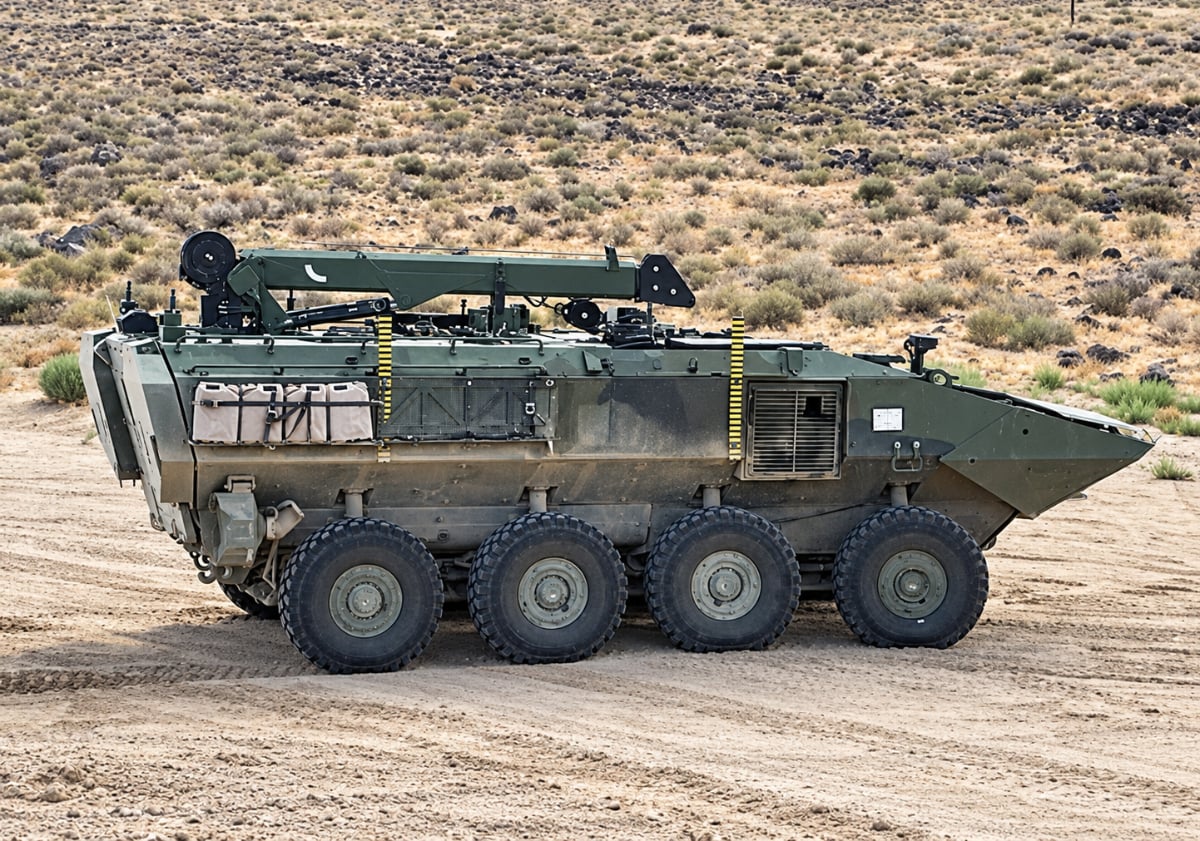
BAE Systems Land & Armaments has received a $230.1 million firm-fixed-price contract modification from the US Marine Corps to build 32 full-rate production Amphibious Combat Vehicle Recovery (ACV-R) variants, according to a Pentagon contract announcement dated September 30, 2026. The award exercises options under contract M67854-16-C-0006 and covers associated production, fielding and support costs and spares, with work due for completion in November 2028.
The order moves the fourth and final planned member of the Amphibious Combat Vehicle (ACV) family into series production, joining the personnel (ACV-P), command and control (ACV-C) and 30mm cannon (ACV-30) variants already on contract. It lands on the last day of fiscal 2026, the year congressional researchers identify as carrying the program’s final production contracts. Planning figures the Marine Corps provided to Congress set the ACV-R objective at 34 vehicles within a 608-vehicle fleet. With all options exercised, the contract is now valued at $4,096,198,614.
ACV Recovery Vehicle Design: Winch, Crane, and Shared Automotive Core
The ACV-R replaces the AAVR7A1, the recovery version of the tracked Assault Amphibious Vehicle fielded since the early 1970s. It provides field maintenance, vehicle recovery and limited repair to the Marine Corps’ assault amphibian units. According to the Pentagon’s Director, Operational Test and Evaluation (DOT&E), the variant shares its powertrain, drivetrain, water propulsion, navigation and communications and survivability features with the ACV-P. That commonality simplifies spares and training across the fleet it supports.
The mission payload centers on an internal hydraulic winch for recovery and an external crane sized to assist with engine pack removal in the field. BAE Systems rates the ACV-R to recover vehicles weighing more than 30 tons, an envelope DOT&E frames as similar or smaller platforms, which covers the ACV family itself. The crew drops to two, a driver and a vehicle commander, with two maintainers embarked in place of an infantry squad. Self-defense rests on a ring-mounted M240 7.62mm medium machine gun. The government, not BAE Systems, designed and integrated the crane at Anniston Army Depot, Alabama.
Publicly available specifications for the common ACV 1.1 platform, derived from the Iveco Defence Vehicles SuperAV, indicate an 8×8 vehicle of roughly 35 tons powered by an FPT Industrial Cursor 16 diesel rated at 690 to 700 horsepower. The baseline vehicle reaches 65 mph on paved roads, covers about 325 miles on land and exceeds 6 knots afloat, with a rated ship-to-shore transit of 12 nautical miles. Recovery-specific combat weight, crane lift capacity and winch line pull have not been released.
The operational case rests on a shortfall reported during ACV testing: the Logistics Vehicle System Replacement (LVSR) wrecker, the service’s heavy recovery truck, proved inadequate to support the new vehicle and cannot swim. The ACV-R keeps recovery inside the amphibious formation, from the surf zone inland.
ACV-R Full-Rate Production Order and the FY2027 Test Schedule
Fiscal 2026 Marine Corps procurement funds cover the full amount, obligated at award and not expiring at fiscal year end. Work divides across five BAE Systems sites: York, Pennsylvania (60%); Aiken, South Carolina (15%); San Jose, California (15%); Sterling Heights, Michigan (5%); and Stafford, Virginia (5%). York is where BAE Systems assembles the ACV family. Marine Corps Systems Command, Quantico, Virginia, is the contracting activity. Spread evenly, the award equals about $7.2 million per vehicle, a figure that includes fielding, support and spares; the announcement does not break out a unit cost.
The path to production ran through a $34.9 million design and development contract announced in March 2022, completed within its 20-month schedule, and a $79 million modification for three production-representative test vehicles (PRTVs) for government evaluation. BAE Systems confirmed in February 2026 that all three PRTVs had been delivered.
The timing stands out against the published test calendar. DOT&E’s fiscal 2025 annual report scheduled ACV-R live fire testing to begin in the first quarter of fiscal 2026, with operational testing in fiscal 2027 informing a full-rate production decision in the fourth quarter of fiscal 2027. The Navy’s December 2020 full-rate production decision for the ACV-P also authorized production of future variants. Public documents reviewed for this article do not show whether ACV-R live fire testing finished on schedule or whether the operational test has been pulled forward. The ACV-30 followed a comparable sequence: the Marine Corps awarded its base vehicle production contract in March 2025, two months before operational testing concluded.
Analysis: The award closes the ACV fleet’s most visible sustainment gap, but on thin margins. Against 574 planned ACV-P, ACV-C and ACV-30 vehicles, a 34-vehicle ACV-R objective works out to roughly one recovery vehicle for every 17 combat vehicles, in a fleet whose program office has cited lower-than-anticipated readiness and long lead times for spares. Ordering full-rate quantities before operational testing also means any crane, winch or protected recovery shortfall would likely require retrofits under a fixed-price contract after ACV procurement funding winds down. For a force built around distributed littoral operations, the ACV-R carries more operational weight than a 32-vehicle buy suggests.
The next decision points are the ACV-R operational test, the DOT&E assessment that follows, and first full-rate deliveries to assault amphibian units. Initial operational capability targets have shifted, from the first quarter of fiscal 2028 in fiscal 2025 budget documents to 2027 in an April 2025 program office briefing. Open questions include crane and winch ratings, the delivery cadence through November 2028, and how 32 vehicles on order map to the 34-vehicle objective.