BAE Systems has developed a passive radar that detects and tracks airborne threats, from small drones to larger aircraft, without emitting a signal, the company announced on November 17, 2026. The company says the covert sensor costs up to ten times less than many current passive radar offerings. It will enter live trials with law enforcement, defense and critical infrastructure partners throughout 2027.
The announcement comes as European governments struggle to protect airports, power stations and military bases from drone incursions. Munich Airport suspended operations twice in early October 2025 after drone sightings, following a nearly four-hour closure at Copenhagen Airport on September 22. On the battlefield, BAE notes, a conventional radar’s own emissions can reveal its location to adversaries.
How BAE Systems Passive Radar Exploits TV and Mobile Signals
A conventional radar transmits energy and listens for the return. The BAE system transmits nothing. It exploits emitters already present in the environment, including digital TV, radio broadcasts and mobile networks, and processes the reflections those signals produce off airborne objects. Because the sensor never radiates, it remains invisible in the radio frequency domain, denying an adversary any emission to geolocate or target with anti-radiation weapons.
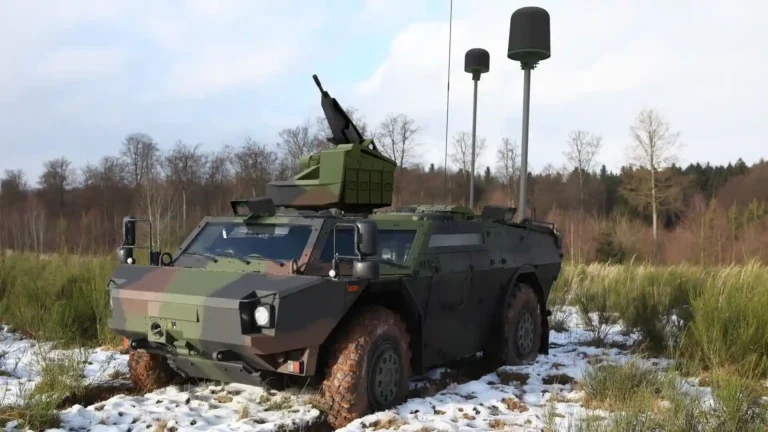
According to BAE Systems, the radar builds a 3D air picture that includes target speed, heading, range and altitude, data the company says supports both tracking and engagement of hostile threats. The hardware is compact enough to be deployed from SUVs, allowing operation in almost any urban environment.
Chris Shepherd, product manager for counter-uncrewed systems (CUxS) at BAE Systems’ Digital Intelligence & Land business, said the technology can use TV and radio transmissions “without disturbance to keep crucial infrastructure such as power stations and air force bases safe from drone attacks.” He added that it allows “a soldier to monitor the battlefield undetected.”
BAE has not disclosed detection range against small drones, the frequency bands exploited, system weight, processing architecture or unit price. Those figures will decide whether it can cue effectors alone or needs a wider layered network.
Civil Airspace Demand and the Competitive Passive Radar Field
Passive radar, formally known as passive coherent location, is an established concept. Germany’s Hensoldt markets its TwInvis system, for which the manufacturer has claimed 3D tracking of up to 200 aircraft within a 250-kilometer radius, and launched a sheltered military variant in August 2023. BAE’s pitch rests less on reach than on cost and footprint: a vehicle-portable sensor priced for wider distribution.
The civilian angle is deliberate. At airports and critical national infrastructure sites, active radar is often restricted because of its emissions. A receive-only sensor can be deployed without disrupting existing electromagnetic activity, opening a market beyond defense ministries.
The launch follows Echodyne’s November 2026 announcement that its EchoShield radar had been selected for the BAE Systems Anti Threat System (BATS), a counter-drone architecture whose recent live trials in Scotland integrated multiple sensors and effectors through a single command-and-control system. BAE has not said whether the new sensor will be integrated into BATS.
Analysis: The value of this radar lies in survivability and density rather than raw performance. Physics constrains passive radar against small drones; a 2025 study by Germany’s Fraunhofer FKIE institute, published in IET Radar, Sonar & Navigation, detected a DJI Matrice M210 up to a bistatic range of about 1,600 meters using an LTE450 mobile network base station as illuminator. A tenfold cost reduction answers that limitation by letting operators field more nodes around a base perimeter or across an urban district. If BAE’s cost claim holds, the sensor could fill the gap between expensive military passive systems and emitting radars that are increasingly exposed on drone-saturated battlefields.
The 2027 trial campaign will be the first public test of BAE’s claims. Key unknowns include detection range against Group 1 drones, performance in rural areas with sparse broadcast coverage, and whether UK police forces or the Ministry of Defence move to procurement. BAE has not announced a production timeline or a launch customer.