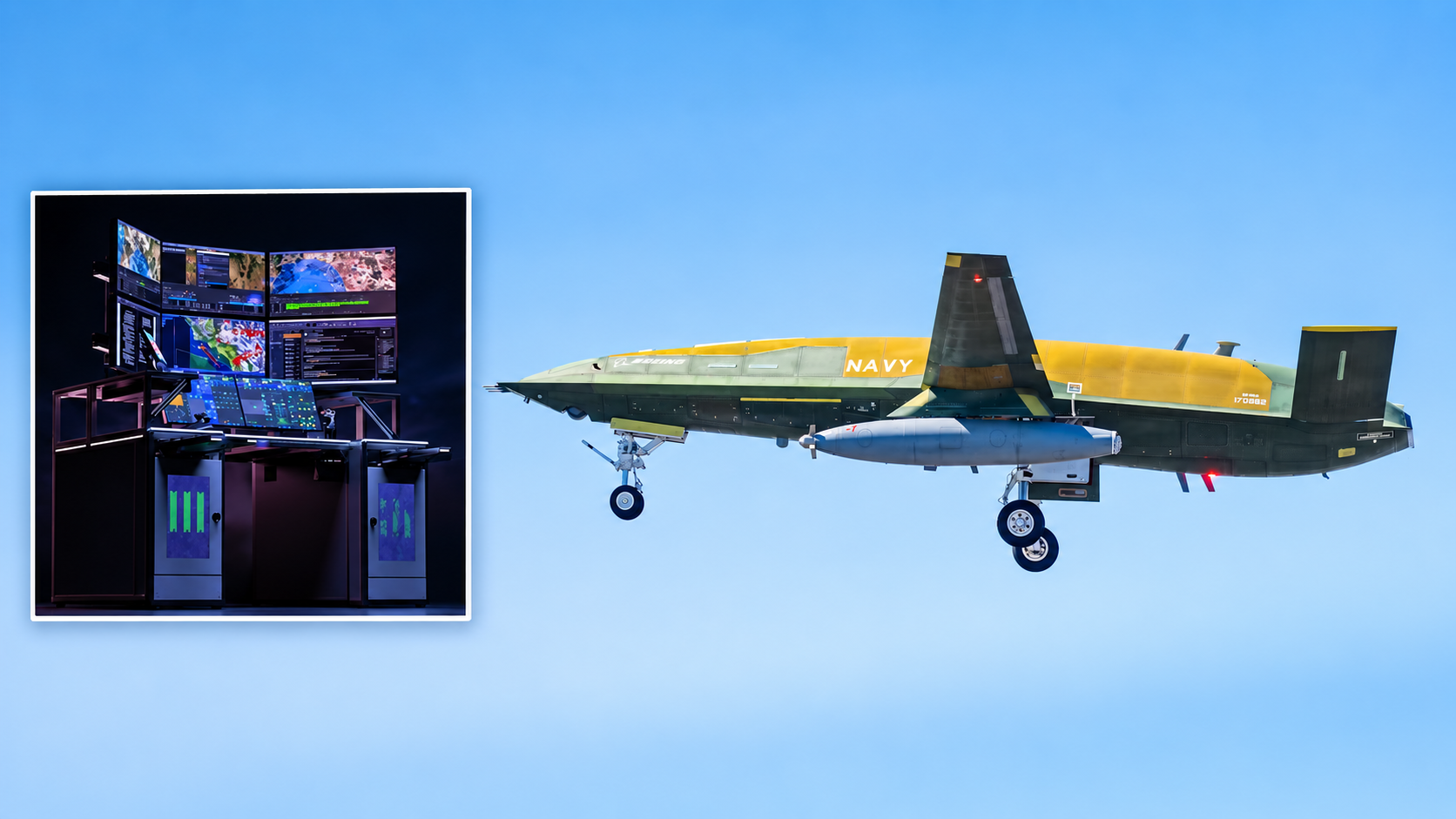
Naval Air Systems Command (NAVAIR) has awarded Lockheed Martin Aeronautics a not-to-exceed $57,710,427 undefinitized contract for software development, a qualification-tested software build, and integrated test and evaluation of the Multi-Domain Combat System (MDCX) supporting the MQ-25 Stingray test program, the Pentagon announced September 30, 2026. The sole-source award, contract N0001926C1024, also funds technical field support for MDCX systems already installed for the Navy, with work running through September 2027.
MDCX is the software core of the ground segment that commands the Navy’s first carrier-based unmanned aircraft. The award lands five months after the first Navy-owned MQ-25A engineering development model flew on April 25, 2026, in Illinois under commands from the Unmanned Carrier Aviation Mission Control System (UMCS) MD-5 ground control station. The program cleared Milestone C for low-rate initial production in May 2026, yet the Navy has pushed initial operational capability (IOC) to 2029, three years later than planned. The program of record covers 76 aircraft, and a June 2025 Government Accountability Office report put total cost at $15.9 billion, about $209 million per aircraft.
How the MQ-25 MDCX Software Contract Is Structured
The contract combines undefinitized, cost-reimbursable, and firm-fixed-price elements, a hybrid structure that lets NAVAIR start work before final terms are negotiated. At award, the Navy obligated $14,124,363, roughly 24.5% of the ceiling: $11,050,000 in fiscal 2026 research, development, test and evaluation (RDT&E) funds and $3,074,363 in fiscal 2026 other procurement, Navy (OPN) funds. RDT&E covers development and test, while OPN aligns with field support for installed systems. The initial obligation sits well below the 50% cap defense acquisition rules generally place on undefinitized actions before the contractor submits a qualifying proposal.
Work divides across three sites: Marietta, Georgia (42%); Fort Worth, Texas (38%); and Patuxent River, Maryland (20%). The Patuxent River share places Lockheed engineers inside the Navy test enterprise, where MQ-25 flight testing will relocate for envelope expansion and carrier qualification preparations. The announcement does not explain the Fort Worth workload.
NAVAIR did not compete the award. In 2025, the command published a notice of intent to negotiate only with Lockheed Martin Aeronautics for Block 1 MDCX hardware, software, and support covering MQ-25 initial operational test and evaluation (IOT&E), follow-on test and evaluation (FOT&E), and aircraft carrier deployments. That notice justified the sole-source path by identifying Lockheed as the only designer, developer, and manufacturer of the MQ-25A ground control station. The September 30 announcement does not confirm whether this contract is the action described in that notice.
Undefinitized actions also run on a clock. Defense acquisition rules generally require definitization within 180 days of award, subject to extensions, which points to final terms in the first half of 2027.
MDCX and the MD-5 Station: Common Control for Carrier Drones
The MD-5 ground control station is a government-developed system. Within it, Lockheed Martin Skunk Works’ MDCX supplies the air vehicle pilot operating consoles and associated computing, while the government provides communications, networking, and other ancillary equipment, according to the Pentagon’s operational test and evaluation office. The Navy selected MDCX as the UMCS ground control component in 2020.
That split reflects the MQ-25A operating concept. Air vehicle pilots do not fly the aircraft through conventional stick inputs; they issue commands, and the aircraft autonomously executes taxi, takeoff, flight, and landing. The April 25 flight followed that model, with Boeing and Navy pilots commanding and monitoring the aircraft from the station during a two-hour pre-planned profile.
The air vehicle is a Group 5 unmanned aircraft powered by a single Rolls-Royce AE 3007N turbofan. Publicly available specifications indicate a length of about 51 feet and a wingspan of about 75 feet, folding to roughly 31 feet for deck handling. Its primary mission is organic aerial refueling, a task the F/A-18E/F Super Hornet performs today, with a secondary maritime intelligence, surveillance, and reconnaissance (ISR) role. Both missions depend on the command and control chain that MDCX anchors.
The Navy also intends UMCS to reach beyond the Stingray. In November 2024, the Unmanned Carrier Aviation program office (PMA-268) used the MD-5 station at Patuxent River to control a General Atomics MQ-20 Avenger flying from El Mirage, California, in an effort supporting future Collaborative Combat Aircraft (CCA). Lockheed credited its MDCX command and control software development kit, built on the government’s Open Mission Standards, with enabling rapid integration of the third-party aircraft.
Analysis: The contract shows where MQ-25 risk now sits. The air vehicle has flown and cleared Milestone C, but IOC depends on qualifying the software that commands it at sea, and a qualification-tested build is a prerequisite for the operational test events tied to Block 1 MDCX. The sole-source structure also deepens Lockheed’s position inside a Boeing-built program. If UMCS becomes the Navy’s common station for future carrier drones, MDCX becomes the incumbent control layer of the unmanned air wing, giving Lockheed leverage over the integration of aircraft it does not build. Open Mission Standards are the Navy’s hedge against that lock-in; their reach remains unproven.
Near-term milestones include definitization of the contract, the MQ-25A’s transfer to Naval Air Station Patuxent River, planned for late 2026, and delivery of the qualification-tested MDCX build before work concludes in September 2027. The Navy has not disclosed the definitized value, the schedule for carrier qualification trials, or which aircraft will join UMCS after the Stingray. IOC, defined as three deployable MQ-25As with trained personnel and equipment, remains set for 2029.