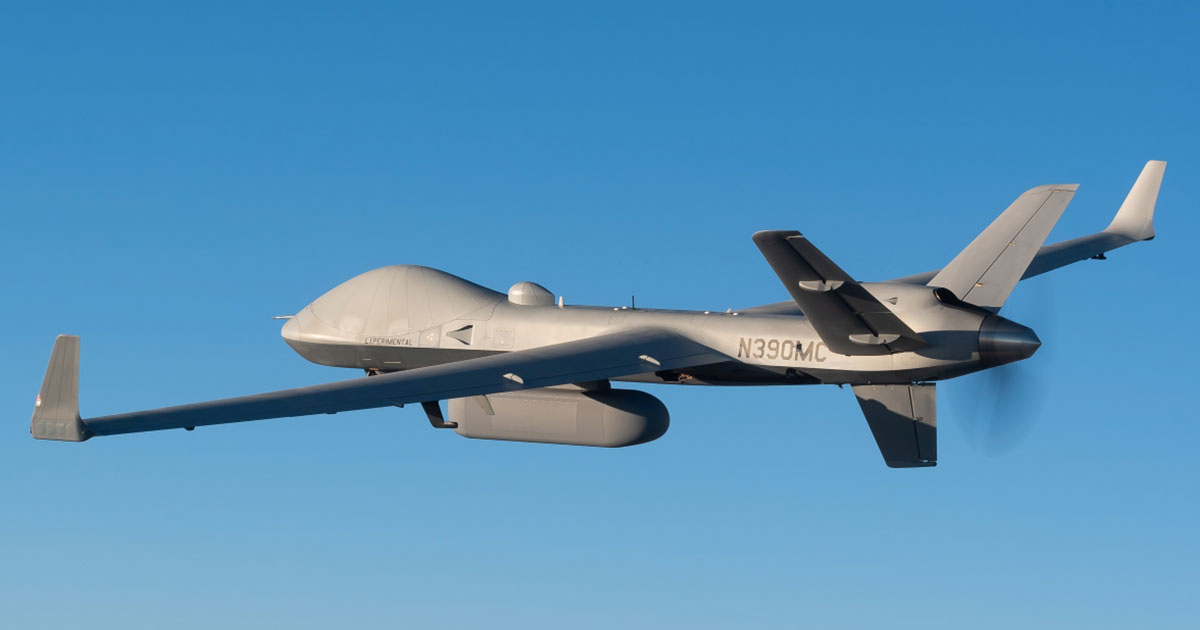
General Atomics Aeronautical Systems, Inc. (GA-ASI) has flight-tested an MQ-9B remotely piloted aircraft carrying a Disaster Relief Unit (DRU) communications pod developed by Japanese telecommunications operator SoftBank Corp., converting the medium-altitude, long-endurance (MALE) platform into an airborne cellular relay for areas where ground networks have collapsed. GA-ASI integrated the pod and flew it on July 27, 2026, and disclosed the test on October 1, 2026.
The demonstration targets a gap Japan knows well. When the magnitude 7.6 Noto Peninsula earthquake struck on January 1, 2024, landslides severed roads to damaged base stations, and carriers spent days moving generators, tethered drones and ship-borne stations into position. Japan Coast Guard (JCG) MQ-9B SeaGuardians flew search-and-rescue and disaster response sorties in that crisis. The JCG has operated the type since October 2022, initially under a contractor-operated arrangement from Hachinohe Air Base, while the Japan Maritime Self-Defense Force (JMSDF) plans to acquire 23 MQ-9Bs, with deployment scheduled to begin in fiscal year 2027.
How the MQ-9B Disaster Relief Pod Restores Cellular Coverage
The DRU allows an MQ-9B to function as a mobile network relay tower in the sky, re-establishing connectivity where floods, earthquakes or other disasters have destroyed cellular towers. GA-ASI has not identified the test location, operating altitude, coverage radius, air interface (LTE or 5G New Radio), frequency bands, subscriber capacity, pod mass or mounting station. Nor has it specified whether the pod backhauls traffic through the aircraft’s own satellite communications (SATCOM) link or a dedicated terminal, a choice that will dictate usable throughput in a real emergency.
The pod extends a layered SoftBank effort. At the low end, its Wired Power Feed Drone Wireless Relay System, a tethered multirotor powered through a ground cable, entered service in Wajima on January 6, 2024, covering a radius of several kilometers. That system still needs a ground crew, a generator and road access. At the high end, SoftBank has said it plans to launch pre-commercial High Altitude Platform Station (HAPS) services in Japan in 2026 using a lighter-than-air platform from US firm Sceye operating around 20 km, with full commercialization targeted for 2027 or later.
An MQ-9B-borne pod fills the middle tier. The aircraft launches from an established base outside the disaster zone, transits at up to 210 knots and loiters for a day or more with no footprint on the ground it serves. “It’s been a great experience working with SoftBank, and we believe this capability will be of interest to many of our MQ-9B operators for disaster relief and emergency communications applications,” said GA-ASI President David R. Alexander.
MQ-9B Airframe, Payload Capacity and Japan’s SeaGuardian Fleet
Publicly available specifications indicate the MQ-9B spans 24 m, measures 11.7 m in length and has a maximum takeoff weight of 5,670 kg, including 2,721 kg of internal fuel. Power comes from a single Honeywell TPE331-10 turboprop, rated between 900 and 940 shp depending on the source. Nine external hardpoints, eight under the wings and one on the centerline, carry up to roughly 2,177 kg. GA-ASI rates the SkyGuardian configuration at more than 40 hours of endurance and a ceiling above 40,000 ft, while open-source references credit the heavier SeaGuardian with about 30 hours.
That pod-based architecture is the operational point. Because the DRU is an external pod, an operator could in principle reconfigure an intelligence, surveillance and reconnaissance (ISR) aircraft for a relief sortie, then return it to surveillance. GA-ASI has not disclosed swap times. Command and control relies on a C-band line-of-sight datalink and an X-, Ku- or Ka-band beyond-line-of-sight SATCOM link, which lets crews fly into a region with no surviving ground infrastructure. The airframe was built to the NATO STANAG 4671 airworthiness standard for non-segregated airspace, which matters when relief flights share the sky with rescue helicopters.
Japan is the most obvious early customer. The JCG contracted in August 2024 to buy two SeaGuardians outright for basing at Kitakyushu Airport. The JMSDF selected the type in December 2024 and said its MQ-9Bs will initially fly without weapons or sonobuoy kits. On August 26, 2026, GA-ASI and Fujitsu signed a memorandum of understanding on domestic MQ-9B maintenance, parts management and training. Outside Japan, MQ-9Bs fly with the United Kingdom and Belgium, while Canada, Denmark, Poland, Germany, Qatar, Taiwan and India have selected the aircraft.
Analysis: The DRU’s value lies less in the radio than in the delivery model. Restoration on the Noto Peninsula stalled wherever crews could not physically reach equipment; a SATCOM-controlled MALE aircraft decouples connectivity from ground access. For Tokyo, the pod would let fleets bought for maritime surveillance double as civil-protection assets, strengthening the domestic case for unmanned ISR spending, and it adds a major telecom operator to a Japanese MQ-9B industrial network that already includes Fujitsu and trading house Sojitz. The trade-off is fleet availability. Every hour a SeaGuardian spends as a cell tower is an hour removed from maritime domain awareness, and with Japan’s inventory still small, the DRU remains a surge capability rather than a standing one until JMSDF deliveries scale up.
No customer, contract value or production schedule accompanied the announcement, and Japanese spectrum authorization for an airborne base station has not been addressed publicly. The next indicators are whether the JCG or JMSDF schedules an operational evaluation and whether the GA-ASI and Fujitsu support framework matures ahead of JMSDF deployment in fiscal year 2027. Until an operator funds integration, the DRU remains a flight-proven demonstrator.