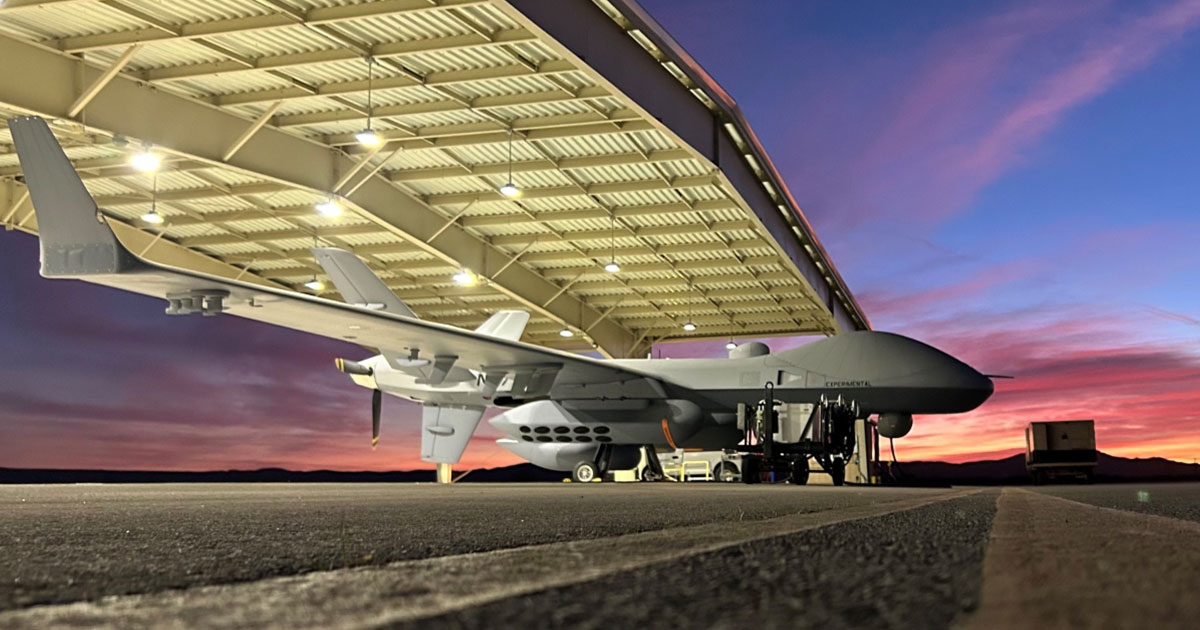
The U.S. Navy evaluated General Atomics Aeronautical Systems’ (GA-ASI) MQ-9B SeaGuardian uncrewed aircraft system during a recent Maritime Patrol and Reconnaissance Force (MPRF) Commander’s Operational Group (COG) at Naval Air Station Whidbey Island (NASWI), Washington, the company announced on September 30, 2026. GA-ASI brought the aircraft at the request of the Commander, Patrol and Reconnaissance Group, displaying it alongside the P-8A Poseidon before the leaders and tacticians who review the fleet’s anti-submarine warfare (ASW) tactics.
The event carries more weight than a static display. The Navy already flies SeaGuardian under a Company-Owned, Company-Operated (COCO) contract supporting an ongoing capability assessment for the U.S. 7th Fleet, and has been evaluating the aircraft as a potential MPRF “force multiplier,” according to GA-ASI. Whidbey Island also hosts Unmanned Patrol Squadron 11 (VUP-11), the Navy’s second MQ-4C Triton squadron, established on November 13, 2025, putting crewed and uncrewed maritime patrol aircraft on the same flight line.
MQ-9B SeaGuardian Sensor Suite and Sonobuoy Mission Kit
SeaGuardian is the maritime configuration of the MQ-9B, a Group 5 medium-altitude, long-endurance (MALE) remotely piloted aircraft designed to NATO’s STANAG 4671 airworthiness standard. Publicly available specifications indicate a 79-foot (24-meter) wingspan, a 38-foot (11.7-meter) length and a maximum gross takeoff weight of 12,500 pounds (5,670 kilograms). A Honeywell TPE331-10 turboprop provides a ceiling above 40,000 feet and a top speed of 210 knots true airspeed. The aircraft carries 6,000 pounds of fuel and 4,800 pounds of payload, 800 pounds internally and 4,000 pounds across nine external hardpoints. GA-ASI rates maximum endurance at more than 30 hours, a figure that falls as external stores are added.
The surveillance fit centers on a 360-degree maritime search radar in a centerline pod, either the Leonardo Seaspray 7500E V2 active electronically scanned array (AESA) or the Raytheon SeaVue, paired with a Raytheon MTS-B electro-optical/infrared turret, an Automatic Identification System (AIS) receiver and Electronic Support Measures (ESM). Fusing radar tracks, emitter data and AIS returns lets one crew flag vessels that have switched off their transponders. Control runs over C-band line-of-sight links, with Ku- or Ka-band satellite links for operations across the Pacific.
The ASW kit is what brings SeaGuardian into the MPRF debate. Each Sonobuoy Dispensing System (SDS) pod holds 10 A-size or 20 G-size buoys, and four wing-mounted pods give a theoretical load of 40 A-size or 80 G-size sonobuoys. A General Dynamics Mission Systems processor handles acoustic data onboard, and the crew can pass tactical reports directly to a theater ASW commander, as demonstrated during Integrated Battle Problem 2023.
From Sonobuoy Trials to 7th Fleet Operational Evaluation
The Whidbey Island appearance follows a test campaign that accelerated over two years. GA-ASI flew a prototype SDS and demonstrated Long Range Anti-Ship Missile (LRASM) targeting during Rim of the Pacific (RIMPAC) 2024. A dedicated ASW demonstration with pre-production pods followed from January 20 to 30, 2025, and an April 2025 ground test showed the aircraft passing in-flight target updates to a missile via Link 16.
The key milestone came on December 17, 2025. In a Navy-sponsored flight test aimed at certifying the SDS, SeaGuardian carried more pods than in any previous trial, doubling its sonobuoy capacity, and released AN/SSQ-36 bathythermal, AN/SSQ-53G Directional Frequency Analysis and Recording (DIFAR) and AN/SSQ-62F Directional Command Activated Sonobuoy System (DICASS) buoys. It also became the first uncrewed aircraft to dispense Multi-static Active Coherent (MAC) sonobuoys, which cover wider areas with fewer buoys. The Naval Air Warfare Center Aircraft Division (NAWCAD) supervised the test, which supported Commander, U.S. Pacific Fleet’s Operational Evaluation deployment to the 7th Fleet. GA-ASI said it expected Navy deployment flight clearance for ASW operations in January 2026; DefenseWarroom could not independently confirm that the clearance has been issued.
Whidbey Island has served as an operating base for SeaGuardian during Navy exercises including Northern Edge and Integrated Battle Problem, and the aircraft has supported carrier pre-deployment workups. “Whidbey Island is a great place to display SeaGuardian alongside the P-8A Poseidon for MPRF professionals to help illustrate that this future focused capability is here now and ready for employment,” said Patrick Shortsleeve, GA-ASI vice president of DoD strategic development.
Analysis: SeaGuardian’s case to the MPRF rests on force economics, not replacement. Publicly available specifications indicate the P-8A carries 129 sonobuoys and offers about four hours on station at a 1,200-nautical-mile radius. An aircraft rated for more than 30 hours, even with endurance trimmed by pods, could hold a MAC field over a chokepoint while scarce Poseidons are reserved for localization and attack. It also fills a gap the MQ-4C leaves open: Triton patrols above 50,000 feet as a wide-area sensor but does not drop sonobuoys. The constraint is contractual. Under COCO, GA-ASI owns and flies the aircraft, so the Navy buys flight hours and data rather than a fielded capability, and no Navy program of record for SeaGuardian has been announced. Allies are moving faster: the Japan Maritime Self-Defense Force selected SeaGuardian in December 2024, and Germany is acquiring eight through the NATO Support and Procurement Agency (NSPA) under a January 12, 2026 contract.
The Navy has not released findings from the 7th Fleet operational evaluation, and GA-ASI has not disclosed how many aircraft fly under the COCO arrangement or when it expires. The fiscal 2028 budget request will show whether the service moves SeaGuardian from contractor-operated assessment toward a funded requirement.