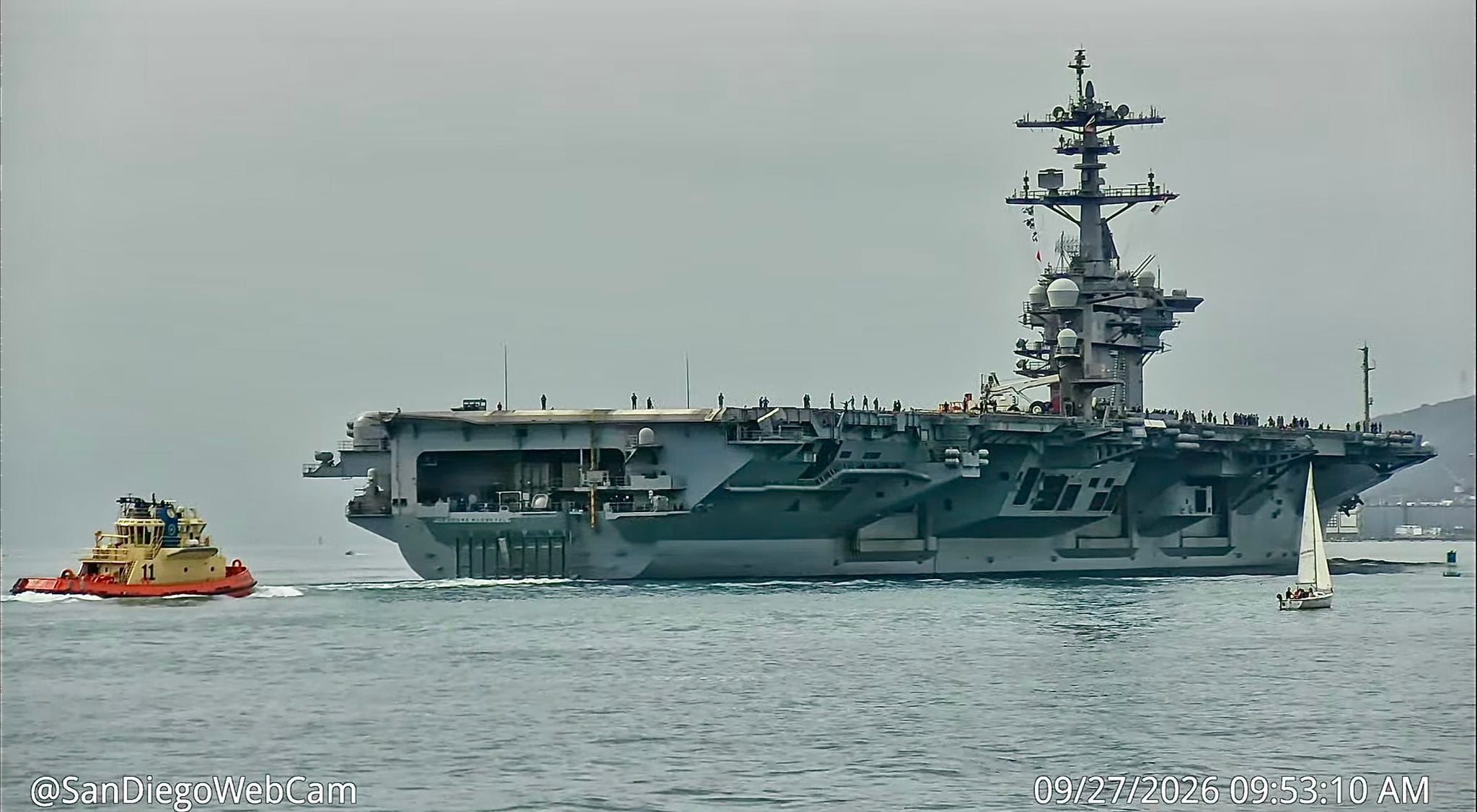
The United States is sending the USS Theodore Roosevelt (CVN-71) Carrier Strike Group and the USS Makin Island (LHD-8) Amphibious Ready Group toward the Middle East, a US official said on October 1, 2026, a deployment that could place three aircraft carriers in the region by the end of October. The two groups carry more than 7,000 sailors and 2,000 Marines, lifting the US naval presence in theater above 20,000 sailors and Marines, supported by hundreds of aircraft.
The movement comes seven months into a war with Iran that began on February 28, 2026, and that President Donald Trump initially promised would last weeks. In an interview published on October 1, Trump said it was “possible” he would step up bombing of Iran after the November 3 midterm elections, and said he had rejected Tehran’s latest ceasefire proposal, including an offer to open up the Strait of Hormuz, as “not good enough.” A US Navy blockade is meanwhile paralyzing Iran’s own oil exports.
How the Third Aircraft Carrier Reshapes the CENTCOM Carrier Rotation
Theodore Roosevelt, flagship of Carrier Strike Group 9, left San Diego on September 27 with Carrier Air Wing 11 (CVW-11) embarked and the Ticonderoga-class guided-missile cruiser USS Chosin (CG-65) in company. Publicly available specifications indicate the Nimitz-class carrier, commissioned in 1986, displaces roughly 100,000 tons at full load and runs on two A4W nuclear reactors, sustaining speeds above 30 knots. Chosin brings an Aegis combat system and 122 Mk 41 vertical launch system cells, the core of the group’s defense against ballistic missiles, cruise missiles and one-way attack drones.
CVW-11 deployed with an F-35C Lightning II squadron on its 2024 cruise aboard Theodore Roosevelt, and the wing is reported to again pair the fifth-generation fighter with F/A-18E/F Super Hornets, EA-18G Growler electronic attack aircraft and E-2D Advanced Hawkeyes. That mix combines low-observable penetration with stand-off jamming and airborne battle management, the baseline for any renewed strike campaign against defended targets.
Officially, the Navy lists the strike group as operating in the US 3rd Fleet area. The carrier is expected to relieve the Japan-based USS George Washington (CVN-73), which entered US 5th Fleet in mid-August and could return to waters off Japan once Theodore Roosevelt arrives. USS George H.W. Bush (CVN-77) and the USS Boxer (LHD-4) Amphibious Ready Group are also in the region. Three carriers would therefore reflect a turnover overlap rather than a permanent increase, unless Washington holds George Washington in place, repeating the April three-carrier posture, the first since 2003.
The rotation exposes the strain on force generation. USS Abraham Lincoln (CVN-72), relieved by George Washington, spent 265 days at sea before its first port call and had been deployed for 311 days as of September 28. Theodore Roosevelt’s crew has been told to expect roughly eight months away.
Makin Island ARG and 13th MEU Expand Amphibious Strike Options
The Makin Island Amphibious Ready Group (ARG) departed San Diego on September 28 with the amphibious transport docks USS Anchorage (LPD-23) and USS John P. Murtha (LPD-26), carrying the Camp Pendleton-based 13th Marine Expeditionary Unit (MEU), roughly 2,200 Marines and sailors. US Pacific Fleet describes the group as operating in 3rd Fleet, and the Navy has not confirmed its final destination.
Makin Island, the last Wasp-class amphibious assault ship, was the first US Navy warship built with hybrid propulsion. Publicly available specifications indicate two LM2500+ gas turbines rated at 35,000 shaft horsepower each for speeds above 12 knots, with electric auxiliary motors covering lower speeds. The MEU’s aviation combat element is reported to include F-35B Lightning II jets, MV-22B Osprey tiltrotors and attack helicopters. The two San Antonio-class Flight I docks each displace about 25,000 tons, embark roughly 700 Marines and operate two Landing Craft Air Cushion from their well decks.
A second ARG/MEU alongside Boxer would give US Central Command two sea-based Marine air-ground task forces, suited to visit, board, search and seizure operations supporting the blockade, raids on coastal or island targets, and non-combatant evacuation. With F-35Bs embarked, the big-deck amphib can also generate fifth-generation sorties independent of the carriers.
Washington is also tracking a possible shift toward asymmetric tactics. Trump said early indications linked Iran to the flydubai co-pilot who attacked his captain and tried to crash a flight to Israel, pending investigation. British authorities separately arrested a British-Iranian dual national in London on suspicion of planning a terrorist attack, after earlier arrests near RAF Fairford, a base US bombers have used to strike Iran.
Analysis: The three-carrier headline overstates the gain in sustained combat power and understates its cost. The real signal is timing: the carrier overlap and a second amphibious group peak around a November 3 vote that Trump has openly tied to possible escalation, giving planners a temporary surge in strike and amphibious capacity without a formal surge order. The bill lands in the Pacific, where US 7th Fleet absorbs the readiness gap left by George Washington’s absence and repeated West Coast diversions, deepening the maintenance backlog that governs future carrier availability.
The next marker is Theodore Roosevelt’s arrival in the Central Command area, expected around the end of October, and the decision on whether George Washington returns toward Japan. Beyond November 3, the variables are Tehran’s answer to the rejected ceasefire terms, the flydubai investigation and whether the blockade erodes Iranian oil revenue faster than Iran can retaliate asymmetrically.