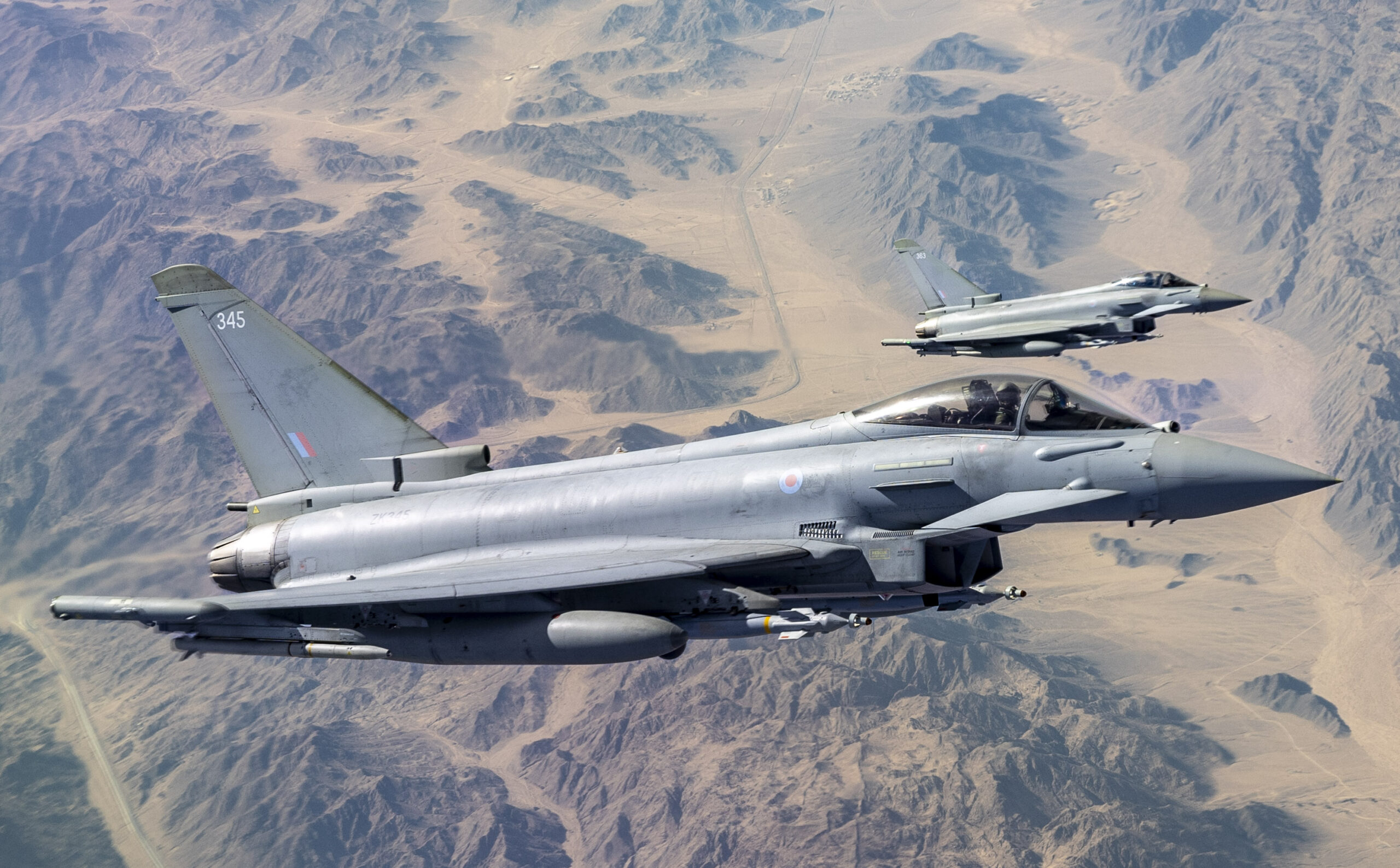
The Royal Air Force has ended Eurofighter Typhoon combat operations over Iraq, the service confirmed on October 4, 2026, closing the jet’s role in a campaign that began with C-130J Hercules airdrops over Mount Sinjar in August 2014. The milestone follows the formal conclusion of the US-led Operation Inherent Resolve in Iraq on September 30, when coalition forces completed their departure from Erbil Air Base.
The withdrawal executes the September 2024 US-Iraq joint statement, which set a phased timetable to end the coalition’s military mission inside Iraq by September 30, 2026. Combined Joint Task Force-Operation Inherent Resolve remains active from a new headquarters in Jordan, and US forces continue counter-Daesh operations in Syria. The UK government stated on September 30 that Operation Shader, the British contribution to the 90-partner Global Coalition Against Daesh, will continue, while defense ties with Baghdad shift to a bilateral partnership built on counter-terrorism, military education, capability development and defense industrial collaboration.
How Project Centurion Made the RAF Typhoon Shader’s Primary Strike Jet
Group Captain Paul Hanson OBE, Typhoon Commander Air Wing, described the moment as the end of Typhoon operations over Iraq while stressing that Shader as a whole continues. He said routine combat air operations have ceased, with Daesh reduced to a level Iraqi forces can contain without persistent coalition support. Across the campaign, RAF aircraft struck more than 2,300 Daesh targets, according to the UK government.
Typhoon FGR4s joined the Tornado GR4 at RAF Akrotiri in Cyprus with 903 Expeditionary Air Wing in December 2015, after Parliament authorized strikes in Syria. Early missions used the Paveway IV, a 500 lb-class bomb pairing GPS/INS with laser guidance. Publicly available specifications credit the jet’s twin Eurojet EJ200 turbofans with roughly 90 kN of thrust each in reheat, but the Typhoon was conceived as an air superiority fighter and could not yet carry the Tornado’s standoff and precision-attack weapons.
The £425 million Project Centurion closed that gap. Its Phase 2 Enhancement added the MBDA Meteor beyond-visual-range missile and the Storm Shadow cruise missile, both declared in service on August 31, 2018, while Phase 3 Enhancement integrated the Brimstone 2 precision-attack missile. Tornados flew their final Shader sorties on January 31, 2019, leaving Typhoon as the RAF’s only fast jet on the operation. On February 19, 2019, a Typhoon fired Brimstone 2 in combat for the first time, destroying a Daesh boat on the Euphrates River.
Storm Shadow followed on March 10, 2021, when Typhoons struck cave complexes in the Makhmur mountains near Erbil during a 10-day operation that expended 42 Paveway IV bombs and 10 cruise missiles. Publicly available specifications put the missile at roughly 1,300 kg with a tandem BROACH warhead designed for hardened and buried targets, the profile Daesh exploited in those caves. In Hanson’s words, over Shader, “Typhoon came of age as a proper multi-role aircraft.”
Operation Shader’s Enablers: ISR, Tanking and the Aircraft Retired Mid-Campaign
Shader also spanned a near-complete recapitalization of the RAF’s support fleet. Hanson listed the E-3D Sentry, Sentinel R1, Tornado GR4, Reaper and C-130 as aircraft the service both employed and retired during the twelve-year operation. The Sentinel R1, which carried a dual-mode synthetic aperture radar and ground moving target indicator on a Bombardier Global Express airframe, left RAF service in 2021, as did the E-3D, whose designated successor is the E-7A Wedgetail. The C-130J that opened the campaign over Sinjar retired in 2023, handing tactical airlift to the A400M Atlas.
The MQ-9A Reaper carried the heaviest persistent load. Flown by XIII Squadron from RAF Waddington and, until 2022, by 39 Squadron at Creech Air Force Base in Nevada, the 10-aircraft fleet logged more than 173,000 flying hours over 18 years before retiring in autumn 2025. Armed with AGM-114 Hellfire missiles and 500 lb-class laser-guided bombs, Reaper fused strike with full-motion video surveillance for partner forces on the ground. Its replacement, the MQ-9B Protector RG Mk1, offers endurance beyond 40 hours, nine hardpoints and a full UK military type certificate; the RAF has 16 on order and has been preparing the type and its crews for Shader.
Persistent enablers filled the remaining gaps. Voyager tankers sustained the long transit from Cyprus to Iraqi and Syrian airspace, while the RC-135W Rivet Joint and Shadow R1 supplied signals intelligence and wide-area surveillance. Hanson estimates that tens of thousands of personnel served across combined air operations centers, forward operating bases, Akrotiri, Baghdad, Erbil and Al Asad.
Analysis: Shader served as the RAF’s operational bridge between two force structures. The service entered the campaign with Tornado, Reaper, Sentinel and E-3D, and leaves Iraq with Typhoon at full Centurion standard and Protector taking over unmanned strike and ISR. With CJTF-OIR headquartered in Jordan, No. 83 Expeditionary Air Group at Al Udeid in Qatar and combat aircraft at Akrotiri, any residual UK counter-Daesh activity depends on over-the-horizon basing, aerial refueling and long-endurance unmanned platforms. The Pentagon has placed primary responsibility for Daesh remnants and Iran-aligned militias on Baghdad, making the durability of that handover the decisive variable.
The Ministry of Defence has not disclosed how many UK personnel stay in the region under Shader’s next phase, whether Typhoons will retain any tasking over Syria, or how Protector will be employed. The terms of the planned UK-Iraq bilateral defense partnership are also unpublished, and will determine whether Shader remains a combat operation or settles into security cooperation.