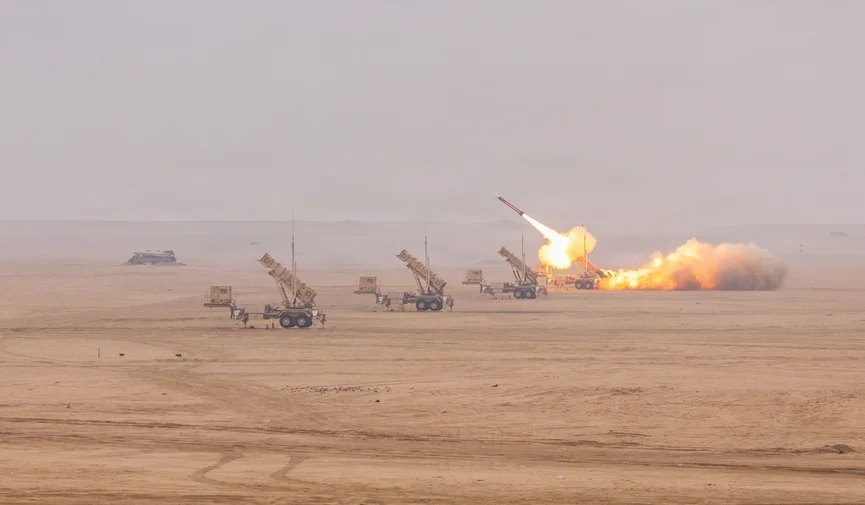
The US State Department on October 2, 2026, approved a possible Foreign Military Sale (FMS) of Patriot missile repair and return services to Kuwait at an estimated cost of $400 million. The package names Lockheed Martin, RTX Corporation, Leidos, and KBR as principal contractors and gives Kuwait’s air defense forces a US channel to restore faulty, damaged, or expiring interceptors to service.
The approval comes seven months after Iran began striking Kuwait on February 28, 2026, in retaliation for joint US and Israeli strikes on Iranian targets. Ali Al Salem Air Base, which hosts US Air Force personnel, was among the first targets. Kuwait’s Ministry of Defense reported intercepting eight ballistic missiles and 19 drones in a single 24-hour period in early April, and a June 3 missile and drone attack damaged Kuwait International Airport, killing one person and injuring more than 60. Kuwait has not disclosed how many Patriot interceptors it fired.
Inside Kuwait’s $400 Million Patriot Missile Repair and Return Package
According to the notification, Kuwait requested repair and return services for Patriot missiles along with transportation, organizational equipment, repair parts, support equipment, tools and test equipment, technical data and publications, personnel training, maintenance services, and US government and contractor engineering, technical, and logistics support. Lockheed Martin is listed in Arlington, Virginia, while RTX, Leidos, and KBR are listed in Huntsville, Alabama. Implementation requires US contractor representatives in Kuwait for two years to provide handling and documentation support.
The package mirrors a May 28, 2020, notification under the same title, valued at $200 million, which covered repair of Patriot GEM-T missiles and components with the same four companies. The 2026 version doubles the ceiling and drops the GEM-T qualifier. With Lockheed Martin as prime on the PAC-3 family and RTX as prime on the GEM-T, the contractor list points to work across both interceptor lines, although the notice specifies neither variants nor quantities. As with all FMS notifications, the figure is a ceiling based on initial requirements, not a signed contract.
The release also contains a drafting anomaly: its summary line refers to counter-unmanned aerial systems platforms, wording that appears carried over from Kuwait’s $1.98 billion Anduril counter-drone notification of June 5, 2026. The itemized request and justification address Patriot repair and return only, citing the protection of Kuwait’s oil and natural gas infrastructure and its homeland defense mission. The State Department assessed that the sale would not alter the basic military balance in the region or harm US defense readiness.
GEM-T and PAC-3 MSE: Two Interceptor Families, Two Repair Pipelines
Kuwait fields a mixed Patriot magazine, and each family imposes its own maintenance burden. The PAC-2 GEM-T, built by RTX, is a blast-fragmentation interceptor using track-via-missile guidance and a proximity fuze. Publicly available specifications indicate the GEM-T upgrade added a low-noise oscillator to the seeker to improve detection of low radar cross-section targets such as cruise missiles, with four rounds carried per launcher. Washington approved a separate $400 million program on April 3, 2025, to upgrade Kuwait’s PAC-2 GEM rounds and recertify its GEM-T inventory.
The PAC-3 family is Lockheed Martin’s hit-to-kill line. Per publicly available specifications, the Cost Reduction Initiative (CRI) round uses a Ka-band active radar seeker and 180 solid-propellant attitude control motors for terminal maneuvering, with 16 rounds per launcher. The Missile Segment Enhancement (MSE) adds a larger dual-pulse solid rocket motor and enlarged control fins to extend reach at altitude, with 12 rounds per launcher. Washington approved 84 PAC-3 MSE for Kuwait on May 28, 2020, the same day as the first repair and return package.
Both families carry limited-life items such as rocket motors, thermal batteries, and pyrotechnic devices. A $150 million notification on September 20, 2023, tied PAC-3 sustainment to replacing expiring limited-life components to support a 30-year operational life. Repair and return covers a different flow: rounds and components that fail field surveillance testing or inspection are shipped to US facilities for fault isolation and repair, then returned to Kuwaiti units. For an operator that spent much of 2026 on heightened alert, that flow determines how many launcher cells hold mission-capable rounds.
Analysis: The package is about magazine depth, not new capability. New-build interceptors remain the bottleneck: Lockheed Martin delivered 620 PAC-3 MSE in 2025 and is working toward roughly 2,000 per year under a seven-year framework announced January 6, 2026, but US Army stocks and a long allied FMS queue draw on the same line. For a Gulf operator that has absorbed months of ballistic missile and drone salvos, regenerating existing rounds is the fastest path back to full launcher loads. The approval also rounds out a 2026 rebuild of Kuwait’s Patriot architecture: $800 million in sustainment in January, up to eight Lower Tier Air and Missile Defense Sensor (LTAMDS) radars for $8 billion in March, and a $2.5 billion Integrated Battle Command System (IBCS) in May, the latter two under emergency authority.
Congress now reviews the notification, after which Kuwait and the US government would negotiate a letter of offer and acceptance. Open questions include the number of rounds to be processed, the split between GEM-T and PAC-3 work, and turnaround times at US facilities. Follow-on contract awards to Lockheed Martin and RTX will provide the first hard data on volume.