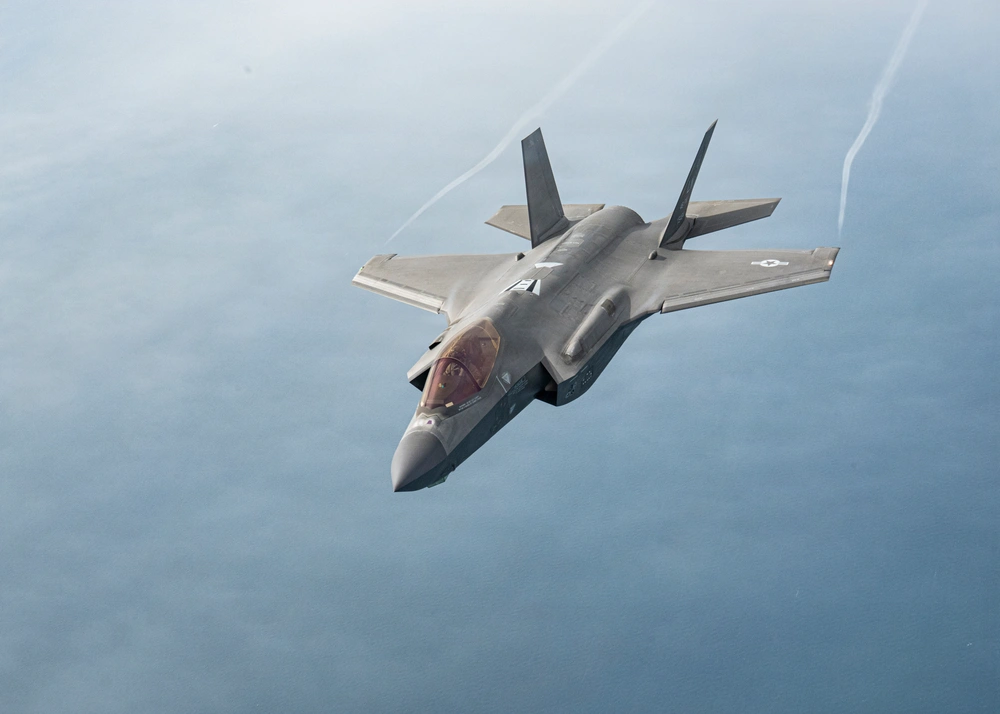
BAE Systems has received a contract from Lockheed Martin to manufacture and deliver AN/ASQ-239 electronic warfare (EW) systems for F-35 Lightning II production Lots 20 through 22, the company announced on October 6, 2026. The award also covers systems to retrofit and modernize F-35s already in service. Neither company disclosed the contract value, the number of shipsets, or the delivery schedule.
The award extends a role BAE Systems has held since the origin of the Joint Strike Fighter program, when it designed the EW suite for the Block 1, 2 and 3 configurations. It arrives as the F-35 enterprise pushes output to record levels: Lockheed Martin delivered 191 aircraft in 2025, and the F-35 Joint Program Office (JPO) finalized the Lot 18-19 agreement for up to 296 aircraft on September 29, 2025. The most recent public Pentagon actions for the follow-on lots, including a $1.14 billion modification in December 2025, fund long-lead materials for 65 Lot 20 and 133 Lot 21 aircraft.
F-35 Electronic Warfare Contract Covers Lots 20-22 and Fleet Retrofits
The agreement pairs new-production systems for three consecutive lots with kits to bring older jets up to a more current hardware standard. BAE did not specify which configuration the retrofit systems will carry. Its production line transitioned to Block 4 EW hardware with Lot 17, under a $491 million contract announced in April 2023, with production running from mid-2024 into 2025. The October 6 announcement does not state whether Lots 20 through 22 build to that Block 4 baseline.
BAE says it has now delivered more than 1,500 F-35 EW systems. The figure tracks the ramp of the past five years: the company reported 800 deliveries in June 2021 and 1,200 by April 2023. In 2021, it was producing 18 shipsets a month, with a target of more than 20 per month in 2022 to match aircraft output.
Production is split between Austin, Texas, and three New Hampshire sites in Manchester, Merrimack and Nashua. The Manchester facility, a 200,000-square-foot engineering and production center, opened in May 2022. BAE says it is applying automation, updated system designs and supply chain measures to accelerate output. Amber Dolan, Vice President of F-35 Solutions at BAE Systems, said the company’s priorities are scaling production and delivering software-based capabilities fast enough to keep pace with modern conflict.
Inside the AN/ASQ-239: Passive Sensing, Countermeasures and Reprogramming
The AN/ASQ-239 merges radar warning, emitter geolocation, targeting support, and radio frequency and infrared countermeasures into one integrated system. Unlike fourth-generation fighters that rely on external jamming pods, the F-35 carries its EW apertures inside the airframe; publicly available descriptions place the antennas in the edges of the wings and horizontal tails, preserving the aircraft’s low-observable signature while providing 360-degree coverage.
The suite’s core value is passive, long-range sensing. It detects and classifies emitters without radiating, which lets pilots locate fighters, surface-to-air missile batteries and other threats and act on them first. BAE cites wide instantaneous bandwidth, high-speed signal processing and threat-detection algorithms that operators can update through software. Open sources generally attribute the F-35’s offensive electronic attack to the AN/APG-81 active electronically scanned array radar working in concert with the EW suite, a division of labor that keeps the jamming function inside the stealth envelope.
The system descends from the integrated EW suite BAE developed for the F-22 Raptor, publicly identified as the AN/ALR-94. A hardware refresh, the Digital Channelized Receiver Techniques Generator and Tuner Insertion Program (DTIP), reduced volume and power demand while freeing space for growth. BAE also provides reachback support to the F-35 U.S. Reprogramming Laboratory, which maintains the mission data that determines how quickly the fleet can respond to new adversary emitters. The company reported in 2021 that it had cut the EW system’s unit cost by 77 percent since initial production.
Block 4 EW Hardware and the TR-3 Software Bottleneck
The EW upgrade is widely regarded as the centerpiece of F-35 Block 4 modernization. BAE received a $493 million contract in December 2021 to develop Block 4 core EW hardware, test infrastructure and engineering support, part of a multi-year effort the company said would add 11 new capabilities to the system. Exploiting that hardware depends on Technology Refresh 3 (TR-3), which replaces the integrated core processor, aircraft memory system and cockpit displays.
TR-3 remains the program’s central constraint. The Director, Operational Test and Evaluation (DOT&E) stated in its fiscal 2025 annual report that no combat-capable TR-3 aircraft had been delivered to the United States through September 2025, by which point roughly 158 TR-3 jets had been accepted with software limited to training and combat training. Any change in that status since then has not been publicly confirmed. In practice, Block 4 EW hardware is entering airframes faster than the software required to unlock its full capability.
Analysis: The award separates two timelines the F-35 program has struggled to align. On the industrial side, BAE is reserving capacity for three production lots and a retrofit pool, securing continuity for the sole supplier of the subsystem most directly tied to the jet’s survivability against modern integrated air defense systems. On the capability side, the return on that hardware depends on TR-3 combat certification and Block 4 software releases that DOT&E has repeatedly found behind schedule. The retrofit element may carry as much weight as new production: with more than 1,500 systems fielded across several hardware baselines, converging older aircraft on a common EW standard simplifies configuration management and allows threat-library updates to reach a larger share of the U.S., partner and foreign military sales fleet at once.
The contract value, shipset quantities and delivery dates remain undisclosed. The next markers are a definitized Lot 20 aircraft contract, which has been reported as a candidate for the program’s first multiyear procurement, TR-3 combat certification, and dedicated TR-3 operational testing that officials had projected for mid to late fiscal 2026. Each will determine how quickly the Lots 20-22 EW hardware translates into fielded Block 4 capability.