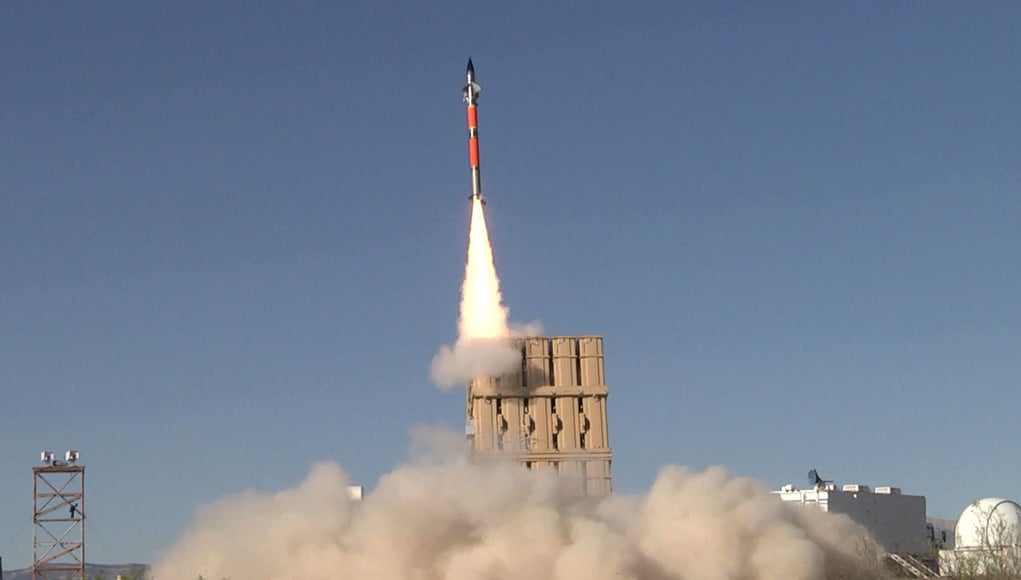
Raytheon-Rafael Area Protection Systems (R2S) has delivered the first Iron Dome Tamir interceptor built and assembled entirely in the United States to the Israel Missile Defense Organization (IMDO), Israel’s Ministry of Defense announced on October 8, 2026. The handover took place at the joint venture’s plant in East Camden, Arkansas, now the first site outside Israel to manufacture complete Tamir rounds.
The delivery turns more than a decade of U.S.-Israeli component co-production into an all-up-round capability on American soil. Washington and Jerusalem signed an Iron Dome co-production agreement in March 2014 that tied U.S. procurement funding to American industrial participation, and Raytheon, an RTX business, has supplied Tamir parts to prime contractor Rafael Advanced Defense Systems since. The milestone lands as both governments push to rebuild interceptor stocks, a requirement Congress funded with $4 billion for Iron Dome and David’s Sling replenishment in the April 2024 emergency supplemental.
How R2S Built a U.S. Tamir Interceptor Line in Arkansas
R2S announced the Camden project in 2023 as a $33 million investment, broke ground in February 2024 and opened the facility in November 2025. Arkansas officials value the completed site at $63 million and expect it to support up to 60 jobs. The plant sits in Camden’s Highland Industrial Park, alongside a munitions cluster that already includes Lockheed Martin’s PAC-3 MSE and Guided Multiple Launch Rocket System production.
On November 21, 2025, weeks after opening, R2S received a $1.25 billion direct commercial sales contract to supply Israel with Tamir missiles, missile kits and test equipment, the joint venture’s first production award. The ministry did not disclose how many Tamirs Camden will build, the planned production rate or the schedule for follow-on deliveries.
Attendees included Arkansas Governor Sarah Huckabee Sanders, U.S. Missile Defense Agency (MDA) Deputy Director Maj. Gen. Jason D. Cothern, IMDO Director Moshe Patel, Rafael Executive Vice President Shlomo Toaff and R2S CEO Jonathan Casey. Patel described the line as part of IMDO’s drive to accelerate output across all of Israel’s missile defense systems, adding that U.S. funding for cooperative programs, including emergency supplemental appropriations, is reinvested in the American industrial base. Toaff said the plant gives Tamir customers another reliable source while supporting the Marine Corps’ SkyHunter.
Inside the Tamir: Seeker, Warhead, and 70-Kilometer Engagement Envelope
Rafael developed Tamir under IMDO leadership, and the missile has armed Iron Dome since the system entered service in 2011. Publicly available specifications describe a round about 3 meters long and 160 millimeters in diameter, with a launch mass of roughly 90 kilograms and a solid rocket motor. The interceptor flies on mid-course datalink updates from the battery’s battle management and weapon control center, then hands off to an active radar seeker for terminal homing. A proximity-fuzed high-explosive fragmentation warhead, reported at about 11 kilograms, detonates near the target rather than relying on a direct hit.
That design choice shapes Iron Dome’s threat coverage. A fragmentation kill tolerates small miss distances against rockets, mortar bombs and drones with limited radar cross-section, keeping Tamir more compact than hit-to-kill interceptors such as the Stunner fired by David’s Sling. Early open-source descriptions put the engagement range at 4 to 17 kilometers; figures cited for the current system reach 70 kilometers, reflecting successive upgrades against cruise missiles, unmanned aircraft and longer-range rockets.
A standard battery pairs an Elta EL/M-2084 multi-mission radar with the control center and three to four launchers holding 20 interceptors each. The ministry credits Iron Dome with more than 10,000 operational interceptions over 15 years. At that tempo, the binding constraint on Tamir is magazine depth rather than performance, the problem a second production line addresses.
SkyHunter and MRIC: What the Camden Line Means for Marines
Camden is also the first U.S. facility to build complete SkyHunter missiles, the American variant of Tamir that arms the Marine Corps’ Medium Range Intercept Capability (MRIC). The service’s Ground Based Air Defense program manager, Col. Andrew Konicki, has described SkyHunter as sharing 95 to 99 percent commonality with Tamir, allowing one line to serve both customers with minimal retooling.
MRIC adapts Iron Dome to Marine Corps architecture: a trailer-mounted launcher carrying up to 20 SkyHunters, cued by the AN/TPS-80 Ground/Air Task-Oriented Radar (G/ATOR) and tied into the Common Aviation Command and Control System (CAC2S). It targets cruise missiles, aircraft, rockets, artillery and mortars, filling a medium-range gap the Corps has carried since retiring the MIM-23 Hawk in the late 1990s.
Raytheon received a $380 million full-rate production order in late 2025, bringing MRIC contract value to $412.5 million. The Corps plans to field the system to all three Low Altitude Air Defense battalions between 2026 and 2028, and III Marine Expeditionary Force evaluated MRIC on Guam during Valiant Shield 2026 in June. A domestic all-up-round source ends the Corps’ reliance on interceptors drawn from Israeli lines that also feed wartime demand.
Analysis: The value of the Camden handover lies less in the single round delivered than in the production geometry it creates. Until now, every complete Tamir came off lines inside Israel, within reach of the rocket and missile arsenals Iron Dome exists to defeat, and Israeli capacity alone set the ceiling on replenishment during high-consumption campaigns. A second source in Arkansas adds dispersal and depth to Israel’s most heavily used interceptor. The arrangement also reverses the usual direction of dependency: the $1.25 billion Israeli order is roughly three times MRIC’s contract value to date, so Israeli demand effectively underwrites a warm SkyHunter line that Marine Corps volumes alone would struggle to sustain.
Key unknowns remain Camden’s sustained production rate, the share of subcomponents sourced domestically and the delivery schedule under the $1.25 billion contract. The next markers are the first Camden-built SkyHunter deliveries to MRIC units, completion of Marine Corps fielding by 2028, and talks on a successor to the current U.S.-Israel memorandum of understanding, which allocates $500 million a year to cooperative missile defense through fiscal 2028.